Investigation Development Series

Lesson 10: Environmental Red Flags Most Investigators Miss

Not all environmental factors are obvious. Some of the most influential conditions affecting human perception are subtle, gradual, and easy to overlook.

Series Index Equipment & Technology
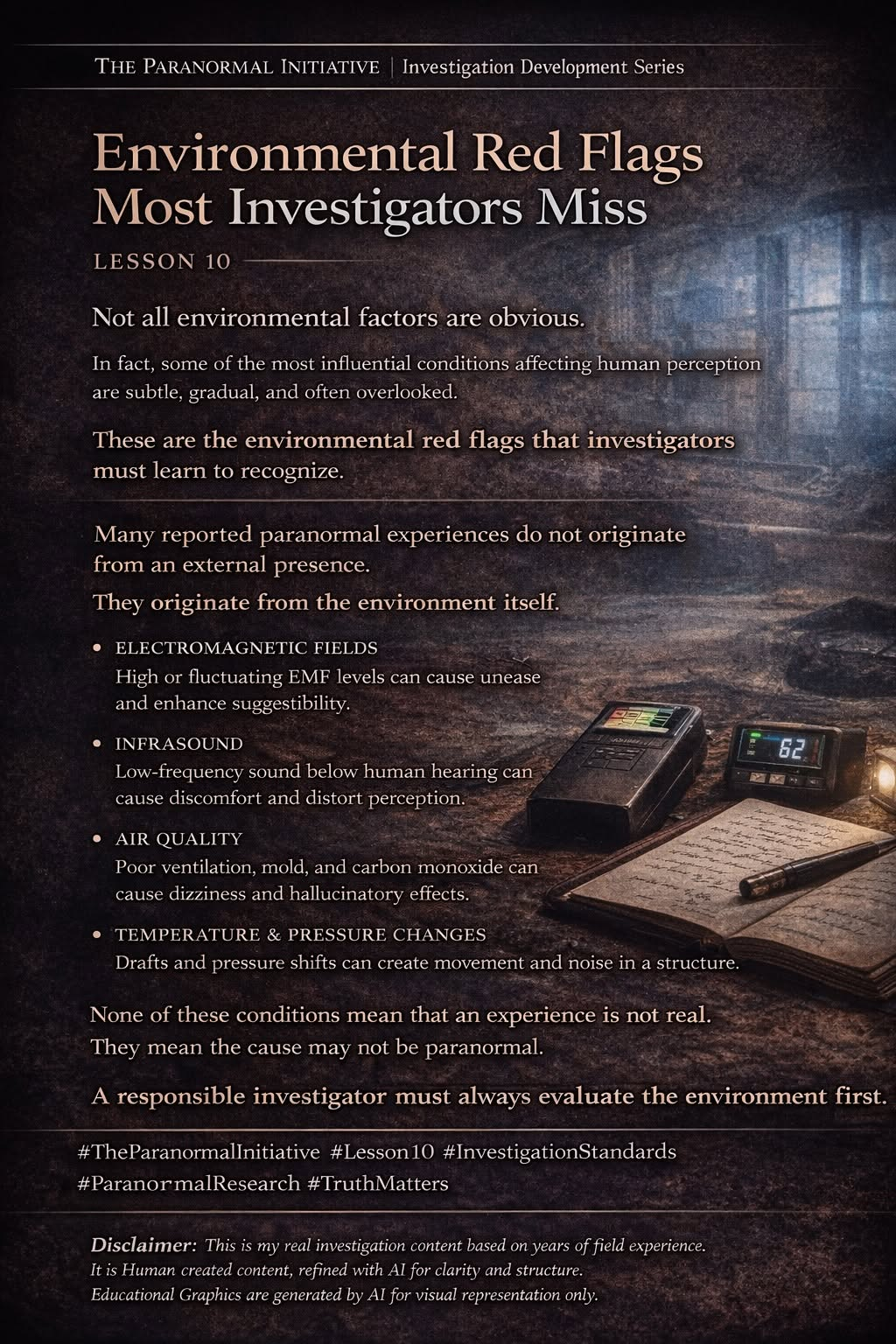
Environmental red flags most investigators miss lesson graphic

The Environment Can Shape The Experience

These are the environmental red flags investigators must learn to recognize.

Many reported paranormal experiences do not originate from an external presence. They originate from the environment itself.

A professional investigator must understand that the human body is highly responsive to environmental conditions, and those conditions can influence perception, emotion, and interpretation.

Electromagnetic Field Exposure

One commonly overlooked factor is electromagnetic field exposure.

High or fluctuating EMF levels may affect how people feel in a space. Prolonged exposure is often discussed in connection with unease, anxiety, disorientation, and heightened suggestibility.

In some cases, people report sensations of being watched or followed without any visible source. That does not automatically make the experience paranormal. It may be physiological.

Infrasound

Infrasound is another critical factor. These are low-frequency sound waves below the normal range of human hearing.

Infrasound can be produced by machinery, wind interacting with structures, vibration, or other environmental sources.

It has been discussed in relation to pressure sensations, discomfort, visual disturbance, and the feeling that something is present in the room. Investigators may interpret these sensations as external when they may be generated by the body's response to the environment.

Air Quality

Air quality is equally important and frequently ignored.

Poor ventilation, mold exposure, elevated carbon monoxide levels, and airborne contaminants can lead to dizziness, confusion, headaches, fatigue, and in some cases hallucination-like experiences.

These conditions can create very real experiences for the individual, even when the source is environmental.

Temperature And Pressure Changes

Temperature and pressure changes can play a significant role during an investigation.

Drafts can create the sensation of movement or touch. Sudden pressure shifts can cause doors to move, floors to creak, and objects to subtly shift within a structure.

These effects can easily be misinterpreted when the environment has not been properly evaluated.

Lighting And Visual Noise

Lighting conditions must also be considered.

Low light, shifting shadows, reflections, and visual noise can distort perception. The human brain is designed to recognize patterns, even when none exist.

In poorly lit environments, this can result in the interpretation of shapes, movement, or figures that are not actually present.

Real Experience, Environmental Cause

None of these conditions mean that an experience is not real. They mean the cause may not be paranormal.

That distinction matters.

A responsible investigator must always evaluate the environment first before considering any unexplained conclusion.

Why It Matters

If the environment can account for the experience, then the investigation must reflect that.

Ignoring environmental factors does not strengthen a case. It weakens it, introduces bias, and compromises credibility.

Understanding the environment is not optional. It is essential.

Equipment & Technology Back to Series Walkthrough Variables