Research Question

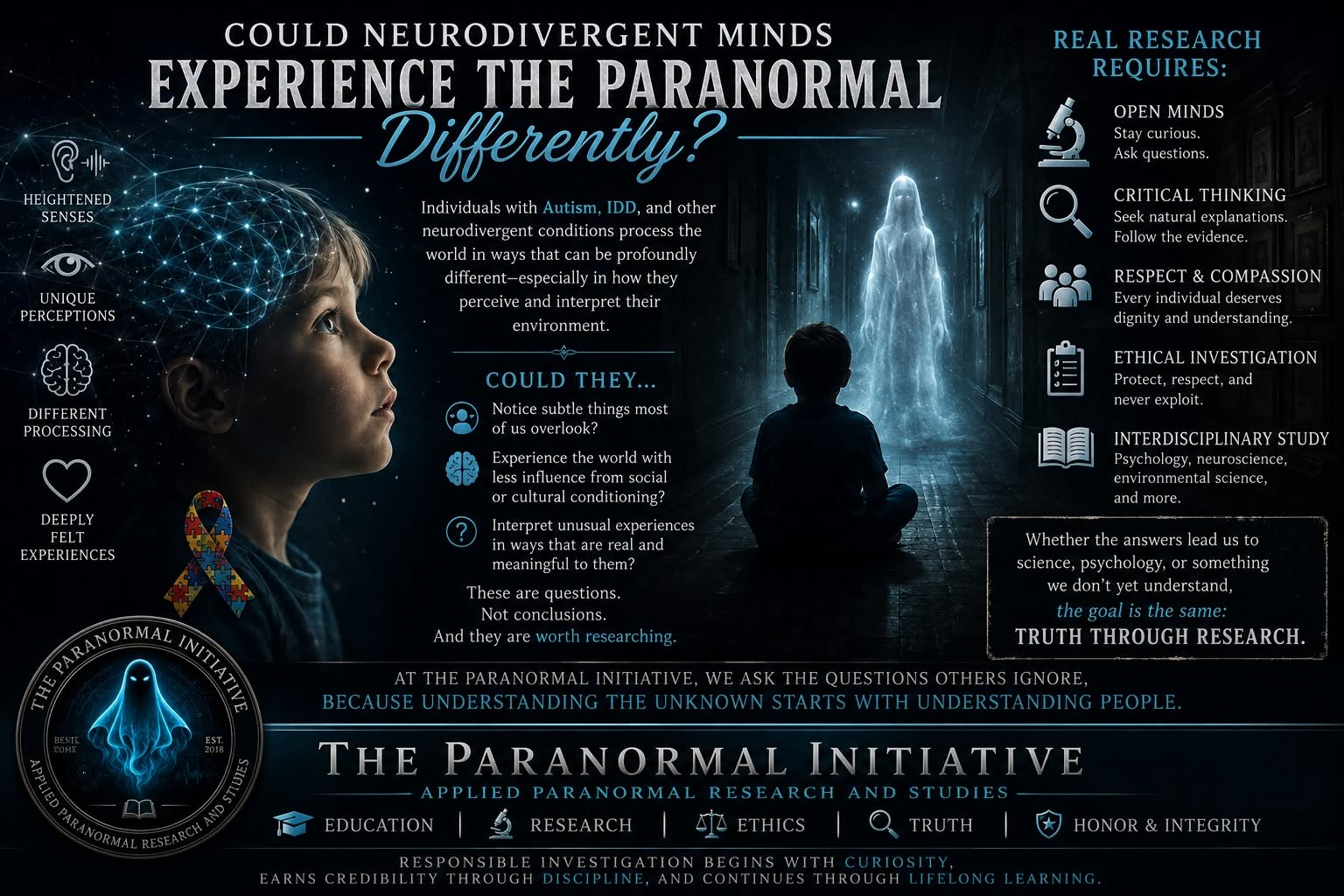
Could Neurodivergent Minds Experience The Paranormal Differently?

A respectful discussion about sensory processing, perception, children, neurodivergence, anomalous experiences, and the need for ethical, interdisciplinary research.

Series Index Education Center
Could neurodivergent minds experience the paranormal differently research discussion graphic

Beginning With A Question

Some of the most important discoveries do not begin with answers. They begin with someone asking a question that others may be afraid to ask.

Could individuals with Autism Spectrum Disorder, Intellectual and Developmental Disabilities, or other forms of neurodivergence experience unusual or unexplained phenomena differently?

What This Does Not Mean

This question should be approached with care.

It does not mean that autism, IDD, or any developmental disability gives someone paranormal abilities, allows them to communicate with spirits, or makes them psychic.

There is currently no established scientific evidence supporting those claims. The point is not to sensationalize neurodivergence. The point is to ask whether perception, sensory processing, memory, and interpretation deserve more careful interdisciplinary study.

Sensory Processing And Perception

Research has long recognized that many autistic individuals process sensory information differently than neurotypical individuals. Differences in sound, light, touch, smell, movement, interoception, and other sensory experiences can shape how someone perceives an environment.

That is important because paranormal investigation often begins with perception: what someone saw, heard, felt, sensed, remembered, or interpreted as unusual.

What remains unestablished is whether those sensory differences influence how unusual experiences are perceived, described, remembered, or interpreted in ways that deserve dedicated study.

Interpretation Matters

If two people experience the same unexplained event, could they interpret it differently because their brains process information differently?

Would one person immediately search for a conventional explanation while another simply describes what they experienced without filtering it through the same social expectations?

Could someone notice subtle environmental details that others unconsciously ignore? Or would neuroscience eventually explain these differences without invoking anything paranormal?

These are questions, not conclusions.

Children, Openness, And Development

This question may also extend beyond neurodivergence.

Children often approach the world with curiosity rather than certainty. They may describe what they see and experience without the same filters that adults develop through culture, religion, skepticism, fear, expectation, or social pressure.

Does that mean children are interacting with something genuinely unexplained? Perhaps. Perhaps not. It could be imagination, development, perception, environment, memory, or something we do not yet fully understand.

Compassion And Critical Thinking

Whether we are discussing children, neurodivergent individuals, or anyone who experiences the world differently, the goal should never be to label those experiences as paranormal simply because we do not yet understand them.

The goal should be to investigate with compassion, critical thinking, and an open mind.

Sometimes the answer may be psychological. Sometimes environmental. Sometimes neurological. And perhaps, on rare occasions, an experience may challenge our current understanding.

What Ethical Research Could Look Like

Imagine long-term studies comparing how neurotypical and neurodivergent participants perceive the same environments. Imagine combining psychology, neuroscience, environmental monitoring, and careful documentation to better understand why people report unusual experiences.

Whether the findings support conventional explanations or reveal something unexpected, we would learn something valuable about human perception.

That is what real research looks like: asking better questions, protecting people, avoiding sensationalism, and remaining disciplined enough to follow the evidence wherever it leads.

Research Context

For general background on autism and sensory differences, see the CDC overview of autism spectrum disorder and peer-reviewed research on sensory processing in autism.

CDC: About Autism Spectrum Disorder

PubMed: Autism sensory processing review search

Truth Through Research

At The Paranormal Initiative - Applied Paranormal Research and Studies, advancing the field requires more than stories and opinions. It requires thoughtful questions, ethical research, critical thinking, compassion, and a willingness to challenge our own assumptions.

This is not about proving ghosts. It is about better understanding people, perception, and the mysteries that continue to inspire us to explore.

Responsible investigation begins with curiosity, earns credibility through discipline, and continues through lifelong learning.

Thought For The Day Back to Series Standards & Ethics