EVP / ITC Research

What Was The Original Goal Of ITC Research?

A grounded look at Instrumental Transcommunication, early EVP/ITC ambitions, the challenge of word-bank systems, and why controlled source material matters.

EVP / ITC Research Series Index
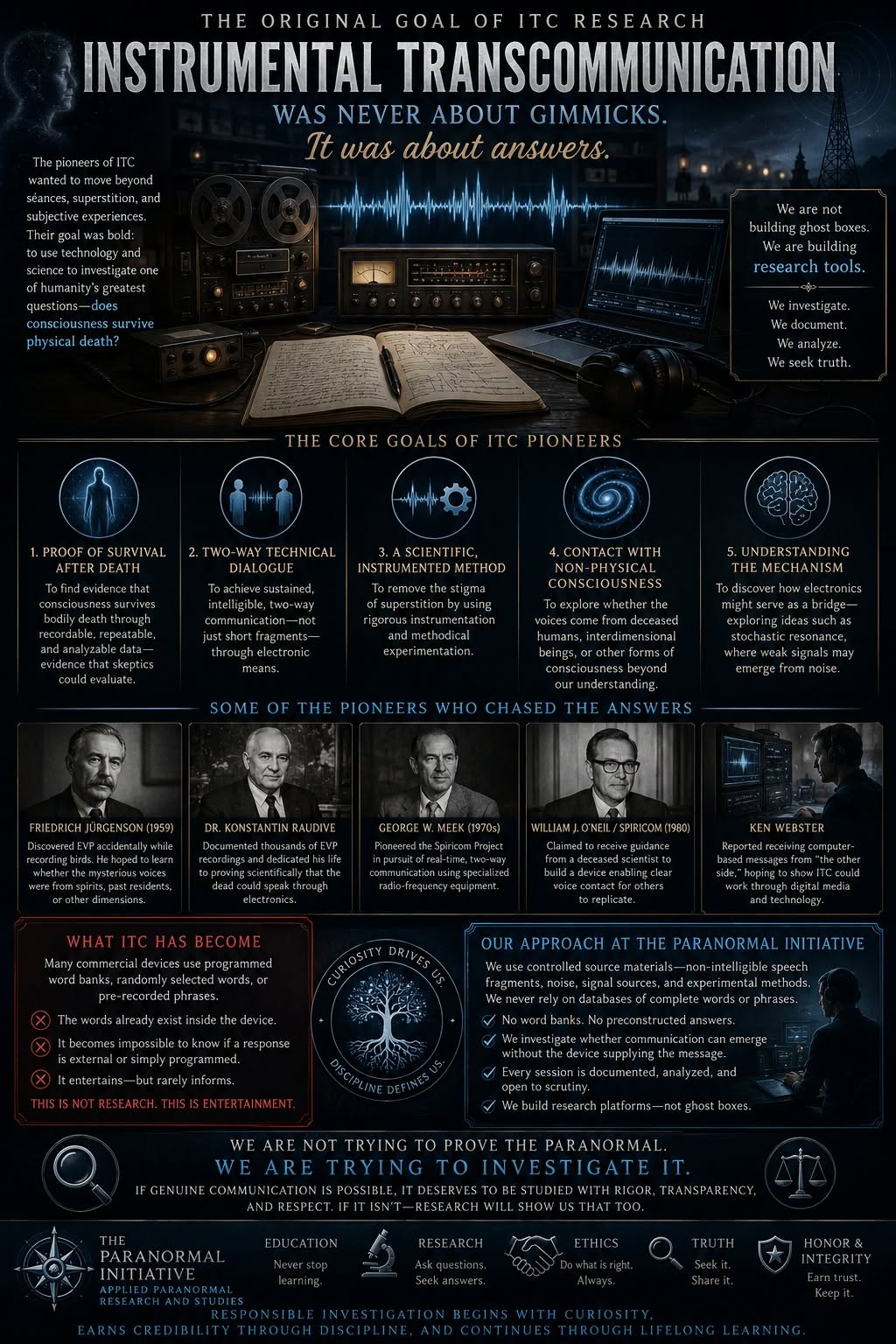
Original goal of ITC research and instrumental transcommunication graphic

A Misunderstood Goal

One of the biggest misconceptions in today's paranormal community is what Instrumental Transcommunication was originally trying to accomplish.

Many modern products marketed as ITC devices rely on programmed word banks, randomly selected complete words, or preconstructed phrases. Those systems can create interesting experiences, but they are a major departure from the research question that drove many early EVP and ITC experimenters.

Not A Novelty Device

The early goal was not to build a novelty device.

The deeper question was whether consciousness might survive physical death, and whether technology could help record, document, analyze, and potentially replicate evidence related to that possibility.

Researchers wanted to move beyond seances, subjective impressions, and personal belief into something that could be examined more carefully.

The Dream Of Two-Way Communication

Early EVP work often focused on brief words, fragments, or voice-like anomalies captured during recording and reviewed later.

George W. Meek's Spiricom work attempted to go further by exploring whether sustained, real-time dialogue through electronic equipment might be possible.

Whether those claims withstand scientific scrutiny remains debated, but the goal itself was ambitious: not occasional snippets, but repeatable instrument-based communication.

Technology As A Research Tool

As electronics evolved, researchers experimented with tape recorders, radios, televisions, computers, electronic circuits, video feedback systems, and radio-frequency equipment.

The objective was not simply to hear unexplained voices. It was to ask whether technology could detect, facilitate, or record communication with forms of consciousness that might otherwise remain outside ordinary perception.

Physicist Ernst Senkowski is widely associated with the term Instrumental Transcommunication, a phrase that emphasized technological contact experiments rather than purely spiritualistic or occult framing.

Who Or What Was Being Contacted?

Not every pioneer interpreted the source of reported communications in the same way.

Some believed they were communicating with individuals who had survived physical death. Others wondered about non-physical intelligences, interdimensional possibilities, consciousness-based phenomena, or informational fields we do not yet understand.

Those ideas remain speculative, but they show how broad the original research questions were.

The Mechanism Question

Perhaps the most fascinating question was not only who might be communicating, but how.

Could weak signals become detectable when combined with noise? Could unknown physical processes be involved? Could electronics act as a bridge? Or were investigators finding meaningful patterns within randomness?

More than sixty years later, those questions remain unresolved.

What Modern ITC Often Becomes

Much of today's commercial ITC equipment has moved away from those research goals.

When a device relies on programmed vocabularies, randomized word selection, or pre-recorded phrases, the words already exist inside the device before the session begins.

If the device already contains the answer, how can we confidently investigate where that answer came from?

That question sits at the heart of serious ITC research.

Our Philosophy

At The Paranormal Initiative - Applied Paranormal Research and Studies, the goal is not to build another ghost box. The goal is to build a research platform.

The EVP/ITC Research Labs we are developing are designed for experimentation, documentation, and repeatable investigation, not predetermined answers.

Rather than relying on complete word databases or programmed phrases presented as spirit communication, our research explores controlled source materials such as non-intelligible speech fragments, noise sources, phonetic elements, and experimental signal environments.

That Is The Experiment

We are not asking a device to randomly choose words that already exist inside its software.

We are asking whether an unknown influence, if one exists, can organize or manipulate controlled source material into meaningful communication under carefully documented conditions.

Whether the outcome supports a conventional explanation, reveals an unknown physical process, or provides no evidence of anomalous communication at all, every result contributes to understanding.

Continuing The Mission

The pioneers of EVP and ITC asked difficult questions, designed ambitious experiments, built new technologies, documented their observations, and pursued answers with curiosity and determination.

That spirit of exploration deserves to continue through transparent experimentation, ethical methodology, careful documentation, critical thinking, and a willingness to follow evidence wherever it leads.

We are not trying to prove the paranormal. We are trying to investigate it.

Real research is not about proving what we hope is true. It is about discovering what is true.

Research Context

For readers who want to explore the historical context further, start with these general reference points on EVP and ITC history.

World ITC

Association TransCommunication: ITC White Paper

Association TransCommunication: Spiricom

EVP / ITC Experimentation Back to Series EVP / ITC Research