Investigator Development Series

Lesson 10: Understanding The Different Types Of Hauntings

Not all reported activity should be treated as if it comes from the same source. Understanding the claim category helps investigators avoid assumption and choose the right method.

Series Index Investigation Methodology
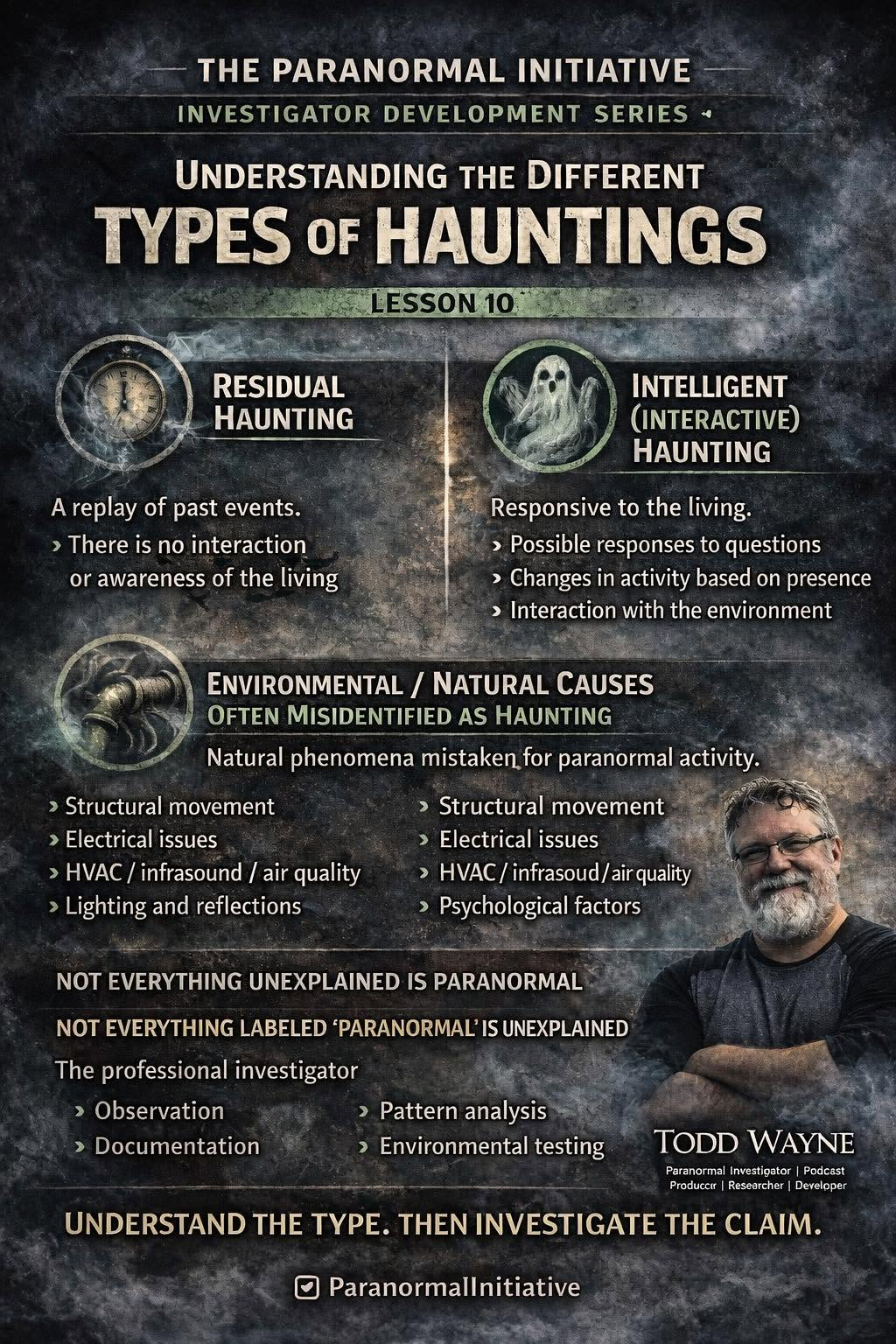
Understanding the different types of hauntings lesson graphic

Not All Reported Activity Is The Same

One of the most common mistakes in paranormal investigation is treating all reported activity as if it comes from the same source.

Not all hauntings are the same, and if investigators do not understand the difference, they cannot investigate the claim properly.

There are several commonly recognized categories of paranormal activity. These categories do not prove what is happening, but they help investigators approach a case with clarity instead of assumption.

Residual Haunting

A residual haunting is often described as a replay of past events.

These experiences are usually reported as patterned events that occur at similar times or under similar conditions. They may include footsteps, voices, or visual apparitions that appear to repeat.

The key idea is that there is no apparent interaction, no direct response, and no clear awareness of the living. In this category, the activity is not considered intelligent or interactive.

Intelligent Or Interactive Haunting

An intelligent or interactive haunting is what many people think of when they hear the word haunting.

These cases may involve possible responses to questions, changes in activity based on presence, or apparent interaction with the environment.

This is also where misinterpretation happens most often. Perceived interaction does not always mean actual intelligence. Investigators must be careful not to confuse timing, expectation, equipment behavior, or environmental coincidence with communication.

Environmental And Natural Causes

This category is often overlooked, yet it is one of the most important areas of responsible investigation.

Many reported hauntings are later explained by structural movement, electrical issues, HVAC systems, infrasound, air quality, lighting and reflections, or psychological factors.

These explanations are not rare. They are common, and they must always be ruled out before an investigator begins treating a claim as unexplained.

Poltergeist-Type Activity

Poltergeist-type activity is often described as physical disturbance, such as objects moving, knocking or banging sounds, or items being displaced.

These cases are complex and require careful, controlled investigation.

Reported physical disturbances may involve environmental factors, human influence, psychological stress, structural conditions, or other causes that need to be documented and tested before any conclusion is considered.

The Most Important Truth

Not everything unexplained is paranormal, and not everything labeled paranormal is actually unexplained.

A professional investigator does not assume the category. They determine it through observation, documentation, pattern analysis, and environmental testing.

If the type of activity is misidentified, the entire investigation can be misdirected.

Understand The Type, Then Investigate The Claim

The purpose of these categories is not to force a case into a label. The purpose is to help investigators ask better questions.

Is the event repeating without interaction? Is there apparent response? Are natural causes being overlooked? Is the reported activity physical, environmental, psychological, or still unresolved?

Understand the type. Then investigate the claim.

Investigation Methodology Back to Series Education Center