Investigation Development Series

Where Paranormal Investigation Leaves Science Behind

Not every meaningful paranormal question fits neatly inside laboratory science. The challenge is knowing when a claim can be tested directly, when it must be evaluated through careful documentation, and when it remains an open possibility.

Series Index True Science
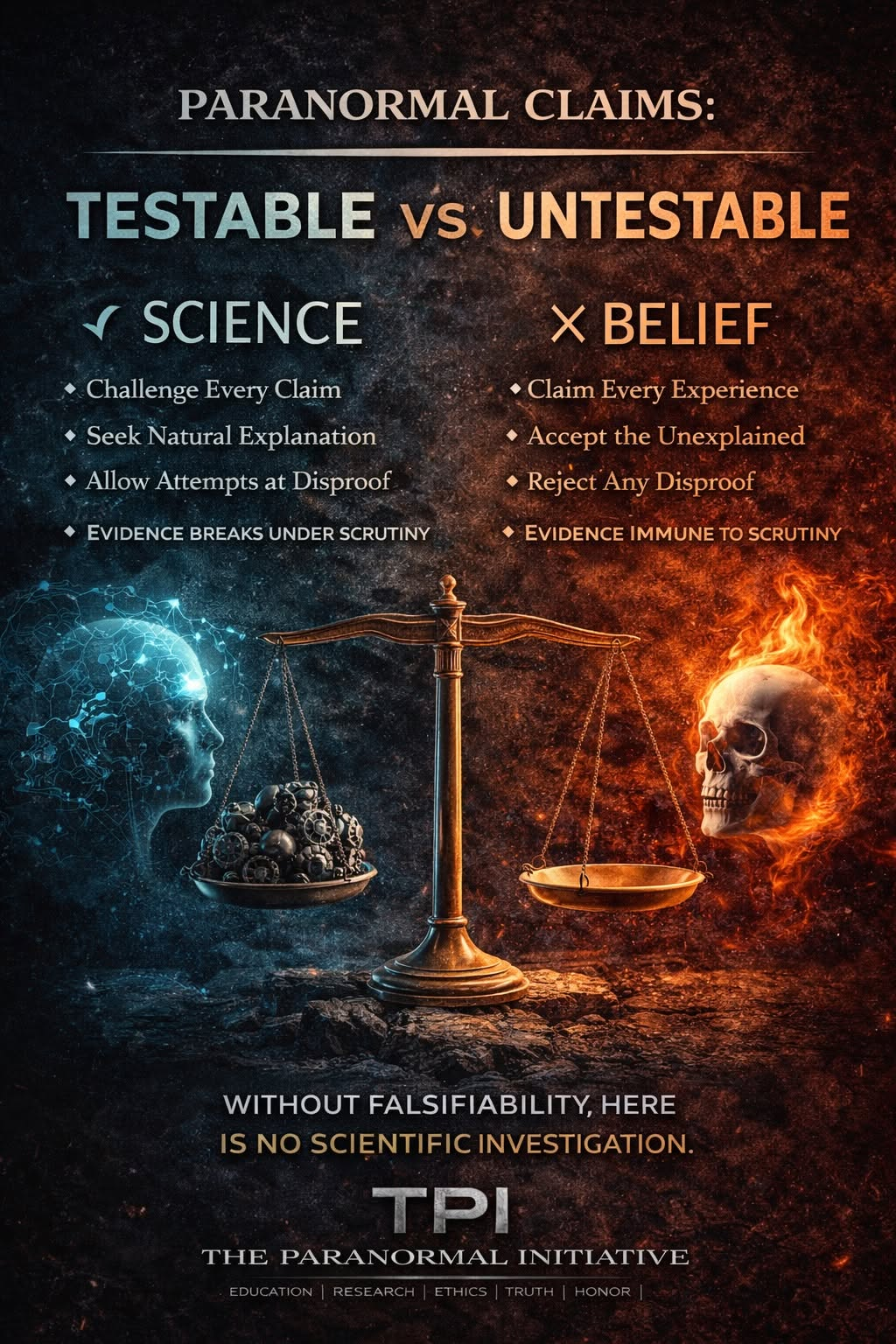
Paranormal claims testable versus untestable science and belief graphic

The Line Investigators Must Understand

One of the most important distinctions investigators need to understand is this: using equipment does not automatically make a conclusion scientific.

In paranormal investigation, this line is crossed more often than people realize.

Science values testing, challenge, repeatability, and measurable data. Paranormal research may also include documented experience, witness testimony, history, pattern analysis, and disciplined interpretation. The investigator's job is to be clear about which kind of support is being presented.

Testable Vs Untestable Claims

If a claim cannot be challenged, tested under conditions that could disprove it, or evaluated in a measurable way, then it should not be presented as scientifically established.

That does not mean the experience is false, meaningless, or unworthy of study.

It means the conclusion requires careful language and should be supported by the strongest documentation available.

What Structured Investigation Does

A structured investigation does not seek to confirm what is believed. It seeks to eliminate what is known.

Every variable must be questioned. Every result must be challenged. Every outcome must be tested against natural explanation.

Evidence is not strong because it feels convincing. It is strong because it survives scrutiny, holds up when tested, and remains consistent even when investigators try to break it.

Explaining Does Not Weaken The Field

There is a common belief that misleading or false evidence harms legitimate cases, but the opposite approach is what strengthens the field.

If something can be explained, it should be. If something can be recreated, it must be considered. If something can be misinterpreted, that possibility has to be accounted for.

This is not skepticism against the paranormal. It is discipline within the investigation.

Testing For Error

A responsible investigator does not assume authenticity too quickly.

They test for error, influence, environmental factors, and psychological factors that could produce the same result.

If those explanations fail and the event remains supported by documentation, it may responsibly move into possible or plausible territory rather than being dismissed out of habit.

Explore The Unknown, But Question It

You can still explore the unknown. You can still investigate. You can still document experiences, run experiments, and pursue answers.

But none of that removes the responsibility to question what you encounter, even when it feels real and even when it seems undeniable.

Certainty is not a strength in this field. It is a warning sign.

Put Conclusions Under Pressure

The moment a conclusion becomes immune to challenge, it is no longer part of an investigation. It has become belief.

A true investigator does not protect conclusions.

They put them under pressure.

True Science Back to Series Standards & Ethics