Investigation Development Series

The Burden Of Proof Lies On The Person Making The Claim

A field-standard lesson on claims, evidence, responsibility, uncertainty, and why investigators must let evidence earn the conclusion.

Series Index Testable Claims
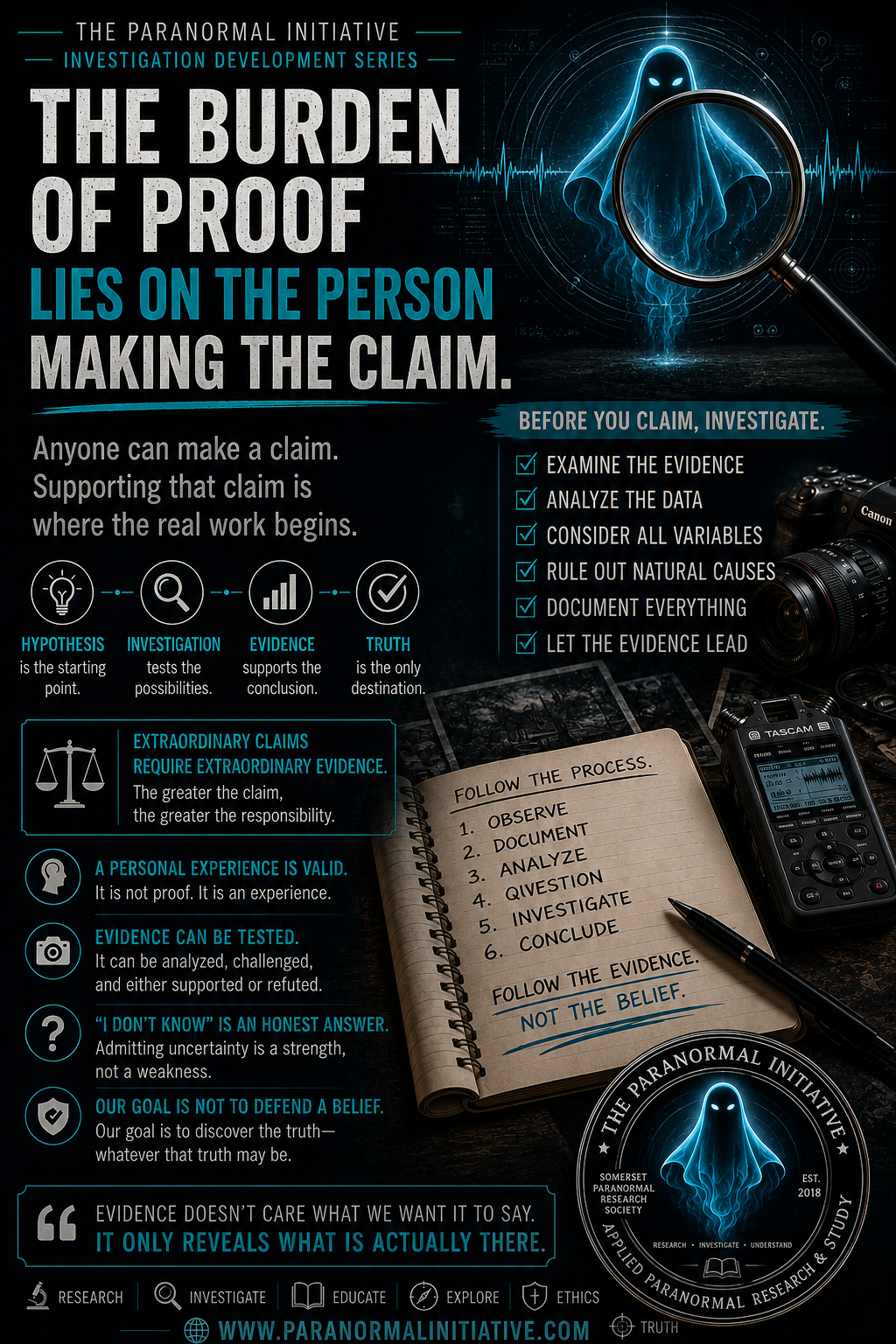
The burden of proof lies on the person making the claim investigation development graphic

Who Carries The Burden?

One of the most important principles in any investigation, whether paranormal, criminal, scientific, or historical, is understanding who carries the burden of proof.

Simply put, the burden of proof lies on the person making the claim.

That principle exists for a reason. Anyone can make a claim. Someone can say they saw a ghost. Someone can claim a photograph contains a spirit. Someone can insist a light anomaly is a fairy, an alien, an angel, or something entirely unknown.

Making the claim is easy. Supporting the claim is where the real work begins.

Evidence Requires Responsibility

If you present something as evidence, then you also accept the responsibility of showing why you believe it supports your conclusion.

That means examining the photograph. Analyzing the video. Reviewing the audio. Looking for environmental factors.

It means considering camera artifacts, lighting, weather, insects, dust, reflections, equipment limitations, and every other reasonable explanation before arriving at a conclusion.

Because without that process, a claim remains exactly that: a claim.

A Claim Is Not Dishonesty

This does not mean someone is lying. It does not mean they are dishonest. It does not even mean they are wrong.

It simply means they have not yet demonstrated that their conclusion is the best explanation for the evidence.

There is an important difference between saying, "I think this may be paranormal," and saying, "This proves the paranormal."

The first is a hypothesis. The second is a conclusion.

Hypothesis Before Conclusion

A hypothesis invites investigation. A conclusion should be supported by evidence.

Unfortunately, too often in the paranormal field those two become reversed. People begin with the conclusion and then search for evidence to support it.

Responsible investigators do the opposite.

We begin with the evidence. Then we allow the evidence to determine where the investigation leads.

The Honest Answer

Sometimes evidence points toward a perfectly natural explanation. Sometimes it reveals that additional investigation is needed. And sometimes it leaves us with something we simply cannot explain.

There is nothing wrong with saying, "I do not know."

In fact, it is often the most honest answer an investigator can give. Admitting uncertainty is not a weakness. It is a strength.

Because the goal of an investigation is not to defend a belief. The goal is to discover the truth, whatever that truth may be.

Strong Claims Require Strong Evidence

That is why extraordinary claims require strong evidence.

Not because skeptics demand it. Not because believers reject it. But because the greater the claim, the greater our responsibility to demonstrate that it is true.

The burden of proof does not belong to the people asking questions. It belongs to the person making the claim.

And that is exactly how it should be.

Follow The Evidence

Evidence should never be expected to support a conclusion until the conclusion has first earned the evidence.

Follow the evidence. Not the belief.

- The Paranormal Initiative

Testable Claims Back to Series Truth Vs Validation