Investigator Development Series

Lesson 6: Emotional Testimony Vs. Objective Observation

Witness testimony deserves respect, but emotional intensity does not automatically increase reliability. Investigation requires both compassion and disciplined observation.

Series Index Standards & Ethics
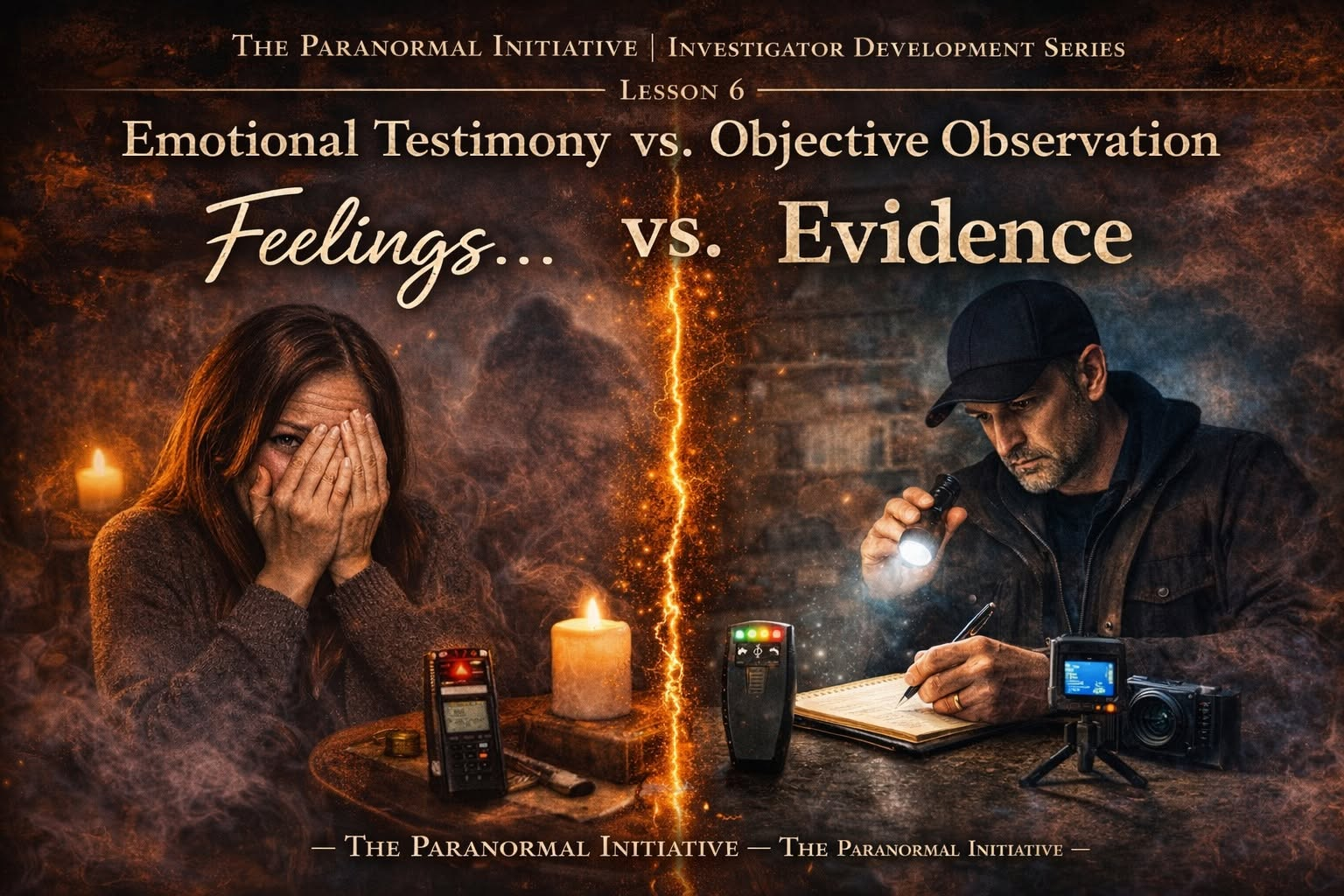
Emotional testimony versus objective observation graphic

Working With Witness Testimony

One of the most sensitive and important aspects of paranormal investigation is working with witness testimony.

Many individuals reach out after experiencing something that has frightened, confused, or deeply affected them. Their emotions are real, and those emotions deserve respect.

However, investigators must understand a critical principle: emotional intensity does not automatically increase reliability.

Witnesses Are Human

Human beings do not experience events as objective recording devices. We interpret what happens around us.

Perceptions are filtered through fear, stress, expectation, memory, and personal belief. When a person is startled or afraid, the mind can intensify details, distort perception, fill in missing information, and reinforce assumptions.

This does not mean the witness is being dishonest. It means the witness is human.

Emotion Is Not The Same As Observable Data

When individuals describe their experiences, they are often communicating not only what occurred, but how it made them feel.

Statements such as "It felt like something was watching me" or "There was a presence in the room" may be emotionally valid and meaningful to the person reporting them.

However, these statements are not observable data. They cannot be measured, recorded, or independently verified as stated.

Move From Interpretation To Observation

This is where the role of the investigator becomes essential. A shift must occur from interpretation to observation.

Rather than simply documenting "I felt a presence," the investigator should guide the account toward clarity by asking what exactly occurred, whether anything was seen or heard, whether there was a distinct sound, movement, or smell, what time the event took place, who else was present, and what the environmental conditions were at the time.

This approach allows the experience to be translated into information that can be examined, documented, and tested.

Compassion And Discipline

A professional investigator does not dismiss emotional testimony. They also do not accept it as fact without examination.

Emotion communicates impact. Observation communicates occurrence. Understanding the difference between the two is fundamental to responsible investigation.

This distinction becomes even more critical in cases involving heightened emotional states such as fear, grief, trauma, or prolonged stress. These conditions can significantly influence both perception and memory.

Do Not Reinforce Conclusions Without Evidence

If investigators are not careful, they may unintentionally reinforce a witness's interpretation instead of helping clarify the actual event.

Professional investigation requires the balance of two essential qualities: compassion and discipline.

An investigator can acknowledge that a person was frightened. They can respect the experience and the emotional weight it carries. However, they must not adopt conclusions without evidence.

The Investigator's Responsibility

The investigator's responsibility is to document accurately, preserve the original account, gather context, evaluate objectively, and test possible explanations.

Emotional testimony can guide the direction of an investigation, but it cannot replace evidence.

This process is not about removing the human element from investigation. It is about preserving accuracy.

Evidence Requires More Than Emotion

True investigation relies on what can be observed, recorded, reviewed, and tested, not solely on what is felt or assumed.

Feelings matter. But evidence requires more than emotion.

Previous Lesson Back to Series Reporting Standards