Investigator Development Series

Faked Evidence, Misinterpretation, And Investigator Responsibility

Not all evidence presented in the paranormal field is genuine, and not every mistake is deception. A credible investigator must understand the difference.

Series Index Standards & Ethics
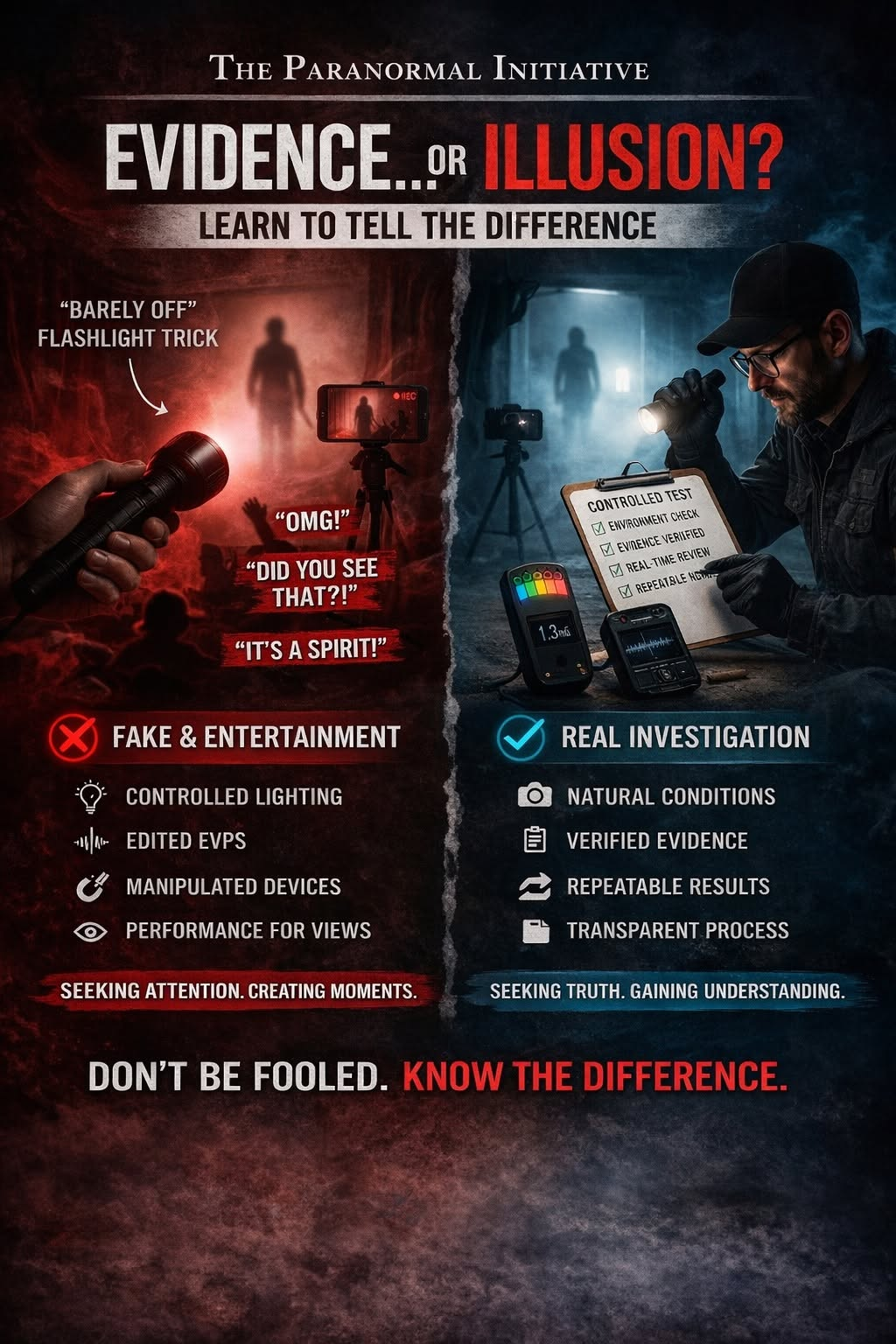
Evidence or illusion graphic comparing fake entertainment and real investigation

A Necessary Conversation

One of the most difficult but necessary conversations in paranormal research is this: not all evidence presented in this field is genuine, and not all investigators operate with the same intent.

If the field is ever going to move forward with credibility, investigators have to be willing to address this honestly.

There are three categories investigators must understand: deliberate fabrication, unintentional misinterpretation, and responsible investigation. They are not the same, and confusing them is part of the problem.

Deliberate Fabrication

Deliberate fabrication occurs when evidence is knowingly created or manipulated to appear paranormal.

This can include creating fake shadow figures with controlled lighting, producing false EVPs through edited or pre-recorded audio, manipulating equipment responses to simulate intelligent interaction, or claiming responses on command that cannot be verified.

This type of behavior is not investigation. It is deception. It may generate attention, views, or followers, but it damages the credibility of the entire field.

The Flashlight Experiment

One widely used method in paranormal investigations is the flashlight experiment, often presented as a way for spirits to communicate by turning a flashlight on and off.

In many cases, this is not paranormal. It is physics.

The method typically involves taking a flashlight, often a Maglite or similar model, and adjusting it so it is in a barely off state. The electrical connection is separated by only a fraction of a millimeter.

Why The Flashlight Cycles

In the barely off state, the flashlight is loosened just enough to break the circuit without fully disconnecting it.

The internal components, including metal, batteries, and rubber gaskets, can retain heat. As they warm, they expand slightly, sometimes enough to reconnect the circuit and turn the flashlight on.

As the light cycles, materials cool and contract. This breaks the fragile connection and the flashlight turns off. The process can repeat naturally, creating what appears to be random on and off responses.

Why It Feels Paranormal

The flashlight is in a highly sensitive state. Small temperature changes, vibrations, or handling differences can trigger it.

When investigators ask questions and wait for a response, a light turning on during that moment can feel intentional. This creates the illusion of intelligent interaction, but in many cases it is a thermodynamic cycle.

This is not always deliberate deception. Many investigators genuinely believe this is communication. They are not faking it. They are misinterpreting it, and that distinction matters because education, not accusation, is what corrects it.

Unintentional Misinterpretation

Unintentional misinterpretation is far more common than fabrication. Investigators may misinterpret lighting and shadows as figures, hear patterns in noise and label them as EVPs, misread environmental fluctuations as intelligent responses, or allow expectation to influence interpretation.

Belief does not equal accuracy. Without understanding the environment and equipment, misinterpretation can appear convincing.

Attention And Entertainment Pressure

Modern paranormal research is also shaped by attention, engagement, and the pressure to entertain. Across social media platforms, public investigations, and paid events, there is an increasing shift away from investigation and toward performance.

Short clips, dramatic reactions, immediate responses, and compelling moments often travel farther than patient review. In today's environment, attention is currency. The more dramatic the moment appears, the more engagement it may generate.

This creates a serious problem because investigation and entertainment do not operate under the same standards.

Investigation Is Not Performance

Investigation requires patience, control, repetition, verification, and often inconclusive results. Entertainment requires impact. It requires something to happen.

When that expectation exists, consciously or unconsciously, it can begin to influence behavior. Not always through deliberate deception, but through subtle reinforcement of what appears to be happening.

At public events, participants often arrive with anticipation. They want to witness something. They want confirmation that what they are experiencing is real. That environment, combined with lighting, equipment, suggestion, and group dynamics, can strongly shape perception.

Responsibility In Public Settings

When a device responds, a sound is heard, or a light turns on, the moment can be amplified. Without proper explanation, control, or critical evaluation, it can easily be interpreted as paranormal even when natural explanations exist.

The people participating are trusting the investigators guiding that experience. They rely on them to interpret honestly, avoid exaggeration, avoid leading conclusions, and explain possibilities instead of only reinforcing beliefs.

When that responsibility is not upheld, the line between investigation and performance becomes blurred. Once that line is blurred, credibility begins to erode.

Responsible Investigation

This does not mean all public investigations or content creators are misleading. It does mean investigators and participants must remain aware of the environment they are in.

Expectation, suggestion, and presentation can shape perception as much as the event itself. A responsible investigator understands this and works to ensure that what is being presented is grounded in observation, not driven by the need to create a moment.

A responsible investigator does not manipulate evidence, does not exaggerate findings, documents thoroughly, evaluates critically, and is willing to say, "This is inconclusive."

Why This Matters

Real investigation is not about proving something is paranormal. It is about determining what can and cannot be explained.

Every time false or misinterpreted evidence is presented as real, it sets the field back. Every time an investigator chooses honesty over hype, it moves the field forward.

This is not about calling people out. It is about raising the standard, because truth matters more than attention, and integrity matters more than entertainment.

Standards & Ethics Back to Series Lesson 4