Investigator Development Series

Lesson 4: Understanding Patterns In Paranormal Claims

Once a claim has been properly documented through intake, the next step in professional investigation is identifying patterns.

Series Index Investigation Methodology
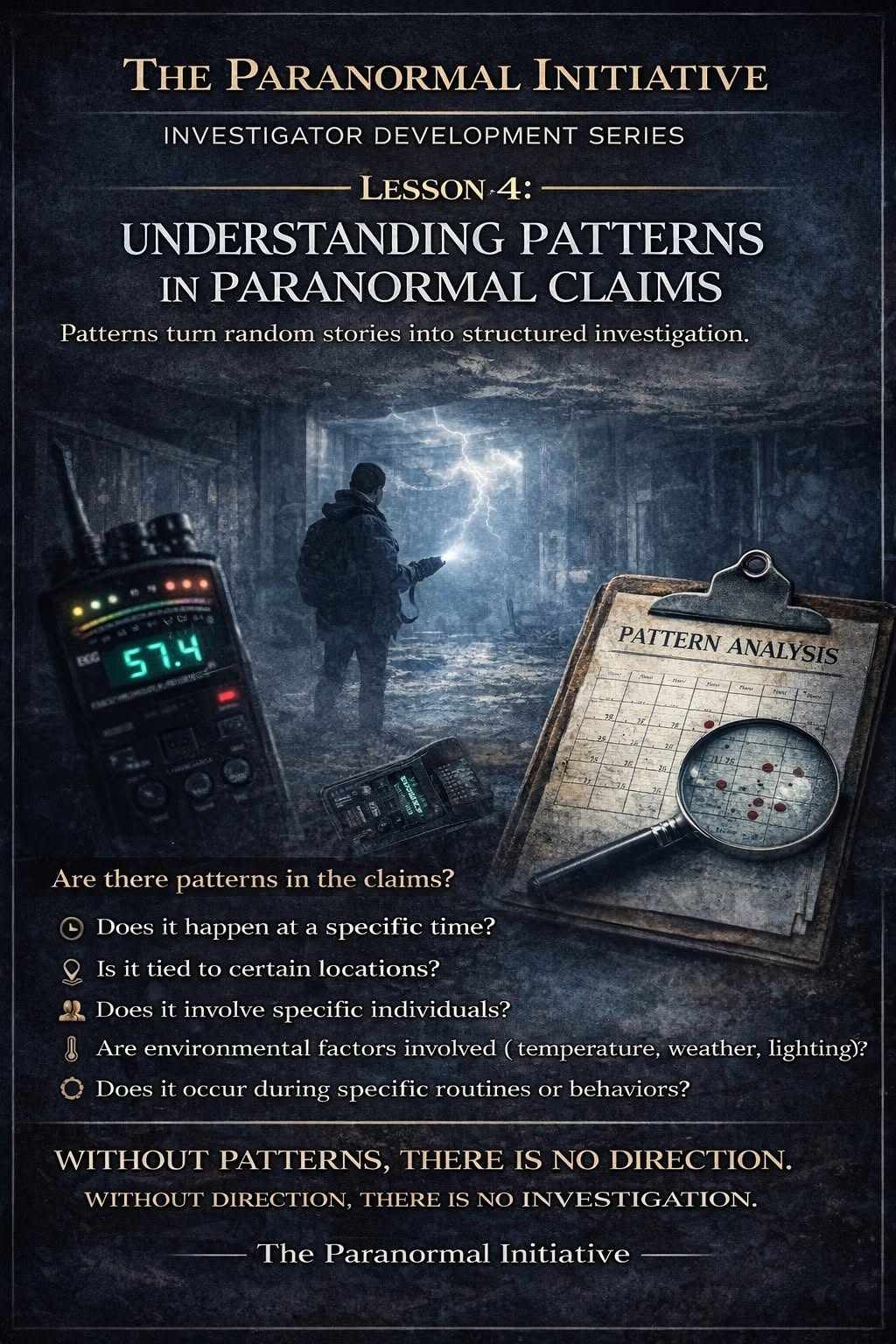
Understanding patterns in paranormal claims graphic

From Storytelling To Analysis

Once a claim has been properly documented through intake, the next step in professional investigation is identifying patterns.

This is where investigation begins to move from storytelling into analysis.

A single unexplained event, on its own, tells investigators very little. Repeated events, especially those that occur under similar conditions, begin to form something far more valuable: a pattern.

Patterns Give Direction

Patterns give investigators direction. They allow the investigation to move from asking, "What happened?" to asking, "Why is this happening here, under these conditions?"

This is a critical shift. Without patterns, an investigation becomes random, and random investigation produces unreliable results.

What Investigators Should Look For

When reviewing claims, investigators should begin looking for consistencies. Does the activity occur at a specific time of day? Is it tied to certain locations within the property? Does it happen in the presence of specific individuals?

Investigators should also ask whether environmental factors are involved, such as temperature, weather, or lighting, and whether the reports occur during specific routines or behaviors.

Patterns Often Point To Natural Causes

Patterns do not always mean paranormal activity. More often than not, patterns point toward natural explanations.

Sounds that occur at the same time each night may be tied to HVAC systems or structural cooling and expansion. Shadows seen in the same location may be caused by external light sources or reflections. Feelings of unease may correlate with environmental conditions such as poor air quality, infrasound, or EMF exposure.

This is why pattern recognition is so important. It allows investigators to test possibilities instead of chasing assumptions.

Patterns Also Reveal Inconsistencies

Pattern review can also reveal inconsistencies. A claim may initially sound frequent and widespread: "It happens all the time, everywhere."

But when the claim is broken down and documented, the pattern may show something very different. It may only happen in one room, at certain hours, under specific conditions, or to one individual.

This is not about discrediting the experience. It is about refining it into something that can be properly investigated.

Consistency Allows Testing

A professional investigator does not look for confirmation. They look for consistency, because consistency is what allows for testing.

Testing is what separates investigation from belief. Without patterns, there is no direction. Without direction, there is no investigation.

Previous Lesson Back to Series Method Exercises