EVP / ITC Research

Ghost Boxes, Radio Scanning, And Why Phoneme-Based Systems Matter

Not all spirit communication tools are created equal. Understanding the source of the audio is essential before interpreting any response as meaningful.

Series Index ACS Phonetic Data
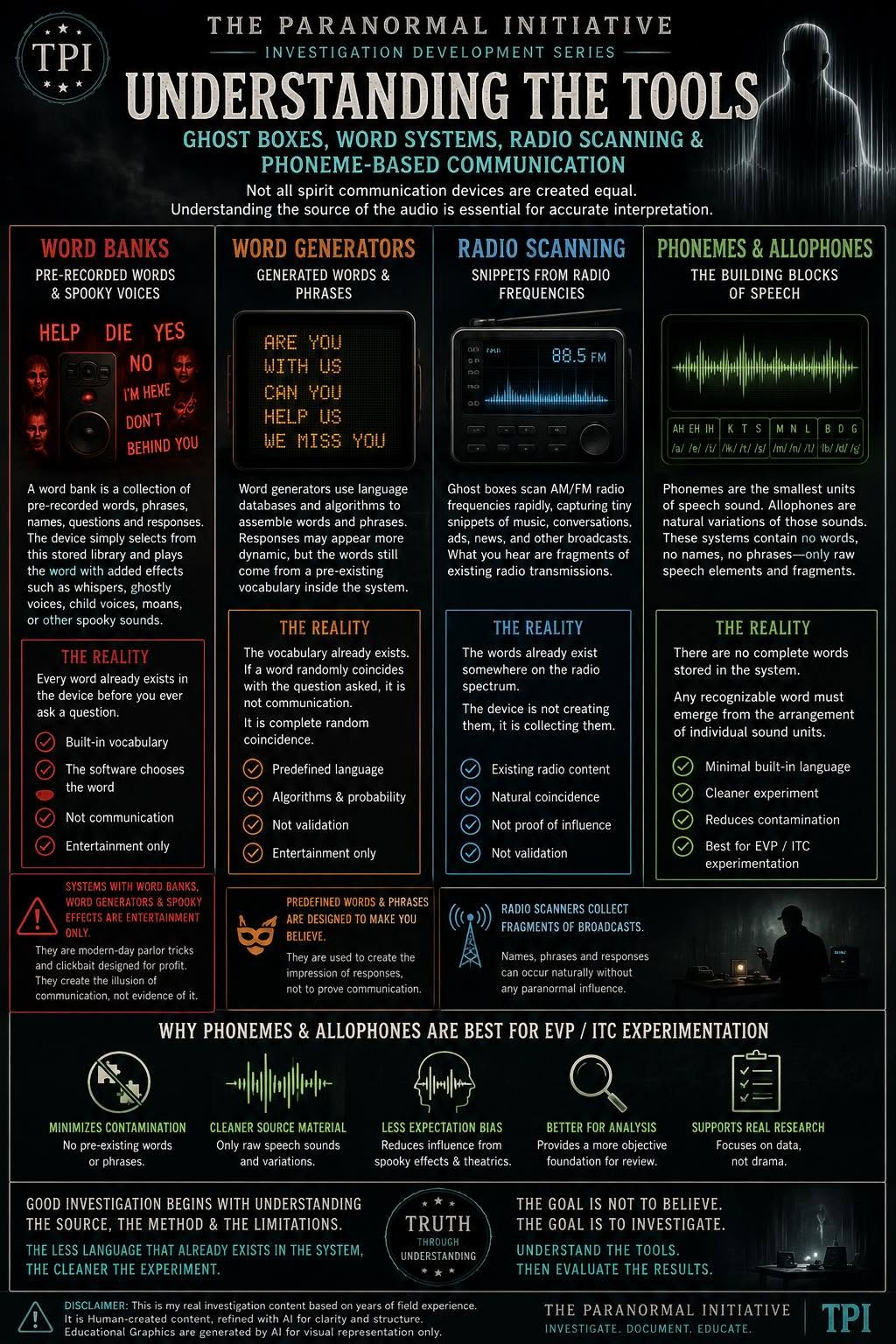
Understanding ghost boxes word systems radio scanning and phoneme based communication graphic

Understanding The Tools

One of the biggest challenges in paranormal investigation is understanding the tools being used.

Many devices are marketed as spirit communication systems, but not all of them operate in the same way. Some use completely different sources of audio, language, and sound generation.

Those differences matter because the source material directly affects how results should be interpreted.

Word Bank Systems

A word bank is a collection of pre-recorded words, names, phrases, questions, or responses stored inside a device or application.

When the software runs, it selects from those recordings and plays them back. Some systems also use whispers, distorted speech, child-like voices, moans, or theatrical effects designed to create a paranormal atmosphere.

These systems can create compelling experiences, but every word already exists within the system before the session begins. The vocabulary is already there. The voices are already there. The software is choosing what to play and when to play it.

Word Generators

Word generators operate in a similar way. Instead of selecting from a fixed list of recordings, they may use larger language databases and algorithms to assemble responses.

The result may appear more dynamic, but the words still originate from a pre-existing vocabulary stored within the software.

If a question is asked and a stored word happens to coincide with that question, it can feel meaningful. But a matching word does not automatically demonstrate communication. It may simply be coincidence inside a system that already contains many possible words and responses.

The Problem With Built-In Language

For research, word-bank and word-generator systems create a major interpretation problem.

They may provide an entertaining experience, but because the language already exists inside the device, separating potential anomalies from programmed output becomes extremely difficult.

The same concern applies to systems built around spooky sound design. Ghostly whispers, dramatic voices, eerie moans, and horror-style effects may create atmosphere, but they also encourage expectation and interpretation before evaluation has taken place.

Traditional Ghost Boxes And Radio Scanning

Traditional ghost boxes take a different approach. Rather than using stored words, they rapidly scan radio frequencies.

As the device sweeps across AM or FM stations, it captures tiny snippets of music, advertisements, talk radio, news broadcasts, conversations, and other live transmissions.

The theory proposed by some researchers is that an external intelligence may somehow influence or manipulate those fragments to create meaningful responses. Whether that is possible remains a matter of debate.

Radio Already Contains Words

What is important to understand is that the words heard through radio scanning already exist somewhere on the radio spectrum.

The device is not creating them. It is collecting them.

This means names, phrases, and recognizable words can naturally appear during scanning without any paranormal influence at all.

Phonemes And Allophones

Phoneme and allophone-based systems operate on an entirely different principle.

Instead of using complete words, sentences, names, or radio broadcasts, they use the smallest building blocks of speech itself.

A phoneme is an individual speech sound. Human language is constructed from combinations of phonemes. An allophone is a natural variation of a phoneme, adding speech texture without introducing complete words.

A Cleaner Experimental Environment

In a true phoneme and allophone system, there are no stored words, names, phrases, or pre-recorded responses.

There are only speech fragments and individual sound components.

From a research standpoint, this creates one of the cleanest environments available for EVP and ITC experimentation because complete language is absent. Any recognizable word or phrase would have to emerge from the arrangement of smaller speech elements rather than being selected from a pre-existing vocabulary.

Why ACS Was Created

This understanding is one of the reasons ACS, the Aetheric Communication System, was created.

ACS was born from a simple question: what would happen if as much pre-existing language as possible was removed from the communication process?

Rather than relying on word banks, stored phrases, pre-recorded responses, spooky voices, or theatrical sound effects, ACS was designed around phonemes and allophones, the fundamental building blocks of human speech.

Designed For Questions, Not Guaranteed Answers

The goal was never to prove communication. The goal was to create a cleaner environment for EVP and ITC experimentation.

By reducing built-in vocabulary and eliminating predefined responses, ACS attempts to bridge the gap between traditional ghost boxes, modern spirit communication apps, and more controlled forms of audio experimentation.

Whether meaningful communication is possible remains an open question. ACS provides an opportunity to explore that question using source material with significantly less structured language than most communication devices currently available.

Compare The Source Material

Word banks already contain complete words and responses.

Word generators already contain language structures and vocabulary.

Radio-scanning devices collect fragments of existing broadcasts that already contain words, conversations, and human speech.

Phoneme and allophone systems contain only the raw materials of speech itself.

Cleaner Foundations Lead To Better Questions

At The Paranormal Initiative, understanding the source material is considered just as important as understanding the result.

The less language that already exists within the system, the fewer assumptions investigators have to make about where a response originated.

That does not guarantee communication, but it does create a cleaner foundation for experimentation. In research, cleaner foundations often lead to better questions.

ACS Phonetic Data Back to Series EVP / ITC Research