Investigation Development Series

Not All "Orbs" Are The Same

A paranormal photography reference on dust, insects, moisture, reflections, optical artifacts, and why context matters before calling an image paranormal.

Series Index Photo Misidentification
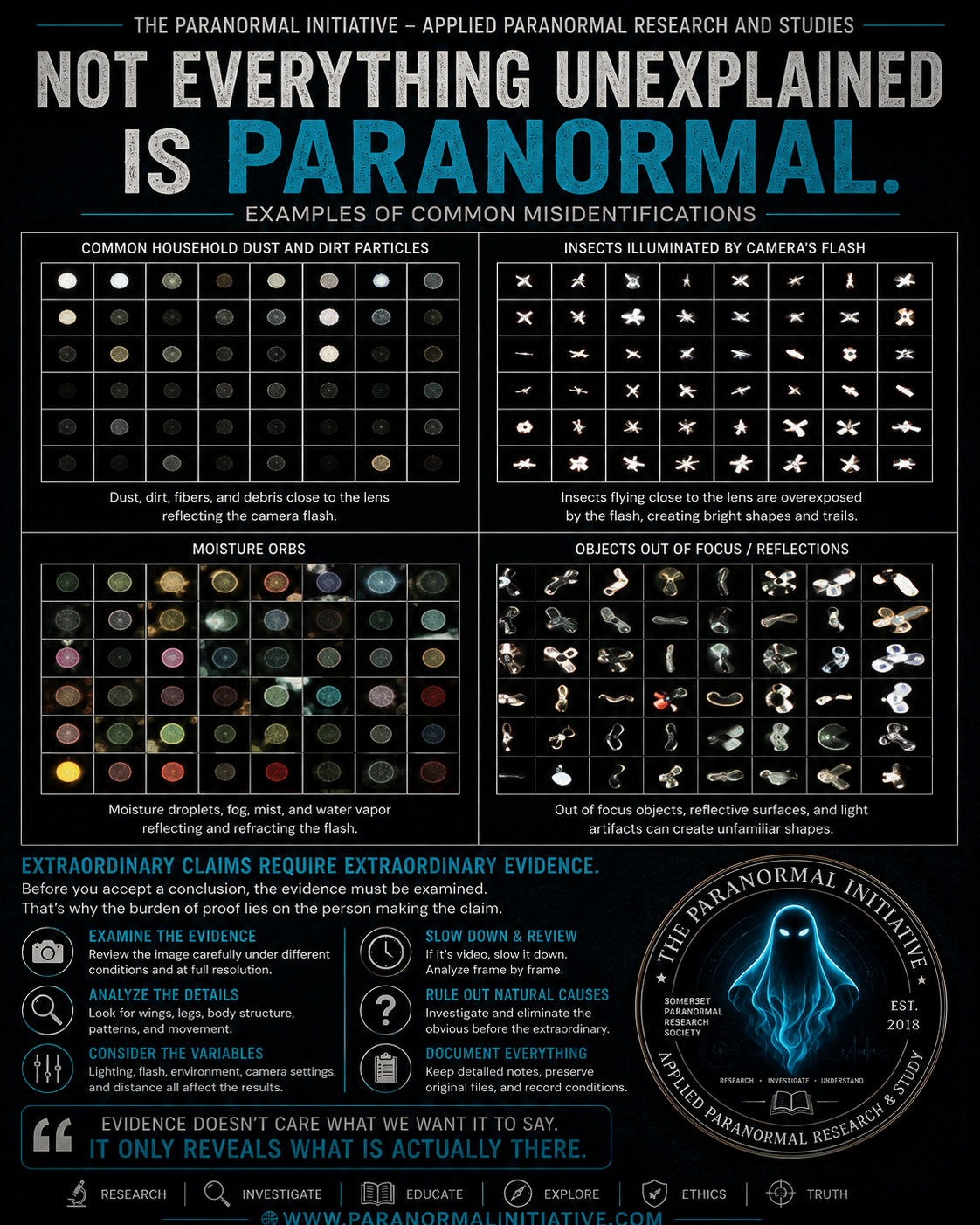
Not all orbs are the same common paranormal photography misidentifications graphic

A Misunderstood Subject

One of the most misunderstood subjects in paranormal photography is the so-called orb.

For years, almost any circular object appearing in a photograph has been labeled a spirit orb. Yet when we actually examine the evidence, we quickly discover that many different natural phenomena can produce remarkably similar images.

The examples shown here illustrate just a few of the most common sources.

Dust And Airborne Debris

The first panel shows common household dust and airborne debris.

Tiny particles floating close to the camera lens can reflect the flash, producing bright circular objects that often appear translucent or glowing.

Their appearance depends on the particle's size, distance from the lens, and the camera's focus.

Insects And Flash

The second panel shows insects illuminated by the camera's flash.

Flying close to the lens, insects become overexposed and blurred by movement, creating unusual shapes that are often mistaken for fairies, spirits, rods, or other unexplained entities.

Moisture Orbs

The third panel demonstrates moisture orbs.

Water droplets, fog, mist, rain, humidity, and even water vapor can scatter and refract light from the flash, creating colorful circular objects that are frequently reported as paranormal activity.

Optical Artifacts

The fourth panel shows out-of-focus objects, reflections, and other optical artifacts.

Reflections from glass, jewelry, lenses, nearby objects, spider webs, moisture on the lens, and countless other variables can create unfamiliar shapes that appear mysterious until carefully examined.

Why Context Matters

This is why experienced investigators never rely on a single photograph.

A photograph captures only one moment in time. Without context, it tells only part of the story.

That is why we ask questions. What were the weather conditions? Was a camera flash used? Was there rain, fog, mist, or humidity? Were insects active? Was dust present?

Could there have been reflections or objects close to the lens? Could the camera have been slightly out of focus?

Understanding Before Believing

These questions are not asked to dismiss evidence. They are asked to understand it.

Good investigation is not about proving that something is paranormal. It is about eliminating what we know before considering what we do not.

Sometimes the answer turns out to be completely ordinary. Sometimes it remains unexplained.

Both outcomes are valuable because both move us closer to the truth.

Extraordinary Investigation

Extraordinary claims deserve extraordinary investigation.

That is why we examine the evidence before accepting the conclusion.

Follow the evidence. Not the belief.

- The Paranormal Initiative

Education | Research | Ethics | Truth | Honor | Integrity

Photo Misidentification Back to Series Burden Of Proof