EVP / ITC Research

Not Every EVP Is Meant To Be Obvious

A reflection on subtle EVP review, listening skill, patience, audio processing restraint, and the fact that not every listener will hear the same thing.

Series Index EVP / ITC Research
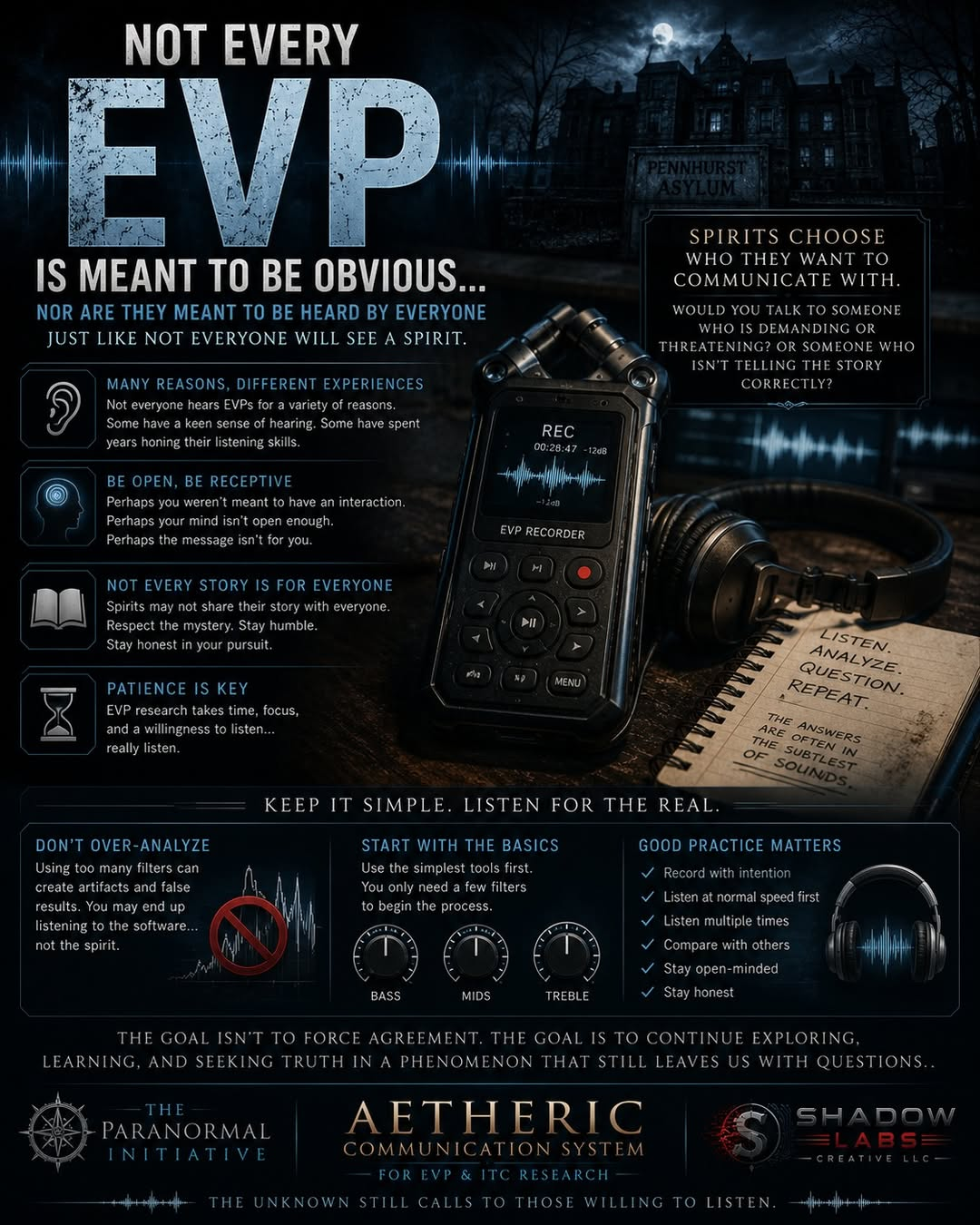
Not every EVP is meant to be obvious educational graphic

Subtle Does Not Mean Simple

Not every EVP is meant to be obvious, and not every possible EVP will be heard the same way by everyone who listens.

That is similar to the broader paranormal field. Not everyone will see an apparition, experience activity in the same way, or walk away from a location with the same impression.

Some people visit well-known locations and never experience anything. Others leave with something they cannot easily explain. There may be many reasons for that difference.

Experience And Receptivity

From a spiritual perspective, some researchers believe communication may not be intended for every person in every moment.

If communication is possible, it is reasonable to ask whether the tone, intention, and approach of the investigator matter. Would any conscious presence want to communicate with someone who is demanding, confrontational, or trying to force a response?

That remains an open question, but it is worth considering with humility. Sometimes a message, if one is present, may not be meant for everyone.

Why Some People Hear More Than Others

There could be many reasons why some people hear possible EVPs while others do not.

Some individuals have a keen sense of hearing and can distinguish subtle sounds and patterns that others miss. Some have spent years developing listening skills and learning how to identify potential anomalies within recordings.

Others may simply be more receptive to certain experiences, or more practiced at staying patient with quiet, unclear, or layered audio.

The Risk Of Over-Processing

One thing I see far too often is investigators over-processing their recordings.

They run clips through countless filters, noise reduction tools, AI cleanup systems, and enhancement software until the original recording is barely recognizable.

In many cases, less is more.

Start with the basics. Adjust bass, mids, and treble. Remove obvious environmental noise if necessary. Listen to the recording at normal speed. Then listen again. And again.

Many times, a possible EVP will reveal itself naturally without needing to be aggressively processed.

When The Software Becomes The Sound

The danger of excessive filtering is that every adjustment changes the original recording.

The more changes you make, the greater the chance of introducing artifacts, distortions, and sounds that were never present in the original file.

At some point, you may no longer be analyzing the EVP. You may be analyzing the software.

Patience Is The Greatest Tool

Perhaps the greatest tool any EVP researcher possesses is not a recorder, a spirit box, or a computer.

It is patience.

Listen carefully. Listen repeatedly. Compare what you hear with what others hear. Keep an open mind, but remain honest with yourself about what is actually present in the recording.

The Goal Is Not Forced Agreement

Not every EVP will be clear. Not every EVP will convince everyone. And that is okay.

The goal is not to force agreement.

The goal is to continue exploring, learning, documenting, and asking questions about a phenomenon that still leaves many of us searching for answers.

Understanding The Tools Back to Series EVP Community Discussion