Investigator Development Series

Lesson 7: The Role Of The Investigator

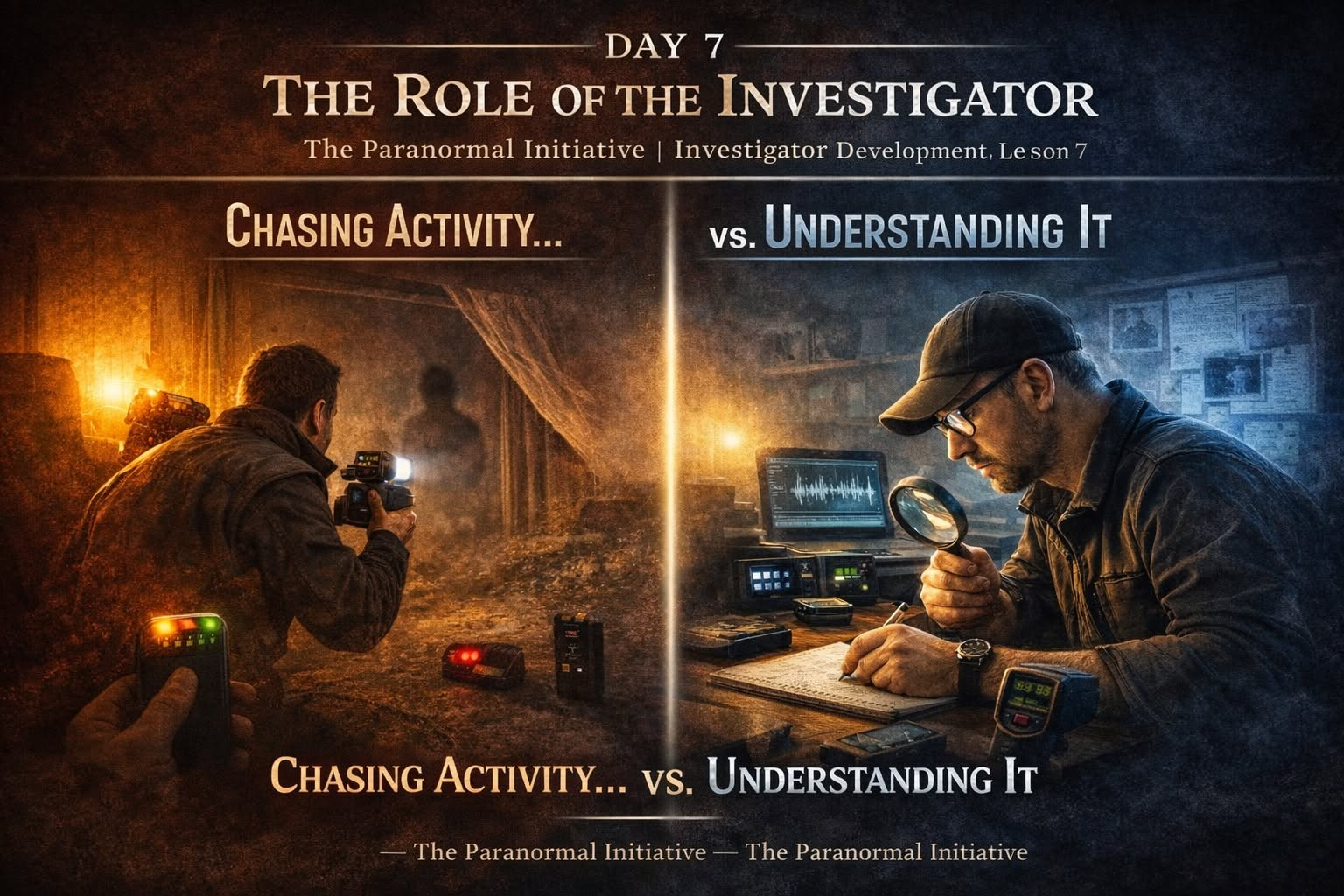
A professional investigator does not chase activity. They evaluate claims, document honestly, and follow the evidence toward understanding.

Series Index Standards & Ethics
The role of the investigator graphic

Do Not Chase Activity

There is a common misconception in the paranormal field about what it means to investigate.

Many people enter this field focused on finding activity, seeking experiences, reactions, or moments that feel unexplainable. A professional investigator operates from a very different mindset.

They do not chase activity. They evaluate claims. That distinction defines everything.

Evaluate Claims, Not Beliefs

A professional investigator is not there to confirm belief, support a narrative, or reinforce what a witness already assumes is happening.

Their responsibility is to evaluate claims. That means remaining objective, eliminating natural explanations, documenting thoroughly, avoiding assumptions, and following the data wherever it leads.

You are not there to create a story. You are there to understand what is happening.

Discipline And Restraint

This role requires discipline and restraint. Investigators must learn not to overreact to sounds, not to force meaning onto equipment readings, and not to confuse feelings with findings.

They must also learn to communicate with precision, because the language used in a case matters.

Use Careful Language

Words such as possible, reported, observed, and unresolved reflect honest investigation.

Words such as confirmed, attached, or definitely haunted, when unsupported, damage credibility.

Careful language protects the witness, the case, and the field.

Understand The Normal World

A true investigator understands that this field does not exist in isolation. Knowledge must extend beyond paranormal theory.

Strong investigators develop an understanding of environmental science, structural behavior, acoustics, psychology, weather patterns, electrical systems, and human perception and behavior.

Many claims exist at the intersection of environment and perception. If you do not understand the normal world, you are not equipped to recognize what may actually be abnormal.

Humility Matters

The role of the investigator is not glamorous. It is disciplined. It requires patience, humility, and the willingness to say, "I do not know."

Sometimes, that is the most honest and accurate conclusion available. Not every case leads to a clear answer.

Sometimes findings point to natural explanations. Sometimes they remain unresolved. Occasionally, they present something that cannot yet be explained.

The Role Remains The Same

In all cases, the role remains the same: investigate responsibly, document honestly, and never allow expectation to override evidence.

Paranormal research does not need more people chasing dramatic conclusions. It needs more people willing to do the careful work of investigation.

That is how the field grows. That is how trust is built. That is how credibility is earned.

Do not focus on chasing activity. Focus on understanding it.

Previous Lesson Back to Series Investigation Methodology