Investigator Development Series

Lesson 3: Claims Vs Evidence — Know The Difference

One of the most damaging problems in paranormal research is the failure to clearly separate claims from evidence. These two are not the same.

Series Index Reporting Standards
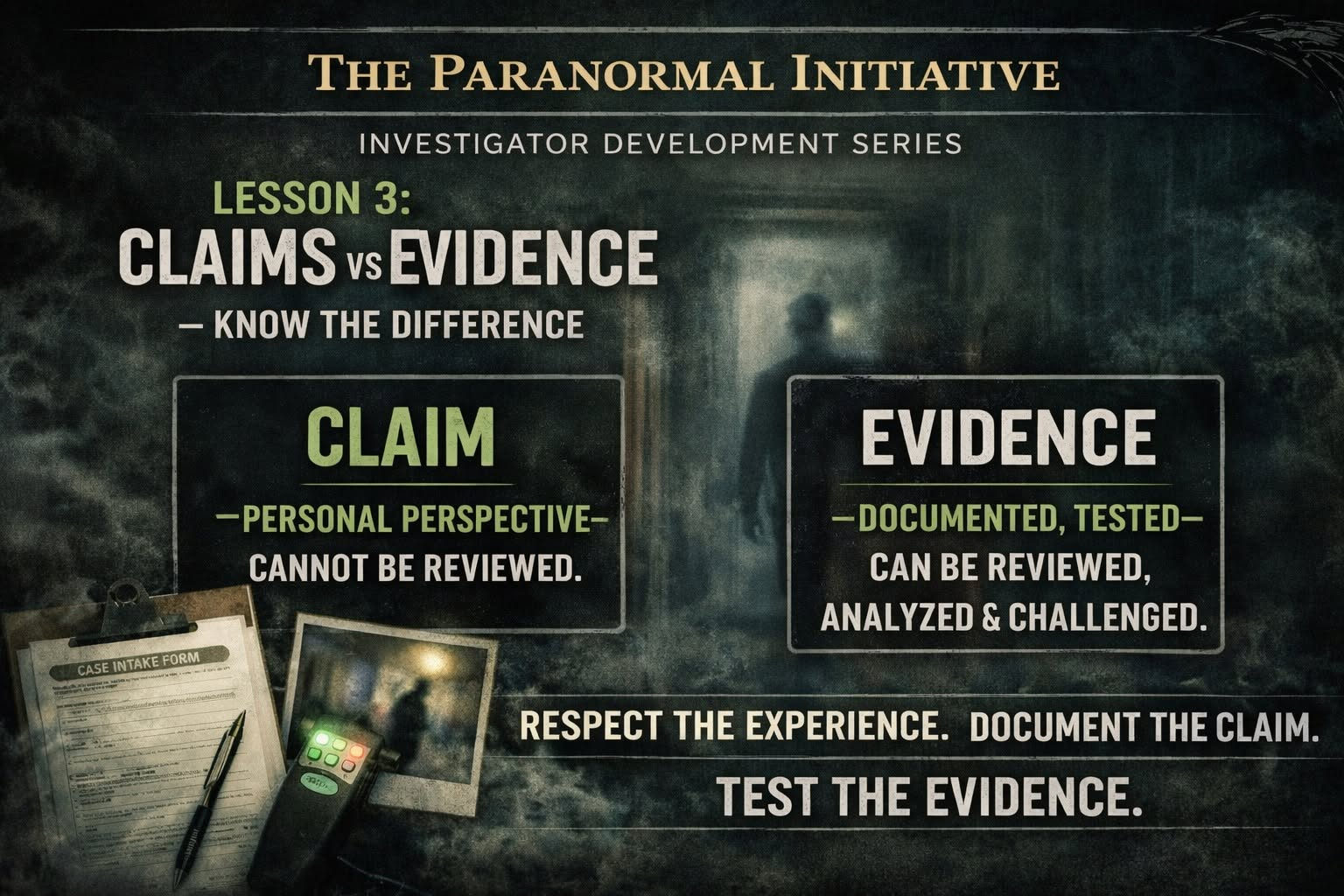
Claims versus evidence know the difference graphic

Separate The Starting Point From The Support

In paranormal research, one of the most damaging and persistent problems is the failure to clearly separate claims from evidence.

These two are not the same. Yet in many investigations, and across much of the field, they are treated as if they are interchangeable.

That confusion is one of the primary reasons paranormal research struggles with credibility. If investigators want to be taken seriously, this is where the correction begins.

What A Claim Is

A claim is an account of an experience. Someone reports that they heard a voice, saw a shadow figure, felt something touch them, or watched an object move.

These statements matter. They tell investigators what is being reported, give direction, and provide the initial data that allows an investigation to begin.

But a claim, no matter how detailed, emotional, or sincere, is not proof. It is not evidence simply because it was experienced. It is a personal perspective of an event.

Why Perception Must Be Tested

Human perception is not perfect. People interpret events through emotion, fear, expectation, prior belief, and limited sensory awareness.

Memory can change. Details can be unintentionally altered. The mind fills in gaps. Under stress or uncertainty, ordinary events can feel extraordinary.

This does not mean the person is wrong. It means the experience has not yet been tested, and that distinction matters.

What Evidence Requires

Evidence is something different. Evidence is information that has been documented, preserved, reviewed, and analyzed.

It can include audio recordings, video footage, photographs, environmental data, written timelines, and investigation logs. But even here, investigators must be careful. Not everything collected is good evidence.

Real evidence must withstand scrutiny. It must be examined within context, compared against environmental factors, challenged by natural explanations first, and reviewed without assumption.

Collected Information Is Not Enough

Data without analysis is not evidence. It is just collected information.

This is why responsible investigators avoid statements such as "the client proved the house is haunted" or "we captured definitive proof." That language moves beyond what the data supports.

It replaces investigation with conclusion. Once that happens, objectivity is lost.

Respect Does Not Mean Confirmation

A witness report may be honest, compelling, and consistent, but it still must be evaluated. What feels unexplainable in the moment may later be understood through environmental conditions, structural causes, psychological factors, or misinterpretation of natural events.

Respecting a person's experience does not mean confirming their conclusion. The most respectful thing an investigator can do is take the claim seriously enough to test it properly.

The Disciplined Standard

Responsible investigation means documenting carefully, asking precise questions, preserving the original report, evaluating without bias, and being willing to say "unexplained" instead of "paranormal."

If this field is ever going to mature, it must stop rewarding dramatic storytelling and start rewarding disciplined evaluation.

Claims are where the investigation begins. Evidence is what remains after documentation, testing, and review.

Respect the experience. Document the claim. Test the evidence.

Previous Lesson Back to Series Evidence Compendium