Investigation Development Series

Why Some People See Ghosts While Others Don't

There is no single answer. Human perception, environment, physiology, memory, culture, and the unknown may all shape reported paranormal experiences.

Series Index Investigation Methodology
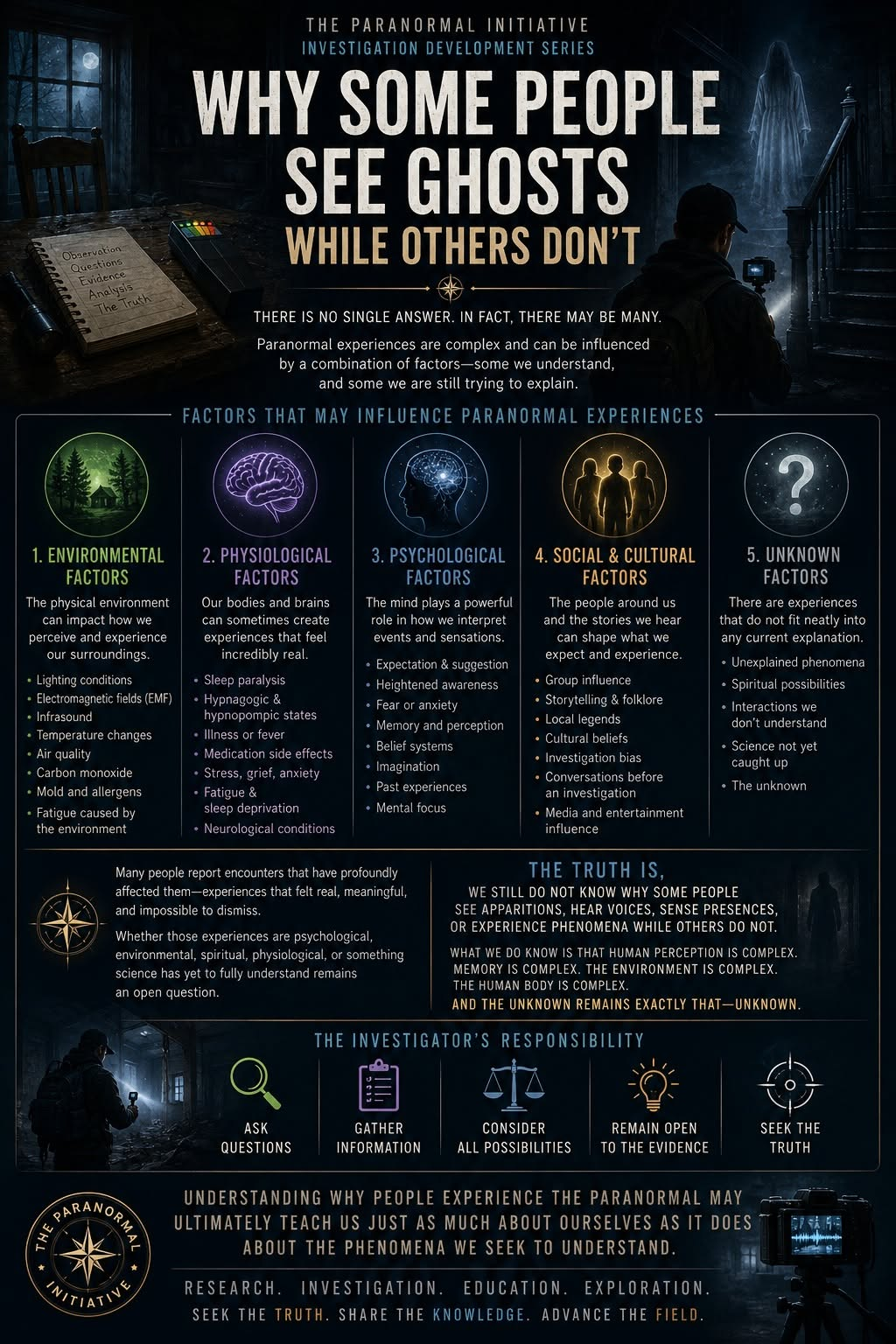
Why some people see ghosts while others do not investigation development graphic

A Question With No Single Answer

One of the most common questions in the paranormal field is surprisingly simple: why do some people report seeing ghosts while others can spend a lifetime in supposedly haunted locations and never see anything at all?

It is a fascinating question because there is no single answer. In fact, there may be many.

As investigators and researchers, the goal is not to immediately confirm or dismiss an experience. The goal is to understand what factors may be shaping it.

Perception Is Not Identical For Everyone

Human beings do not experience the world exactly the same way. Our brains constantly filter, interpret, and prioritize information.

Two people can stand in the same room, witness the same event, and walk away with different memories of what occurred.

Some people may notice subtle details that others overlook. Others may require a higher threshold before considering something unusual. That difference in perception can shape how an experience is remembered and understood.

Expectation And Psychology

Psychology may also play a role. Expectation can influence perception.

If someone enters a location believing it is haunted, they may pay closer attention to sounds, shadows, movements, and sensations that another person might ignore completely.

This does not mean they are imagining things. It means the human brain is an active participant in how we experience the world around us.

Environmental Conditions

Environmental conditions may be another factor.

Lighting conditions, fatigue, stress, electromagnetic exposure, infrasound, temperature changes, air quality, carbon monoxide, mold, and other environmental variables can all influence how a person experiences a space.

A person who is tired, emotionally overwhelmed, sleep deprived, or exposed to unusual environmental conditions may interpret an experience differently than someone who is rested and comfortable.

Physiology And Human States

Physiology may also play a role.

Sleep paralysis, hypnagogic and hypnopompic states, illness, medication, stress, grief, anxiety, and other biological factors can sometimes produce experiences that feel incredibly real to the person experiencing them.

That does not automatically make the experience false. It means there may be additional factors worth considering before any conclusion is reached.

Belief, Culture, And Social Influence

Personal experiences and belief systems can shape how events are understood.

One person may interpret an unusual shadow as a trick of the light. Another may interpret the same event as a paranormal encounter. The experience itself may be identical, while the interpretation may be completely different.

Stories, local legends, group expectations, cultural beliefs, and conversations held before an investigation can also shape how people perceive and remember events. This is one reason experienced investigators try to avoid contaminating a case with assumptions before gathering information.

The Unknown Category

When we step back and look at the bigger picture, several major categories may influence paranormal experiences: environmental factors, physiological factors, psychological factors, social and cultural factors, and finally, unknown factors.

That last category is important.

Despite everything we know about perception, memory, psychology, physiology, and the environment, there are still experiences reported by people that do not fit neatly into any existing explanation.

Whether those experiences are psychological, environmental, spiritual, physiological, or something science has yet to fully understand remains an open question.

The Investigator's Responsibility

The truth is that we still do not know why some people report seeing apparitions, hearing voices, sensing presences, or experiencing phenomena while others do not.

What we do know is that human perception is complex. Memory is complex. The environment is complex. The human body is complex. And the unknown remains exactly that: unknown.

As investigators and researchers, our responsibility is to ask questions, gather information, consider all possibilities, and remain open to where the evidence leads.

Understanding why people experience the paranormal may ultimately teach us just as much about ourselves as it does about the phenomena we seek to understand.

Environmental Red Flags Back to Series Contamination Control