Ghostology 101 · Lesson 01

Why do you want to investigate the paranormal?

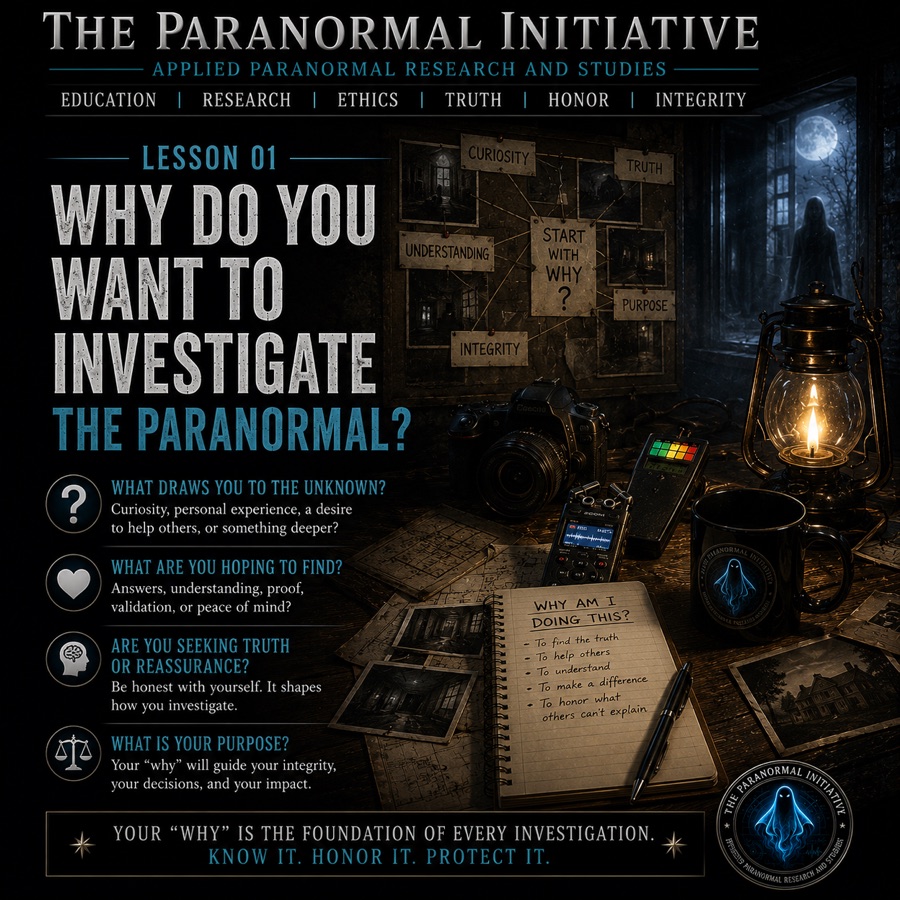
This opening 101 lesson begins with motive. Students examine whether they are drawn by personal experience, curiosity, fear, grief, survival questions, social media, history, mystery, or a desire to help people. The purpose is not to judge the reason. The purpose is to show that motive affects attention, interpretation, patience, and honesty in the field.

All Lessons Ghostology 101 Lesson 02
Ghostology 101 lesson 01 visual

Lesson Reading

Lesson Purpose

This is the first real lesson of Ghostology 101, and it functions as the doorway into paranormal research and investigation. Before you learn about haunted locations, equipment, evidence, investigation techniques, audio review, field safety, or historical research, you need to understand the first variable you bring into every case: yourself. The investigator is never separate from the investigation. Your expectations, questions, fears, beliefs, grief, curiosity, and hopes all travel with you into the field.

The purpose of this lesson is to help you examine your personal reasons for entering paranormal investigation before those reasons quietly shape your conclusions. This is not about judging your motive or telling you that one reason is better than another. Many serious investigators began with a personal experience, a frightening moment, a spiritual question, a love of history, a skeptical curiosity, or the desire to help someone who felt unsettled. The issue is not whether your motive is valid. The issue is whether you can see it clearly enough to keep it from controlling the evidence.

By the end of this lesson, you should be able to name your primary motive, recognize how that motive could help you, identify how it could bias you, and write a personal motive statement that you can revisit later in the course. Self-awareness is the foundation of honest investigation. If you can learn to examine yourself before you examine a claim, you will be better prepared for every lesson that follows.

Introduction — The Question Before the Investigation

Every investigation begins with the investigator. Before you enter a cemetery, a historic building, a client's home, or any location where people have reported strange experiences, you must first examine what you are bringing with you internally. Your expectations, your fears, your hopes, your beliefs, your doubts — all of these will shape what you notice, what you ignore, and how you interpret what you find.

This is not a weakness. It is simply part of being human. But if you do not examine these internal factors, they will influence your work without your knowledge. A motive you can see is a motive you can manage. A motive you ignore is a motive that controls you.

Think of this lesson as the quiet moment before the investigation begins. Before the recorder is turned on, before the camera is aimed down a hallway, before the EMF meter lights up, before someone says they heard a voice, there is already a story forming in the investigator's mind. That story might be: I hope this proves what happened to me. I hope nothing happens because I am nervous. I want to help this family. I want to make good content. I want to prove believers wrong. I want to understand why this place has such a reputation.

Those thoughts matter because they can shape the investigation before the evidence does. If you expect a location to be haunted, you may treat ordinary sounds as meaningful. If you expect nothing to happen, you may dismiss a witness too quickly. If you want to comfort someone, you may overstate what the evidence shows. If you want attention, you may choose dramatic language before careful language.

This lesson asks you to pause before you learn any techniques, before you touch any equipment, before you conduct any investigation. It asks you to look inward first. The answers you find will make you a better investigator because they will help you recognize when you are observing the case and when you are reacting to your own expectations.

Why Motive Matters

Your motives influence nearly every aspect of an investigation. They affect what you notice and what you overlook. When you enter a location hoping to find evidence of paranormal activity, your brain is primed to interpret ambiguous stimuli as meaningful. A creak becomes a footstep. A cold draft becomes a presence. A shadow becomes a figure. When you enter a location expecting to find nothing, you may dismiss genuine anomalies without giving them proper attention.

Motives also affect how quickly you reach conclusions. An investigator who desperately wants proof may call a case closed after the first interesting reading. An investigator who is afraid of being wrong may never call a case closed at all. Both are responding to internal pressures, not to the evidence itself.

Your motives affect how you interact with witnesses and clients. If you are driven by a desire to help, you may be more patient and compassionate. If you are driven by a desire for attention, you may be more likely to dramatize your findings. If you are driven by grief, you may be more vulnerable to wishful thinking.

Motive also affects documentation. A person who wants proof may write notes that emphasize the strange parts of a case while leaving out ordinary details. A person who wants to debunk everything may write notes that minimize witness language and skip emotional context. A person who is frightened may document feelings more strongly than measurable conditions. A person trying to create content may remember the dramatic moment and forget the quiet conditions around it.

None of this means your motives are wrong. It means they are powerful. And like any powerful force, they must be understood before they can be used wisely. In this course, motive is treated as an investigative variable. You do not remove it by pretending it is not there. You manage it by naming it, documenting carefully, inviting review, and allowing the evidence to challenge what you hoped would be true.

Common Reasons People Enter the Paranormal Field

People come to paranormal investigation through many different doors. Some arrive after a personal experience they cannot easily explain. Some are drawn by curiosity, history, cemeteries, old buildings, ghost stories, or the mystery of what may happen after death. Some come through fear because something unsettled them and they want to understand it. Some come through grief because they are looking for comfort, signs, survival, or contact with someone they have lost. Some come through belief, skepticism, religion, science, folklore, social media, entertainment, community, or the desire to help frightened people.

None of these entry points automatically makes someone a good or bad investigator. A person can begin with a frightening experience and still become careful, patient, and evidence-minded. A person can begin as a skeptic and still listen respectfully to witnesses. A person can begin through television or online videos and still learn to separate entertainment from investigation. The important question is not only why you entered the field. The important question is whether you are willing to let method, ethics, and documentation shape what you do next.

Common reasons people enter the paranormal field include:

Personal experience. Something happened that felt unusual, meaningful, frightening, or impossible to forget. This is one of the most common starting points, but the experience should become a question rather than a final answer.

Curiosity and mystery. Some people simply want to understand strange claims, haunted locations, folklore, survival questions, and the boundary between the known and unknown. Curiosity is healthy when it remains open to any outcome.

Fear and reassurance. Some students want to investigate because they were frightened by an event or location. The goal should be understanding, not feeding fear or turning anxiety into a conclusion.

Grief, loss, and the hope of continuation. Some people are looking for signs that consciousness or love survives death. This motive must be handled with special care because grief can make both witnesses and investigators vulnerable.

Belief, religion, and spiritual worldview. Some students already believe in spirits, hauntings, angels, demons, ancestors, energy, or survival after death. These beliefs may be meaningful, but they must not replace observation and evidence.

Skepticism and critical inquiry. Some enter the field because they want to test claims, expose errors, or understand why people report unusual experiences. Healthy skepticism is valuable when it remains curious rather than dismissive.

History, folklore, and place-based stories. Many people are drawn by old buildings, battlefields, theaters, cemeteries, hospitals, family stories, and local legends. This motive can lead to excellent research if the student learns to separate documented history from rumor.

Social media, entertainment, and content creation. Television, YouTube, podcasts, TikTok, livestreams, and ghost tours bring many people into the field. These can inspire interest, but the student must learn that dramatic content and responsible investigation are not the same standard.

Community, identity, and belonging. Some people want to be part of a team, a research group, or a community that shares their interests. This can be positive when the group values safety, honesty, disagreement, and careful documentation.

Helping people. Some are drawn because they want to support families, property owners, witnesses, or communities that feel confused or afraid. This motive can be honorable, but it requires strong boundaries and careful language.

The search for meaning. Some students are asking large questions about death, consciousness, reality, faith, and human experience. Those questions matter, but investigation requires the humility to separate meaning from proof.

As you move through this lesson, notice which reasons resonate with you. More than one may apply. You may have entered through personal experience and stayed because of curiosity. You may enjoy haunted history while also wanting to help people. You may believe something is possible while still wanting to investigate it carefully. The goal is not to erase your motive. The goal is to understand it well enough that it does not quietly control your conclusions.
Personal Experience

Many investigators begin because something happened to them or to someone they trust. A sound in the night. A figure seen from the corner of the eye. A feeling of being watched. An object that seemed to move on its own. These experiences can be powerful and life-changing. They can open questions that ordinary life does not answer.

A personal experience might be dramatic, such as hearing a clear voice in an empty room, seeing a figure at the end of a hallway, or watching a door move when nobody appears to be near it. It might also be subtle: a repeated cold spot, a pattern of footsteps, a dream that feels meaningful, a loved one's perfume at an unexpected moment, or a feeling that something in a place is different from ordinary discomfort. These experiences can stay with a person for years because they feel personal, intimate, and difficult to dismiss.

If you are here because of a personal experience, your motive is valid. That experience matters. But it is important to understand that a personal experience is not the same as evidence. Your memory of the event may be incomplete. Your interpretation may have been influenced by fear, surprise, or suggestion. The experience may have a natural explanation that you did not consider in the moment.

This does not mean the experience was not real. It means the experience is a starting point, not a conclusion. A responsible investigator honors their own experience while still testing it against other possibilities. The best question is not, "How do I prove what happened to me?" The better question is, "What would I need to document if I wanted someone else to review this experience honestly?"

When a personal experience brings you into the field, write it down as carefully as you can. Include the date or approximate time period, location, people present, what happened before and after, environmental conditions, emotional state, and what ordinary explanations were or were not checked. This practice turns a memory into a learning exercise and helps you separate the event itself from the meaning you attached to it.

Curiosity

Curiosity is one of the healthiest foundations for paranormal investigation. It asks questions without demanding specific answers. A curious investigator is open to any outcome. They are not invested in proving or disproving a particular belief. They simply want to understand.

Curiosity becomes even more powerful when it is paired with patience and discipline. The curious investigator who is willing to spend hours researching a location, documenting environmental conditions, and reviewing evidence carefully is the investigator who produces the most credible work.

Curiosity can take many forms. You may be curious about old buildings, local legends, cemeteries, folklore, EVP, survival after death, parapsychology, psychology, environmental science, equipment, or why people report experiences that change their lives. All of those interests can become useful if they are organized into questions that can be researched, observed, documented, or tested.

The risk is that curiosity can become scattered. A beginner may chase every sound, every meter response, every story, every online theory, and every dramatic claim without building a method. Ghostology 101 is designed to turn curiosity into a disciplined path. You learn vocabulary, research habits, environmental awareness, psychology, equipment limits, safety, media review, and ethics so that your curiosity has structure.

If curiosity brought you here, nurture it. But also learn to channel it into productive methods. Curiosity without discipline leads to scattered results. Curiosity with discipline leads to understanding. A good investigator never stops wondering, but they also learn to ask what can be known, what can be checked, and what must remain uncertain.

Fear

Some people investigate because they want to understand something that frightened them. Fear is a powerful motivator. It sharpens attention and can drive people to seek answers they would otherwise avoid.

But fear also distorts perception. When you are afraid, your body is in a heightened state of alert. You notice small sounds, changes in light, and physical sensations that you would ignore in a calm state. This is an evolutionary survival mechanism, but it can create the impression that something paranormal is happening when it is not.

For example, a dark hallway in an old building can make ordinary sounds feel threatening. A shifting floorboard may sound like a footstep. A pipe may sound like a knock. A draft may feel like a presence. A shadow caused by a passing car may look like movement. If the location already has a frightening reputation, the mind may connect those ordinary events into a story before the investigator has tested anything.

Fear can also spread through a group. If one person gasps, whispers, or says they feel something, other people may become more alert and begin noticing sensations of their own. This does not mean anyone is lying. It means human nervous systems respond to one another. A responsible investigator documents the fear response as part of the case context instead of treating fear as evidence of a paranormal cause.

If fear is part of your motivation, acknowledge it. Fear is not a weakness. But it must be recognized so that it does not control your interpretations. An investigator who is aware of their fear can account for it. An investigator who denies their fear will be ruled by it without knowing.

Grief and Loss

This is one of the most sensitive and important motivations to address. Some people enter paranormal investigation after losing a loved one. They may be seeking reassurance that consciousness continues after death. They may hope for contact, a sign, or a message. They may simply want to believe that death is not the end.

If grief brought you here, your motivation is deeply human. The desire to connect with someone you have lost is not wrong. But it carries special risks. Grief can make people vulnerable to wishful thinking, to interpreting ambiguous events as messages, and to investing hope in evidence that would not convince an objective observer.

Grief can make ordinary moments feel charged with meaning. A light flickers on an important date. A song plays at the right time. A dream feels like a visit. A familiar smell appears in a room. A recorder captures a sound that resembles a name. These moments may be meaningful to the person experiencing them, and that meaning should not be mocked. But meaning and evidence are not the same thing. A meaningful experience can comfort a person without proving a paranormal cause.

A responsible investigator who is also grieving must be especially careful. They should work with a team. They should have their evidence reviewed by others who do not share their emotional investment. They should be honest with themselves about what the evidence actually shows, separate from what they hope it shows.

Most importantly, grief should never be exploited. No ethical investigator uses someone's loss to produce dramatic content or to build a reputation. If you are investigating because of grief, seek support from people who understand both the investigative process and the emotional weight you are carrying. If you are investigating for someone else who is grieving, use especially careful language. Do not promise contact. Do not declare a loved one is present. Do not turn longing into evidence.

Belief

Some people enter this field because they already believe in spirits, an afterlife, or paranormal phenomena. Belief can be a source of strength and meaning. It can motivate serious study and sustained effort.

But belief can also create bias. If you already believe that ghosts exist, you may interpret ambiguous evidence as confirmation. If you already believe that a specific location is haunted, you may find evidence that supports that belief while overlooking evidence that contradicts it.

Belief can also influence the language you use. A believer may say "spirit," "message," "energy," or "presence" before the evidence supports those words. Those terms may reflect the investigator's worldview, but they can create problems in a case file. A report should separate what was observed from what was believed. "A voice-like sound was recorded at 9:42 PM" is different from "a spirit spoke at 9:42 PM."

The goal is not to remove belief from your life. The academy does not require students to abandon spiritual, religious, or paranormal beliefs. The goal is to prevent belief from doing the work that evidence must do. You can believe something is possible while still documenting carefully, testing ordinary explanations, and using cautious language.

The key is to hold your beliefs lightly enough that evidence can change them. A belief that cannot be tested is not investigation; it is a conclusion brought in from outside the case. Conclusions should come after observation, documentation, and review, not before.

Skepticism

Skepticism can be a valuable asset in paranormal investigation. A healthy skeptic asks for evidence, tests claims, and refuses to accept conclusions without support. This is exactly the mindset that responsible investigation requires.

But skepticism can also become a bias. Dismissive skepticism — the kind that rejects all paranormal claims without examination — is just as unhelpful as uncritical belief. The goal is not to be a believer or a skeptic. The goal is to be an honest investigator who follows the evidence wherever it leads.

If you consider yourself a skeptic, ask yourself: Am I open to being surprised? Am I willing to accept evidence that challenges my worldview? If the answer is yes, your skepticism will serve you well. If the answer is no, your skepticism is a bias that needs to be examined.

Religion and Spiritual Worldview

Some students enter this field with religious or spiritual frameworks for understanding paranormal phenomena. These frameworks can provide meaning and context. They can also create expectations about what kinds of phenomena are possible and what they mean.

The curriculum respects all sincere spiritual and religious perspectives. At the same time, it teaches that investigation requires careful language and clear boundaries. If a client uses spiritual or demonic language, the investigator must respond with respect but must not validate claims that cannot be supported by evidence. If the investigator's own spiritual framework leads them to interpret evidence in a particular way, they should be aware of that influence.

For more on this topic, see Lesson 12: Spiritual, Religious, and Demonic-Claim Language.

Social Media and Entertainment

Paranormal television shows, YouTube channels, TikTok videos, and livestreams have introduced millions of people to the idea of paranormal investigation. If you came to this field through entertainment media, you are not alone. Many of the best investigators started the same way.

But there is an important difference between performing for an audience and investigating responsibly. Entertainment media often edit out the long periods of nothing happening. They amplify dramatic moments. They may present speculation as fact. They are designed to be exciting, not to be accurate.

If entertainment brought you here, that is fine. But as you move through this curriculum, you will learn to distinguish between what makes good content and what makes good investigation. They are not the same thing.

Community and Identity

Some people join the paranormal field because they want to belong to a team, a community, or a shared purpose. This is a valid and powerful motivation. Investigation can be lonely work, and having a team makes it safer, more productive, and more enjoyable.

But the desire to belong can also create pressure. Team members may influence each other's interpretations. A desire to fit in may make it harder to disagree with a popular conclusion. A healthy team encourages independent thinking and honest disagreement.

If community is part of your motivation, seek out teams that value honesty over agreement, documentation over drama, and learning over winning.

The Search for Meaning

Some people are drawn to paranormal investigation because they are asking deep questions about life, death, consciousness, and the nature of reality. These are among the most important questions a person can ask. Paranormal investigation touches on all of them.

This motivation can be sincere and meaningful. But it still requires discipline. The search for meaning and the search for evidence are related, but they are not the same thing. A meaningful experience is not automatically evidence of a paranormal cause. An unexplained event is not automatically a message or a sign.

The curriculum honors the search for meaning while teaching the methods of evidence-based investigation. Both can coexist. The key is to know which one you are doing at any given moment.

Helpful Motives vs. Risky Motives

No motive is automatically good or bad. But some motives tend to produce better investigation than others. Understanding the difference can help you recognize your own tendencies.

Motives that tend to support good investigation:

Curiosity that is open to any outcome. Compassion for people who are frightened or confused. A genuine desire to learn and improve. Respect for history and for the locations you investigate. A commitment to documentation and honest reporting. An interest in research and method. A desire to help others responsibly.

Motives that tend to create problems:

A desire for fame, attention, or social media followers. A need to prove something at any cost. A desire to scare people or create dramatic content. A need to confirm a belief rather than test it. A desire to prove skeptics wrong. A tendency to declare every location haunted. A willingness to exploit grief or fear for content or reputation.

If you recognize any of the risky motives in yourself, that does not make you a bad investigator. It makes you human. The important thing is to acknowledge them and to build practices that keep them in check.

Confirmation Bias and Expectation

Confirmation bias is the tendency to notice and remember information that supports what you already believe, while ignoring or forgetting information that contradicts it. Every human being has this bias. It is not a character flaw. It is how the brain works.

In paranormal investigation, confirmation bias can be powerful. If you believe a location is haunted, you will notice every creak, every cold spot, every flickering light. You will remember the sounds that seemed like responses and forget the hours of silence. If you believe a location is not haunted, you will explain away every anomaly and dismiss every witness report.

Expectation bias is related. It is the tendency to perceive what you expect to perceive. If someone tells you a room is haunted before you enter it, you are more likely to feel cold, hear sounds, or see shadows. Your expectation shapes your experience.

The best defense against these biases is documentation. Write down what you observe before you interpret it. Review your evidence systematically. Ask someone who does not share your expectations to review it as well. The more you document, the less your biases can distort your conclusions.

The Investigator as Part of the Investigation

Investigators are not neutral recording devices. They bring emotions, assumptions, memories, beliefs, fears, hopes, cultural backgrounds, spiritual worldviews, and prior experiences into every investigation. This does not make them unreliable. It makes self-awareness necessary.

A good investigator knows themselves well enough to recognize when their internal state is affecting their judgment. They notice when they are feeling afraid, excited, impatient, or skeptical. They account for these feelings rather than pretending they do not exist.

This is one of the reasons experienced investigators often work in teams. Another set of eyes — and another set of assumptions — can catch things that a single investigator might miss. A team member who is not emotionally invested in a particular outcome can provide a valuable check.

Respecting Your Own Experience Without Becoming Ruled By It

Many students enter this program because of a personal experience that changed them. That experience deserves respect. It may have been meaningful, frightening, comforting, or confusing. It may have opened questions that you are still trying to answer.

Honor that experience. Write it down. Reflect on it. Share it with people you trust. But also recognize that a personal experience, no matter how powerful, is not the same as evidence. Evidence is documented, preserved, reviewable material that can be analyzed and challenged by others. A personal experience is a memory, and memories are not always accurate.

You can respect your experience without treating it as proof. You can honor its meaning without letting it control your conclusions. This is one of the most important balances an investigator must learn.

The Difference Between Wanting Answers and Forcing Answers

Wanting answers is normal. It is why most people become investigators. You encounter something strange, and you want to understand it. That desire is the engine of investigation.

But wanting answers and forcing answers are different things. Forcing answers means reaching a conclusion before you have enough evidence. It means interpreting ambiguous data to fit a preferred narrative. It means calling a case closed when it is not.

A responsible investigator learns to say: I do not know yet. We need more information. This is unexplained. This has a possible natural explanation that needs to be checked. This is interesting but not conclusive. This needs further review.

These statements are not signs of weakness. They are signs of honesty. And honesty is the foundation of credible investigation.

What Kind of Investigator Do You Want to Become?

As you begin this program, it is worth thinking about the kind of investigator you want to become. There is no single correct answer. Different investigators bring different strengths.

Some become careful observers who notice details others miss. Some become historical researchers who can reconstruct a location's past with precision. Some become technical investigators who understand equipment and data analysis. Some focus on EVP and ITC. Some specialize in client support and compassionate communication. Some are environmental investigators who can identify natural causes quickly. Some are field documentarians who create thorough records. Some are skeptical but open-minded, providing a valuable check on the team's enthusiasm.

All of these styles are welcome in this program. The key is to find the approach that fits your strengths while maintaining the standards of ethics, documentation, and respect that every investigator must uphold.

Practical Examples

The following scenarios illustrate how different motives can affect an investigation. As you read each one, consider what strengths and risks the investigator brings to the case.

Scenario 1: The Believer. A student has always believed in ghosts. She enters every location expecting to find evidence. She captures an EVP that sounds like a whisper and immediately posts it online as proof of spirits. She did not check for radio interference, did not establish a baseline, and did not have anyone else review the recording. Her belief motivated her to investigate, but it also led her to skip the steps that would have made her evidence credible.

Scenario 2: The Grieving Son. A man lost his mother six months ago. He begins investigating after feeling a presence in her old room. Every sound, every temperature change, every flicker of light becomes a message from his mother. He wants desperately to believe she is still with him. His grief is real, and his experience is meaningful. But he needs to work with a team who can help him evaluate the evidence objectively.

Scenario 3: The Skeptic. A student is certain that all paranormal claims have natural explanations. He joins a team to prove that nothing paranormal ever happens. During an investigation, he dismisses every witness report and explains away every reading. His skepticism prevents him from considering evidence that might challenge his worldview. He is as biased as the believer.

Scenario 4: The Social Media Investigator. A student starts investigating because she loves paranormal content on social media. She wants to create her own channel. She stages evidence, exaggerates findings, and presents speculation as fact. Her content is popular, but her credibility is zero. She is performing, not investigating.

Scenario 5: The Curious Student. A student has no strong beliefs about the paranormal. She is simply curious. She reads everything she can find, asks questions, and documents her observations carefully. She is open to any outcome. She is the kind of investigator who will grow the most through this program.

Common Misconceptions

"If I believe, I will find more evidence." Belief can motivate you to look, but it can also cause you to see things that are not there. Evidence should be evaluated on its own merits, not on whether it supports your beliefs.

"If I am skeptical, I am more objective." Skepticism is valuable, but it is not the same as objectivity. A dismissive skeptic is just as biased as an uncritical believer. True objectivity means being willing to follow the evidence wherever it leads.

"Fear means something paranormal is present." Fear is a natural human response to darkness, uncertainty, and unfamiliar environments. It does not indicate the presence of anything paranormal. Fear can be triggered by suggestion, expectation, or simply being in a place with a reputation.

"A personal experience is the same as evidence." A personal experience is a memory. Memories are not always accurate. Evidence is documented, preserved, and reviewable. They are not the same thing.

"Real investigators always get answers." Real investigators often do not get answers. Many cases remain unresolved. The willingness to say "I do not know" is a sign of integrity, not failure.

"If nothing happens, the investigation failed." An investigation where nothing unusual occurs is not a failure. It is data. Documenting that a location showed no anomalous activity is a valid and valuable result.

Practical Self-Check Before Investigation

Before every investigation, take a few minutes to ask yourself these questions. Write down your answers. Review them after the investigation to see how your expectations affected your experience.

What do I hope is true about this location? What do I fear is true? What answer would disappoint me? What explanation am I most likely to jump toward? Am I trying to help, to prove something, to perform for others, or to understand? Can I accept an inconclusive result? Am I open to being wrong?

There are no right or wrong answers to these questions. The act of asking them is what matters. It builds the self-awareness that separates honest investigation from wishful thinking.

Student Activity — Personal Motive Statement

Write a personal motive statement. This is a written reflection that you will keep in your personal notes and revisit at the end of Ghostology 101.

Include the following: Why are you interested in paranormal investigation? What experiences, if any, shaped your interest? What do you hope to learn from this program? What biases or assumptions do you think you might carry? What kind of investigator do you want to become?

This statement is not scored. It is for you. Be honest. The more honest you are now, the more valuable this exercise will be when you revisit it later.

Reflection Questions

1. Think about a time in your life when you wanted something to be true. How did that desire affect what you noticed and what you ignored? How might that same dynamic play out in a paranormal investigation?

2. If you discovered that a case you cared about had a completely natural explanation, would you feel relieved or disappointed? What does your answer tell you about your motives?

3. What is the difference between having an open mind and having a mind that is so open that evidence cannot anchor it?

4. How do you think your background, beliefs, and life experiences might shape the way you interpret paranormal claims?

5. What would it mean for you to conduct an honest investigation, even if the results were inconclusive?

6. How would you feel if a colleague challenged your interpretation of evidence? Would you be defensive, curious, or something else?

7. What kind of investigator do you want to be remembered as?

Key Takeaways

Your motives shape your perception, your interpretations, and your conclusions. A motive you can see is a motive you can manage. Curiosity is a healthy foundation for investigation when paired with discipline. Personal experience deserves respect, but it is not the same as evidence. Bias is human. The goal is not to eliminate it but to recognize it. Wanting answers is normal. Forcing answers damages credibility. "I do not know" is an acceptable conclusion. The investigator must be examined before the investigation begins.

Repository Connections

As you continue through Ghostology 101, you will encounter lessons that build on the concepts introduced here. For a deeper understanding of bias and perception, see Lesson 11: Psychological Triggers of Paranormal Experiences. For guidance on documentation, see Orientation Lesson 6: How to Document Investigations Properly. For terminology, see the Terminology Reference. For investigation standards, see the Investigation Compendium.

Next Lesson Connection

Now that you have examined your own motives, the next lesson defines what ghost hunting is and how it differs from formal investigation. You will learn why ghost hunting is often the doorway into this field, what its limits are, and how to move from casual curiosity toward disciplined method.

Field Application

In the field, why do you want to investigate the paranormal? becomes visible through small decisions. The investigator decides what questions to ask, what details to write down, what assumptions to avoid, and what language to use when speaking with others. A student who understands this lesson should be able to enter a location and behave differently because of it. The learning should change conduct, not simply add information. Imagine a student who had a frightening childhood experience and now wants to prove that it was paranormal. During an investigation, that student hears a faint knock in a hallway and immediately feels the old fear return. A responsible investigator does not shame that response, but they also do not let it control the case. They write down the sound, the time, the location, who was present, what appliances were running, whether the sound repeated, and what ordinary sources should be checked. The point of the example is not to give the student a script to memorize. It is to show how the concept works under real pressure. Fieldwork is rarely neat. People interrupt each other. Equipment fails. Weather changes. A witness remembers something after the interview is over. A teammate gets excited. A client asks for certainty. A responsible investigator uses the foundation from this lesson to stay oriented when the situation becomes messy. When teaching this section live, ask students to describe what they would do first, second, and third. If they jump straight to a paranormal explanation, bring them back to the process. What exactly was reported? Who reported it? When did it happen? What changed in the environment? What was documented? What can be checked? That sequence is the difference between curiosity and investigation.

Documentation Standard

Documentation is the way this lesson becomes reviewable. The student should not merely say that they understand the concept. They should be able to record it in a case file. Notes should include the claim, the setting, the people present, the relevant environmental conditions, the questions asked, the actions taken, and the limits of what was learned. If a later reviewer cannot reconstruct the reasoning, the documentation is incomplete. Create a motive statement for yourself. Then write three ways that motive could help your investigation and three ways it could bias your investigation. Finally, write one rule you will follow when your motive begins to pull you toward a conclusion too quickly. This optional practice can be discussed, demonstrated, or written privately. The student should focus on clear separation between observation and interpretation. The goal is to build the habit of writing like an investigator rather than narrating like a storyteller. A good entry should allow someone who was not present to understand what happened and how the student thought through it. The documentation should also include what was not known. Beginners often omit uncertainty because they think it makes them look unprepared. In reality, uncertainty is one of the most professional things an investigator can preserve. Write down what remains unknown, what still needs to be checked, and what would be required before a stronger conclusion could be reached.

Common Failure Points

The most common failure in this lesson is confusing sincerity with accuracy. A person can be deeply sincere and still be mistaken. An investigator can care deeply and still misinterpret evidence. Motive gives the work meaning, but it cannot be allowed to become the conclusion. This mistake is common because the paranormal field rewards certainty, confidence, and dramatic language. Social media rewards the strongest claim, not the most careful one. A classroom, however, must reward process. The student should learn to recognize when excitement is pushing them ahead of the evidence. Another common failure is treating the lesson as theory only. A student may agree with the principle in class but abandon it during a case because the situation feels unusual. The entire purpose of Ghostology 101 is to make the principle strong enough to survive the field. The lesson should therefore include examples, examples and optional practice prompts that invite the student to apply the idea rather than simply admire it. The instructor should also watch for language that hides assumptions. Words such as "definitely," "obviously," "evil," "spirit," "energy," "proof," and "debunked" can all be useful in some contexts, but they can also smuggle conclusions into the record. Students should be trained to replace conclusion-heavy language with descriptive language whenever the evidence is still being evaluated.

Foundation Deepening — Why This Lesson Matters

Motive is the student's first investigative variable. This lesson deserves extra depth because it shapes how students will interpret every later topic in Ghostology 101. The early lessons are not merely introductory material to get through quickly. They establish the student's habits of attention. If a student learns to think carefully here, that habit will carry into equipment use, evidence review, client communication, and final reporting. The instructor should emphasize that a foundation lesson is successful when it changes the way a student notices details. Students should begin asking better questions, using more careful language, and recognizing when their own expectations are affecting their interpretation. The goal is not to make the student less curious. The goal is to make curiosity disciplined enough to be useful.

Beginner Misinterpretations

Beginners often misunderstand this topic because they enter the field through stories, videos, television, social media, or personal experiences. Those sources can inspire learning, but they often skip the slow middle work: defining terms, documenting context, testing ordinary explanations, and communicating uncertainty. A student may know many ghost stories and still not know how to investigate one. The course should therefore ask students to identify where their existing ideas came from. Was it a family story, a television show, a frightening experience, a historic location, a cemetery visit, a religious belief, or an online creator? Tracing the source of an idea helps the student understand whether they learned a method or simply inherited an expectation.

Case File Translation

Every concept in this lesson should be translated into a case-file habit. The question is always: what would this look like in notes? If the answer cannot be written clearly, the student has not fully learned the concept. A responsible case file turns vague interest into organized information. For practice, students should write a short case-file entry that applies this lesson. The entry should avoid dramatic language and include only what can be responsibly stated. It should distinguish between what someone reported, what the investigator observed, what remains unknown, and what follow-up would be needed.

Ethical Connection

Ethics appear even in this foundation lesson. The way an investigator thinks affects how they treat witnesses, locations, teammates, and the public. If the investigator wants excitement more than clarity, people can be harmed. If the investigator wants to prove a belief more than understand a claim, evidence can be distorted. If the investigator wants attention more than accuracy, privacy can be violated. Students should understand that ethical investigation begins before the first client call or field visit. It begins in the student's own expectations. A person who practices careful thinking in the classroom is more likely to practice careful conduct in the field.

Manual and Reference Connection

This lesson should be connected to the larger reference library. The HTML manuals are not separate from the course; they are the extended library behind it. When a concept appears in this lesson, students should know where they can study it more deeply. Terminology belongs with the Terminology Reference. Procedure belongs with the Investigation Compendium. Evidence questions belong with the Evidence Compendium and Forensic Analysis Compendium. For independent study, students should open at least one linked reference and notice how the reference expands the lesson. This trains them to use the curriculum as a research system rather than as a single page to read once.

Reflection Readiness

Students are ready to move on when they can explain the lesson without relying on slogans. They should be able to define the main idea, give a practical example, identify a beginner mistake, describe a professional observation, and explain why the topic matters to ethical investigation. If a student can only repeat a phrase but cannot apply it to a scenario, they need more practice. Application is the standard. Ghostology 101 is not built to create passive readers. It is built to create students who can think through a claim step by step.

Case File Standard

A finished student should be able to create a case-file entry that reflects this lesson. The entry should include a claim summary, a context note, at least three possible ordinary explanations, one question for a witness, one observation that should be made on site, and one sentence explaining what would be irresponsible to conclude too early. This case-file entry does not need to be long, but it must be precise. Precision matters because future reviewers will not have access to the student's memory. They will only have the record. The case file should therefore preserve what was actually known at the time and what still needed to be checked. The instructor should reject vague entries. "Check for normal stuff" is not enough. "Check HVAC timing, loose doors, hallway airflow, exterior traffic, plumbing expansion, and team movement during the reported event" is much better. Ghostology 101 should teach students to replace vague skepticism with specific investigation.

Readiness Check

Before moving forward, students may use a reflection check in their personal notes. First, summarize this lesson in three sentences. Second, describe one way the lesson could prevent a false conclusion. Third, describe one way the lesson could help a frightened witness. Fourth, explain how the lesson connects to documentation. These questions matter because they connect knowledge to responsibility. A student who can define a concept but cannot explain how it protects people has only learned half the lesson. The academy standard is higher. Students must understand that method, ethics, and communication are connected. The final reflection can be phrased in the student's own words. If the response sounds copied from the lesson, the student should try again. Real readiness means the student can carry the idea into a new situation and still use it correctly.

Casebook Expansion Exercise

The following casebook exercise should be used to deepen this lesson into full textbook-level study. A community theater reports several unusual experiences: actors hear footsteps on the stage after closing, a volunteer sees a shadow near the balcony, one room feels colder than the rest of the building, and a board member believes the activity is connected to a former performer. Students should approach the case through the specific lens of why do you want to investigate the paranormal?. First, students should identify what is actually being reported. There are auditory claims, visual claims, environmental claims, historical claims, and interpretive claims. Each one belongs in a different part of the case file. The footsteps are not the same as the shadow report. The cold room is not the same as the historical story. The board member's belief may matter as context, but it is not proof. This sorting process teaches students to prevent one dramatic narrative from swallowing several separate observations. Second, students should write the first five questions they would ask. The questions should be open-ended and non-leading. Instead of asking, "Do you think the former performer is haunting the theater?" they might ask, "When did you first hear the footsteps?" "Where were you standing?" "Who else was present?" "What was happening in the building at the time?" "Has any maintenance work been done near the stage or balcony?" Good questions widen the investigation. Leading questions narrow it too soon. Third, students should list ordinary explanations without using them as dismissals. Stage buildings have pipes, rigging, HVAC systems, settling wood, exterior traffic, animals, old wiring, lighting changes, reflective surfaces, and acoustical surprises. A responsible investigator does not say, "It was just the building," without checking. The proper statement is, "These are the ordinary causes we need to test before considering anything unexplained." Fourth, students should write one professional paragraph that could appear in a preliminary case file. The paragraph should include the reported claims, the current limits of knowledge, the next investigative steps, and cautious language. It should not use words like proof, ghost, demon, portal, or confirmed. The exercise is not about draining meaning from the case. It is about preserving meaning without replacing investigation with assumption. This casebook exercise can be repeated with different locations: a cemetery, a private home, a museum, a school, a restaurant, or an abandoned industrial site. The location can change, but the method remains the same. Define the claim. Document the context. Test ordinary explanations. Preserve uncertainty. Communicate respectfully. That is the heart of Ghostology 101.

Review and Mastery Questions

Students should end this expanded section by answering mastery questions in complete sentences. What part of the theater case is a claim? What part could become evidence? What details are missing? What ordinary explanations should be checked first? What language would be harmful or irresponsible? What would you say to a witness who feels frightened? What would you write in the case file if no explanation is found? These questions force students to move from recognition to application. A student who can answer them carefully is not merely reading the curriculum; they are practicing the mental habits of a responsible investigator. The answers do not need to be perfect, but they should show patience, humility, and discipline. If the class is live, use the answers for discussion. If the course is self-guided, students may save their reflections as part of their personal notes. Those notes become evidence of learning, and they can later be compared to the student's work in advanced tracks.

Ghostology 101 Back to Ghostology 101 Lesson 02