Ghostology 101 ยท Lesson 02

What is ghost hunting?

This lesson defines ghost hunting as the approachable doorway into the subject: visiting places connected to ghost stories, looking for unusual experiences, and trying to understand claims of hauntings. It also explains the limits of casual ghost hunting and why excitement alone is not investigation.

All Lessons Lesson 01 Lesson 03
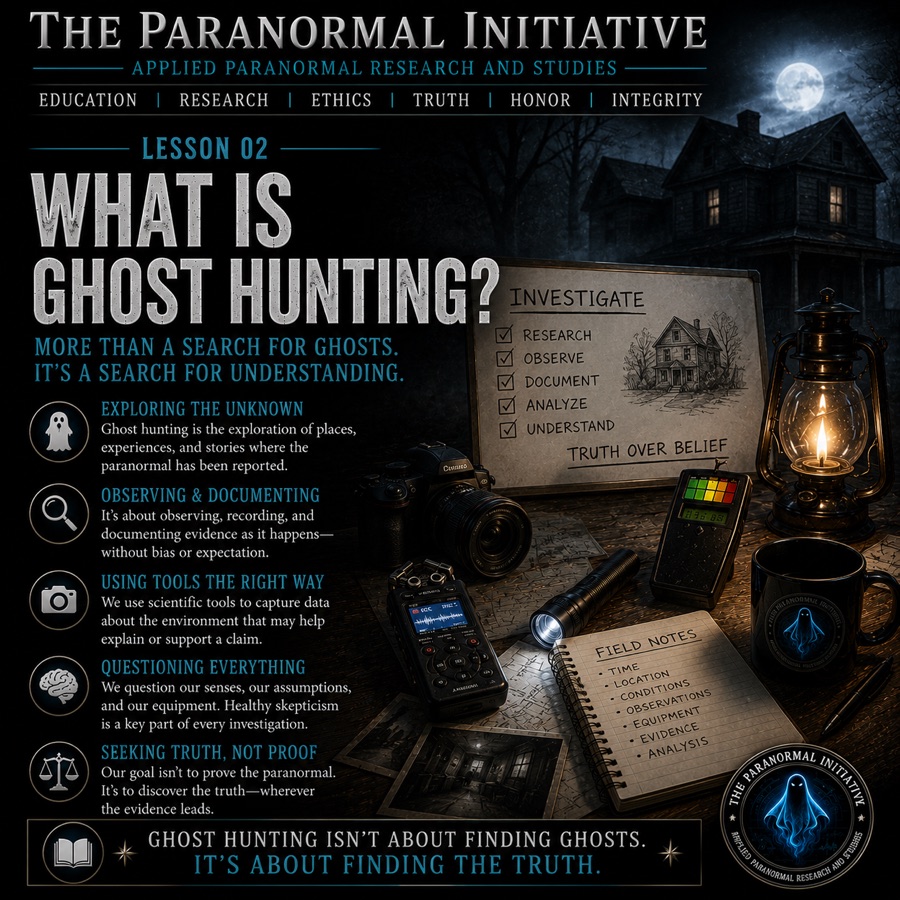
Ghostology 101 lesson 02 visual

Lesson Reading

Lesson Purpose

This lesson explores what ghost hunting is, how it developed, why millions of people enjoy it, how it differs from structured paranormal investigation, and where the two overlap. The goal is understanding, not judgment. Ghost hunting has introduced more people to the paranormal field than almost any other modern pathway. Respecting that reality is essential before moving into more structured methods.

Students should understand from the beginning that ghost hunting is not being treated here as something foolish or embarrassing. For many people, ghost hunting is the first time they walk into a historic location, pay attention to local folklore, listen carefully to a witness story, or wonder whether an experience could be documented. That beginning matters. At the same time, this course must be honest: curiosity by itself is not the same as investigation. A personal experience is not automatically evidence. A device reaction is not automatically communication. A frightening moment is not automatically paranormal.

The purpose of this lesson is to honor the doorway while clearly showing where the doorway leads. A student may begin as a ghost hunter because the subject is exciting, mysterious, social, historical, or personal. Ghostology 101 then teaches how to carry that interest into better questions, better records, safer field conduct, and more careful conclusions.

This lesson also gives students permission to begin where they actually are. Some students arrive with years of watching shows and visiting public events. Some arrive after a single personal experience. Some are skeptical but curious. Some are believers who want discipline. The classroom standard is the same for all of them: begin with curiosity, then build method around it.

Learning Objectives

By the end of this lesson, students should be able to explain what ghost hunting means and why the term is used differently by different people. They should be able to describe why people enjoy ghost hunting as a recreational, historical, social, and exploratory activity. They should also be able to distinguish ghost hunting from structured paranormal investigation without ridiculing either one.

Students should be able to identify where ghost hunting and investigation overlap: both may involve location history, observation, recording tools, witness stories, and unusual experiences. They should also be able to name where they separate: investigation requires permission, planning, baseline awareness, evidence handling, documentation, and restrained conclusions. Most importantly, students should recognize that ghost hunting can become a gateway into deeper study when curiosity is joined with method.

Students should also be able to describe the major historical forces that shaped modern ghost hunting: folklore and ghost stories, nineteenth-century psychical research, early investigation clubs, the growth of portable recording tools, the public-event and ghost-tour economy, and the early-2000s boom in equipment-centered ghost hunting. They should be able to explain why each stage added something useful while also creating new risks.

Introduction

Almost everyone who enters the paranormal field today encounters ghost hunting first. It appears on television, on YouTube, on TikTok, in podcasts, on social media, and in weekend events held at historic locations across the country. Ghost hunting has become the public face of paranormal exploration. It is approachable, exciting, and accessible. It requires no degree, no certification, and no prior experience. You can simply show up at a location, walk through with a group, and see what happens.

There is nothing wrong with this. Ghost hunting has introduced more people to history, investigation, and the paranormal than any textbook or lecture ever could. But ghost hunting is not the same as paranormal investigation. Understanding the difference is essential if you want to move from being a curious visitor to being a credible researcher. This lesson will help you understand ghost hunting on its own terms, appreciate what it offers, and recognize its limitations.

Think of ghost hunting as the moment when interest becomes action. A person who has always liked ghost stories decides to visit a historic prison. A family takes a recorder to a battlefield. Friends attend a public overnight event. A beginner walks through a cemetery and reads the names on old stones with new attention. These moments can awaken respect for history, curiosity about human experience, and a desire to learn. They can also create bad habits if the student learns to chase reactions instead of documenting conditions.

Ghostology 101 does not ask students to stop enjoying the mystery. It asks them to become more responsible with it. The central question for this lesson is simple: how do we keep the curiosity and wonder that bring people into ghost hunting while adding enough structure that the experience becomes useful, respectful, and reviewable?

That question matters because the field is crowded with different kinds of people: hobbyists, historians, spiritual seekers, skeptics, public-tour guests, equipment enthusiasts, podcasters, content creators, private investigation teams, and researchers. They do not all share the same goals. Ghostology 101 gives beginners a common foundation so they can understand those differences without becoming lost in them.

Defining Ghost Hunting

Ghost hunting does not have a single universal definition. The term is used differently by different people in different contexts. For some, it means visiting a historic location known for ghost stories and hoping to experience something unexplained. For others, it means conducting informal investigations with friends using basic equipment. For many, it simply means exploring old buildings, cemeteries, and landmarks with an interest in the strange and unknown.

Common characteristics of ghost hunting include: an emphasis on personal experience, informal or no methodology, minimal documentation, a focus on excitement and discovery, and a social or recreational component. None of these are inherently negative. They describe an activity that millions of people enjoy. The key is to recognize ghost hunting for what it is and to understand how it can evolve into more structured practice.

A useful beginner definition is this: ghost hunting is the informal search for possible paranormal experiences, usually at locations associated with ghost stories, hauntings, legends, deaths, tragedy, history, or public reputation. The word search matters. Ghost hunting often begins with the hope that something will happen. The investigator, by contrast, begins with a claim or question and asks what can be documented.

This difference does not make one group superior to another. It simply clarifies purpose. A ghost hunter may ask, "Will something happen tonight?" A paranormal investigator asks, "What is being reported, what conditions exist, what can be tested, and what can be responsibly concluded?" A student can enjoy ghost hunting while still learning to think like an investigator.

For this curriculum, ghost hunting should be understood as an entry practice. It may include visiting reportedly haunted locations, participating in public events, using basic equipment, recording audio, taking photographs, conducting informal vigils, or collecting local stories. It becomes stronger when students add permission, safety, location research, baseline notes, source preservation, and careful language.

A Brief History of Ghost Hunting

Ghost hunting did not emerge from a single source. It grew from many traditions: folklore passed down through generations, Victorian-era interest in spiritualism and seances, early psychical research societies, local ghost clubs, weekend explorers, and eventually television shows that brought the concept into mainstream culture.

Before modern equipment, ghost stories lived mainly through oral tradition, religious belief, folklore collections, local memory, newspaper accounts, seance culture, and witness testimony. A family might pass down a story about footsteps in an old farmhouse. A town might preserve a legend about a bridge, cemetery, battlefield, hotel, or abandoned building. These stories were not always investigated in a modern sense, but they created the cultural map that later ghost hunters would follow. They taught people that places can carry memory and that strange experiences are often tied to location, history, death, grief, or community identity.

In the nineteenth century, interest in spirits and survival after death grew alongside Spiritualism and the early study of psychical phenomena. Organizations such as the Society for Psychical Research investigated reports connected to apparitions, mediumship, telepathy, hauntings, and other unusual claims. This period matters because it introduced a more organized attempt to study extraordinary reports rather than merely repeat them as legends. It also created an important tension that still exists today: some people approached the subject through belief and spiritual practice, while others wanted records, controls, interviews, comparisons, and careful case collections.

Early clubs and societies helped shape the idea that ghost reports could be gathered, discussed, and investigated. The Ghost Club in London and the Society for Psychical Research are important reference points because they show that modern ghost hunting did not appear out of nowhere. It grew from a longer history of people trying to organize strange reports into something that could be studied. Students should notice the difference between this older psychical research tradition and many modern casual ghost hunts. The older tradition often centered on testimony, case reports, correspondence, and controlled sittings. Modern ghost hunting often centers on location visits, recording devices, public events, and immediate experience.

Harry Price is one of the major early figures students should know. He was a British psychic researcher and investigator associated with high-profile haunted-location work, fraud exposure, and the use of investigative equipment. His career is useful for teaching because it contains both promise and warning. On one hand, Price helped make haunted-location investigation public, visible, and equipment-minded. On the other hand, his work reminds students that public attention can complicate credibility. A famous case may attract interest, but fame does not replace documentation.

By the early twentieth century, investigators were already experimenting with tools and test conditions. Cameras, sealing methods, measuring devices, electrical controls, fingerprint materials, and other practical instruments were used in attempts to document claims or expose fraud. This is important because equipment-centered ghost hunting is not only a twenty-first-century invention. The tools have changed, but the desire is older: people wanted a way to move beyond testimony and create records that could be examined later.

Early ghost hunting was also informal. Small groups of people would visit reportedly haunted locations, share stories, and look for unusual experiences. As equipment became more affordable, hobbyists began carrying audio recorders, cameras, and basic environmental sensors. Online communities formed around shared experiences, and the hobby grew rapidly. The internet made it easier for small teams to publish findings, compare methods, advertise investigations, and build communities around local haunted places.

The early 2000s created a major turning point. Paranormal television, public ghost hunts, websites, forums, podcasts, DVDs, books, and affordable consumer electronics all came together. Many people saw teams walking through dark historic locations with EMF meters, cameras, audio recorders, thermal tools, and night vision equipment, and they realized they could try some version of that themselves. Equipment businesses grew because beginners wanted tools that seemed to make the invisible measurable. Some teams expanded rapidly, and ghost-hunting tours and public events became more common.

This period also changed public expectations. A person who once might have told a family story privately could now post a clip online. A local legend could become a tourist attraction. A haunted location could sell overnight access. A team could become known through a website or channel. This made the field more accessible, but it also created pressure to produce dramatic moments. Students should understand this as a historical development, not simply a complaint. When a field becomes public, commercial, and media-friendly, its methods must become stronger or its conclusions will become weaker.

Commercial ghost tours became another important branch of modern ghost hunting. Tours can preserve local stories, introduce visitors to architecture and history, support historic sites, and give beginners a safe way to enter the subject. They can also blur the line between education, entertainment, legend, and evidence. A responsible student should enjoy a good ghost tour while still asking what parts are documented, what parts are folklore, and what parts are shaped for atmosphere.

Safety also belongs in the history. As ghost hunting became more popular, more people entered old, dark, abandoned, or privately owned locations without fully understanding permission, structural hazards, falls, law enforcement concerns, wildlife, weather, or confrontation risks. Ghostology 101 treats this as a core lesson: curiosity does not cancel safety. A location being spooky, famous, or tempting does not make it legal or wise to enter. The history of the field includes injuries and dangerous incidents, and students should learn from that before they ever plan a site visit.

Today, ghost hunting exists alongside more structured paranormal investigation, public tourism, content creation, historical storytelling, spiritual exploration, and academic parapsychology. These areas sometimes overlap, but they are not identical. Some practitioners remain hobbyists. Others evolve into serious researchers. Both paths can be valid when they are honest about their purpose. The key is transparency: if the goal is entertainment, say so; if the goal is education, teach responsibly; if the goal is investigation, document like the work may be reviewed years later.

It is also important to understand that ghost hunting changed as technology changed. In earlier periods, people relied on personal testimony, written accounts, seances, newspaper stories, photographs, and local memory. Later, portable tape recorders, camcorders, night vision, digital cameras, EMF meters, phone apps, streaming video, and social media all changed how people looked for experiences and how quickly those experiences were shared. Every new tool created new possibilities and new false positives.

This history gives students humility. The way people investigate today is not the only way humans have approached ghost stories. Older traditions often preserved meaning, place, and memory. Modern methods add recording and measurement, but they also add performance pressure. A responsible student learns from both: respect the story, but do not let the story replace the evidence.
Why People Enjoy Ghost Hunting

People enjoy ghost hunting for many reasons. Adventure and the thrill of exploring abandoned or historic locations. Curiosity about the unknown and the possibility of experiencing something unexplained. An appreciation for history and old buildings. A love of photography and storytelling. The opportunity to spend time with friends or family in a shared experience. The search for answers to personal questions about life, death, and consciousness. The simple pleasure of being in a place with atmosphere and history.

None of these reasons should be dismissed or ridiculed. Enjoyment is not something to criticize. The goal of this program is not to take away what people love about ghost hunting. The goal is to show how adding structure, documentation, and critical thinking can deepen that enjoyment and produce more meaningful results.

For some students, ghost hunting is about adventure. They enjoy the late night, the old building, the flashlight beam, the silence, and the possibility that something unexpected might occur. For others, it is about history. A reportedly haunted location may be a prison, battlefield, theater, hotel, hospital, school, cemetery, or private home with layers of human memory. The ghost story becomes a doorway into learning who lived there, who worked there, who suffered there, who died there, and what the community remembers.

For some, ghost hunting is social. It creates community among people who are willing to talk about questions that ordinary conversation often avoids. For others, it is personal. A student may have had an experience they cannot explain, or they may be carrying grief, religious questions, fear, skepticism, or curiosity about survival after death. The instructor should avoid shaming any of these motivations. The proper teaching move is to ask: how can this motive be handled responsibly?

People also enjoy the sense of participation. Ghost hunting lets a beginner feel that they are not only reading about mystery but stepping into it. That can be powerful. A person may leave a public event with a stronger interest in history, photography, audio recording, psychology, folklore, or environmental science. When the experience is guided responsibly, ghost hunting can become the first doorway into serious study.

Television and Entertainment

Paranormal television has had both positive and negative impacts on the field. On the positive side, it has introduced millions of people to historic locations, inspired preservation efforts, encouraged interest in investigation, and created a community of enthusiasts who share a common passion. Many serious investigators started because a television show sparked their curiosity.

On the negative side, television has also created unrealistic expectations. Real investigations are often quiet, uneventful, and inconclusive. Television compresses hours of nothing into minutes of drama. Equipment readings that would be questioned in a real investigation are presented as definitive evidence. The pressure to produce entertaining content can lead to exaggeration, staging, and the prioritization of drama over accuracy.

If you came to this field through television, that is fine. The key is to recognize that television is entertainment, not education. Use it as inspiration, but not as a training manual.

Students should learn to watch paranormal entertainment with a trained eye. Ask what was shown, what was omitted, how much time passed, whether controls were used, whether original files were preserved, whether a device was explained correctly, whether witnesses were asked leading questions, and whether the conclusion was stronger than the evidence allowed. These questions do not ruin the show. They train the mind.

The same standard applies to online content. Short clips are powerful because they remove context. A ten-second sound can feel convincing when the viewer does not see the hour before it, the room layout, the people nearby, the traffic outside, or the editing choices. A responsible student learns to enjoy content without confusing content with a case file.

For live instruction, this section should be handled carefully. The point is not to attack shows, creators, or public events. Many students are here because those things inspired them. The point is to teach students the difference between inspiration and methodology. Entertainment can open the door; it cannot be the whole training program.

Ghost Hunting Versus Paranormal Investigation

Ghost hunting and paranormal investigation share some surface similarities, but they are fundamentally different activities. Ghost hunting asks: can we experience something unusual? Paranormal investigation asks: what happened, what evidence supports that, and what alternative explanations exist?

Ghost hunting is typically experience-driven. The goal is to see, hear, or feel something that cannot be explained. Documentation is minimal. Methodology is informal. Conclusions are often based on personal impressions rather than systematic review. Paranormal investigation is evidence-driven. The goal is to document, analyze, and report findings with enough rigor that others can evaluate them.

Neither approach should be ridiculed. Ghost hunting has value as a recreational and exploratory activity. Paranormal investigation has value as a method for producing credible findings. Many of the best investigators started as ghost hunters. The transition from one to the other is a natural progression, not a rejection of the past.

The practical difference can be seen in what happens after an event. If a group hears a knock during a ghost hunt, they may react, talk about how it felt, ask questions into the room, and remember the moment as exciting. If a trained investigator hears the same knock, they still may feel excitement, but they also ask for the time, location, recorder status, team positions, building conditions, weather, possible plumbing, exterior traffic, and whether the sound repeats. The experience is not ignored. It is protected by documentation.

Students should not think of this as losing wonder. Investigation does not remove mystery. It removes unnecessary confusion. When ordinary explanations are checked, the remaining unknown becomes more meaningful, not less.

A useful classroom comparison is this: ghost hunting is often event-centered, while investigation is process-centered. An event-centered approach asks, "What happened tonight?" A process-centered approach asks, "What was claimed, how did we prepare, what did we document, what did we test, what did we preserve, and what can we say responsibly afterward?" Both may happen in the same building, but they produce different kinds of records.

Common Ghost Hunting Activities

Ghost hunting encompasses a wide range of activities. Visiting historic locations known for ghost stories. Participating in public ghost hunts or paranormal events. Conducting night investigations with small groups. Using equipment such as EMF meters, recorders, and cameras. Taking photographs and recording audio in reportedly active locations. Joining ghost walks or tours led by local historians. Exploring cemeteries, battlefields, and old buildings. Collecting stories from locals and researching location history. Attending paranormal conferences, expos, and meetups. Weekend trips to famous haunted locations.

Each of these activities can be enjoyable and meaningful on its own. Adding structure to them does not diminish the enjoyment. It enhances the experience by producing more reliable and shareable results.

For example, a cemetery walk can remain respectful and educational if students understand boundaries: visit during permitted hours, do not disturb graves, avoid sensational claims about the dead, document names and dates accurately, and research records before repeating legends. A public ghost hunt can remain fun while still using logs, time stamps, team positions, and environmental notes. A haunted hotel overnight can remain exciting while still documenting room conditions, sounds from other guests, HVAC cycles, and hallway traffic.

The lesson is not that every casual outing must become a full formal investigation. The lesson is that every outing can practice at least one responsible habit. A beginner can start with a notebook. Then they can add a baseline recording. Then a location history summary. Then a simple evidence log. Growth happens one habit at a time.

Students should also recognize that some activities are not appropriate without permission or training. Abandoned buildings, private property, active businesses, hospitals, schools, tunnels, rooftops, construction sites, and condemned structures introduce legal and physical risks. A responsible ghost hunter chooses access, safety, and respect over thrill.

Equipment Commonly Used in Ghost Hunting

Ghost hunters often use basic equipment to document their experiences. Common tools include flashlights, digital audio recorders, EMF meters, thermometers, motion sensors, cameras, video recorders, spirit boxes, and trigger objects. These tools are introduced here only to show what ghost hunters commonly use. Detailed instruction on how each tool works, what it measures, and how to interpret its readings comes later in the Equipment Studies track. For now, simply recognize that equipment is a tool for documentation, not a detection device for spirits.

A flashlight provides light and can also reveal shadows, dust, surfaces, exits, and hazards. An audio recorder captures sound, but it also captures handling noise, distant speech, fabric movement, HVAC, traffic, insects, electrical hum, and compression artifacts. An EMF meter detects electromagnetic fields, not ghosts. A thermometer measures temperature, but temperature changes may come from airflow, exterior walls, stone, vents, open doors, humidity, or equipment placement. A camera records light, but it also records reflections, focus issues, motion blur, insects, dust, lens flare, and compression.

Students should begin with one rule: know what a tool measures before using the result in a claim. If you cannot explain what a tool measures, what can trigger it, and what its false positives are, you should not use it as evidence. Equipment can make ghost hunting more interesting, but misunderstood equipment can also create false confidence.

Another beginner rule is to avoid calling a tool a "ghost detector." That phrase may be common in marketing or casual conversation, but it teaches the wrong lesson. A device may detect temperature, electromagnetic fields, motion, vibration, radio signals, sound pressure, light, or image data. The investigator still has to decide what the reading means in context. The device does not make the conclusion for you.

Common Misconceptions About Ghost Hunting

Several misconceptions surround ghost hunting. One is that ghost hunting proves the existence of ghosts. Ghost hunting can produce personal experiences, but personal experiences are not the same as evidence. Another is that every old building must be haunted. Age and atmosphere are not the same as paranormal activity. A creaky floorboard is a creaky floorboard until evidence suggests otherwise.

Some believe that equipment identifies ghosts directly. It does not. Equipment measures physical conditions. The interpretation is the investigator's responsibility. Some believe that fear or strange feelings indicate paranormal presence. Fear is a natural response to darkness and uncertainty. It does not confirm paranormal activity. Some believe that every sound or shadow is meaningful. Most have ordinary explanations once investigated. Some believe that if nothing happens, the investigation failed. Documenting that nothing unusual occurred is a valid and valuable result.

Another misconception is that skepticism means closed-mindedness. In this curriculum, skepticism is not ridicule. Skepticism means the student cares enough about the claim to test it. A person who accepts everything immediately is not being respectful to the witness; they may be building a conclusion on weak ground. A person who rejects everything immediately is also not being respectful; they may be refusing to examine what was actually reported. Responsible ghost hunting lives between those extremes.

Students should also avoid the idea that famous locations are automatically stronger cases. A well-known haunted location may have history, atmosphere, and many reports, but reputation can also create expectation. The more famous a location is, the more students must ask whether people are responding to the evidence or to the story they brought with them.

A final misconception is that more equipment automatically means a better investigation. A table full of devices can look impressive, but if no one understands placement, calibration, interference, timestamps, or false positives, the equipment may create more confusion than clarity. A notebook used well can be more valuable than a full kit used poorly.

Strengths of Ghost Hunting

Ghost hunting has genuine strengths that should be acknowledged. It encourages an appreciation for history and historic preservation. It builds community among people who share a common interest. It nurtures curiosity about the unknown. It provides a gateway into deeper learning about investigation methods. It promotes exploration of local history and architecture. It creates opportunities for learning about equipment, documentation, and research. It introduces people to the idea that strange experiences can be studied rather than simply feared.

Another strength is accessibility. A person does not need expensive equipment to begin learning. They can start by reading about a location, visiting respectfully, taking notes, listening carefully, and comparing stories to records. This makes the field approachable for beginners and allows students to grow through practice rather than waiting until they own a full kit.

Ghost hunting can also preserve local memory. Many communities have stories attached to old buildings, bridges, schools, theaters, cemeteries, hotels, and private homes. Some stories are inaccurate, but others point toward real history that might otherwise be forgotten. A careful ghost hunter can become a better student of place, and that respect for place is one of the healthiest reasons to enter the field.

Ghost hunting can also help students learn humility. A person may enter a location expecting dramatic activity and leave with nothing unusual. That result teaches patience. A person may enter expecting nothing and leave with a question they cannot explain. That teaches openness. Either outcome can be useful when the student is willing to document honestly.

Limitations of Ghost Hunting

Ghost hunting also has limitations that must be understood. Expectation can shape experience, leading people to interpret ambiguous events as paranormal. Documentation is often minimal or absent, making it impossible to review findings later. Methodology is often inconsistent, making results difficult to compare across investigations. Confirmation bias can cause investigators to notice what supports their beliefs and ignore what contradicts them. Equipment is often used without understanding what it actually measures. Social media pressure can encourage exaggeration and dramatization. The focus on entertainment can conflict with the goal of honest investigation.

None of these limitations make ghost hunting wrong. They simply mean that ghost hunting produces different kinds of results than structured investigation. Understanding these limitations is the first step toward overcoming them.

The greatest limitation is often the absence of a clear question. If a team enters a location only hoping for activity, every sound can become important and no sound can be evaluated properly. A structured question changes the work. Instead of "Is this place haunted?" the team might ask, "Are the reported footsteps connected to a specific hallway, time, temperature condition, building system, or witness pattern?" That question can be investigated.

Another limitation is group influence. In a dark location, one person's reaction can spread quickly. If one person says, "I feel something," others may begin scanning for evidence that supports the statement. A student must learn to document individual experiences separately before group discussion turns uncertain impressions into a shared story.

Commercial pressure is another limitation. When locations, events, channels, tours, or teams depend on activity to attract attention, there can be pressure to make an ordinary night sound extraordinary. Students must learn that credibility grows when investigators are willing to report uneventful nights, inconclusive findings, and ordinary explanations.

Becoming a Better Ghost Hunter

If you enjoy ghost hunting and want to improve your practice, start with small changes. Take notes during your visits. Record the date, time, location, conditions, and what you observed. Learn the history of the locations you visit before you arrive. Respect the locations, the property owners, and any clients or visitors. Learn how your equipment actually works and what it measures. Document your observations before interpreting them. Question your own assumptions and ask what alternative explanations might exist. Accept that not every question will have an answer. Keep learning. Every investigation, whether casual or structured, is an opportunity to improve.

A better ghost hunter does not have to become cold or overly technical. They become more aware. They notice exits, weather, traffic, people, lighting, loose doors, reflective surfaces, animal sounds, and building systems. They write exact times instead of vague impressions. They ask open questions instead of leading ones. They save original media files. They do not edit a clip before preserving the source. They avoid telling frightened people that a place is haunted when the evidence has not earned that conclusion.

The improvement path is simple: prepare before you arrive, observe while you are there, preserve what you collect, and review it with patience afterward. Each step reduces confusion and increases credibility.

Students can also improve by learning to ask better questions. Instead of asking, "Is there a ghost here?" ask, "What has been reported here?" "Who reported it?" "When did it happen?" "What else was happening in the building?" "What records support the location story?" "What normal causes would produce the same report?" Better questions turn ghost hunting into education.

Practical Scenarios

Scenario 1: The Family Ghost Hunt. A family visits a historic battlefield with a camera and a recorder. They walk the grounds at dusk, capture some audio, and review it later. They hear what sounds like a whisper. This is a meaningful family experience. But the whisper might be wind, a distant conversation, or radio interference. Without a baseline recording or environmental notes, the sound cannot be evaluated. A small improvement: record a quiet control sample at the start of the visit for comparison.

Scenario 2: The Historic Prison Tour. A group joins a public ghost hunt at an old prison. The guide tells stories, the group uses equipment, and several people feel cold spots. The experience is memorable. But the cold spots could be drafts from the building's structure, not paranormal activity. A small improvement: bring a thermometer and note the temperature in different areas. Compare readings to see if the cold spots correspond to windows, vents, or stone walls.

Scenario 3: The Weekend Paranormal Event. A team spends the night at a reportedly haunted inn. They set up cameras, record audio, and take turns doing vigils. They capture a few sounds and a shadow on video. The shadow could be a car headlight passing outside, a reflection, or a team member moving. A small improvement: log the position of all team members during each vigil and note any external light sources.

Scenario 4: The YouTube Investigation. A content creator investigates an abandoned school. The final video shows dramatic EVP, sudden temperature drops, and moving shadows. The video gets thousands of views. But editing can make any location look active. A small improvement: include unedited segments in the video description and be transparent about what was cut.

Scenario 5: The Historic Hotel Overnight. A group stays in a reportedly haunted hotel room. They experience strange sounds, a flickering light, and a feeling of being watched. The sounds could be plumbing, the flickering could be a loose bulb, and the feeling could be heightened awareness in an unfamiliar environment. A small improvement: document the room's normal sounds by recording five minutes of silence upon arrival as a baseline.

Scenario 6: The Local Ghost Tour. A guide tells a dramatic story about a downtown building. The group enjoys the atmosphere, but a student notices that the story includes no dates, names, or records. A small improvement: write down the claim respectfully, then check newspapers, property records, historical society files, and library archives later. The tour can be enjoyed as folklore while still being researched as history.

Scenario 7: The Abandoned House Temptation. Friends discover a vacant-looking house with stories attached to it and want to enter at night. A responsible student says no unless permission and safety are confirmed. Curiosity does not override trespassing laws, structural danger, or the possibility that someone still owns or occupies the property. The correct investigation begins with ownership research and permission, not entry.

Common Misconceptions

"Ghost hunting proves ghosts exist." Ghost hunting can produce personal experiences, but personal experience is not the same as evidence. Proof requires documentation that others can review.

"Every old building is haunted." Old buildings make sounds. They settle, creak, and have drafts. These are not evidence of paranormal activity unless they cannot be explained.

"Equipment identifies ghosts." Equipment measures physical conditions. An EMF meter detects electromagnetic fields. A thermometer detects temperature. Neither detects spirits.

"Fear means something paranormal is present." Fear is a natural response to darkness, uncertainty, and unfamiliar environments. It does not confirm paranormal activity.

"Every sound or shadow is meaningful." Most sounds and shadows have ordinary explanations. Investigation is the process of finding those explanations before concluding that something is unexplained.

"If nothing happens, the investigation failed." An investigation where nothing unusual occurs is not a failure. It is data. Documenting a location as having no anomalous activity is a valid result.

"A ghost tour story is the same as history." A ghost tour may contain real history, folklore, interpretation, performance, or a mixture of all four. Treat it as a lead, not a final source.

"A public ghost hunt is automatically an investigation." A public event can teach useful habits, but it may not have the privacy, controls, documentation, or site access needed for a complete investigation.

Strengths in Practice

In practice, the strengths of ghost hunting appear when students let curiosity lead them toward better learning. A weekend visit to a haunted location can become a history lesson. A ghost walk can become an exercise in separating documented facts from local legend. A cemetery visit can become a lesson in respect, genealogy, public records, and community memory. A public ghost hunt can introduce students to equipment, location safety, team communication, and the value of taking notes.

The instructor should help students name these strengths because they are often the healthiest parts of the field. Curiosity, community, history, and wonder are not problems. They become problems only when they are allowed to replace method. When handled well, these strengths can carry a student into deeper research and more ethical investigation.

Instructors can make this section interactive by asking students to list a location they would like to visit and then identify one historical question, one safety question, one documentation question, and one possible ordinary explanation they would bring with them. This keeps the energy of ghost hunting while immediately training investigative discipline.

Limitations in Practice

In practice, the limitations of ghost hunting appear when the group cannot explain how it reached a conclusion. If the only record is "we heard something," the event cannot be reviewed. If no one logged the time, location, people present, weather, equipment status, or possible ordinary sources, the event remains a memory rather than a piece of evidence. It may still be meaningful to the people who were there, but it cannot carry much investigative weight.

Another practical limitation is that ghost hunting often begins with a reputation. A location is said to be haunted, so the group arrives already expecting activity. That expectation shapes attention. Students should learn to ask what they would notice if the same sound happened in a normal office, a grocery store, or their own kitchen during the day. This mental exercise helps separate atmosphere from evidence.

Students should also practice identifying missing information. If a story says, "People hear footsteps upstairs," the missing information may include time, frequency, witnesses, building materials, heating system, occupancy, neighboring rooms, animals, weather, floor condition, and whether anyone recorded the sound. Missing information is not a weakness in the student. It is the investigation beginning.

Next-Step Habits

Students should leave this lesson with a beginner action plan. First, carry a notebook or digital log and use it every time. Second, write the time and location before writing the interpretation. Third, research one documented fact about the location before repeating a legend. Fourth, ask what ordinary explanations should be checked before using paranormal language. Fifth, preserve original audio, photo, and video files before sharing edited versions.

These habits are small enough for a beginner and strong enough to change the work. They are also the bridge into the next lesson. Ghost hunting becomes paranormal investigation when these habits are organized into a method: permission, planning, observation, documentation, analysis, and responsible reporting.

For practice, students should choose one habit from this list and use it during the next week in a non-paranormal setting. Document an ordinary sound in the house, a temperature change in a room, a reflection in a window, or a story told by a family member. Practicing on ordinary events makes the method easier to use when the setting feels unusual.

Student Activity โ€” My First Responsible Ghost Hunt

Design a respectful investigation plan for a location you would like to visit. Include your goals for the visit. Identify the location and describe why you chose it. Research the location's history briefly and note what you find. List safety considerations and permission requirements. List the equipment you would bring and what each piece would be used for. Describe how you would document your observations. Describe what outcomes you would consider meaningful, including inconclusive results. This plan will help you practice thinking like an investigator before stepping into the field.

Your plan should include three separate lists: what you hope to experience, what you can actually document, and what ordinary explanations you must be ready to consider. This separation is important. Hope belongs in the student's private motivation. Documentation belongs in the case record. Ordinary explanations belong in the investigation plan. When those three things are separated, the student is less likely to confuse a meaningful night with a proven claim.

After writing the plan, add a short conduct statement. How will you treat the location? How will you treat other visitors or witnesses? How will you speak if someone becomes frightened? What will you refuse to claim without evidence? This turns the activity from a trip plan into the first draft of an investigator's code.

Finally, add a short history plan. Identify where you would look for background information: the location's official website, local library, historical society, newspaper archive, cemetery database, property records, maps, city directories, or oral history interviews. Even a beginner-level ghost hunt becomes more meaningful when the student knows where the story came from.

Reflection Questions

1. What is the difference between having an experience and gathering evidence? Can you have both at the same time, or do they require different mindsets?

2. Have you ever participated in a ghost hunt or similar activity? What did you enjoy about it? What would you have done differently with the knowledge you have now?

3. How do you think television and social media have shaped public expectations about paranormal investigation? What expectations might be unrealistic?

4. Is it possible to enjoy ghost hunting while also practicing responsible documentation? How would you balance both?

5. What would it mean for you to move from being a casual ghost hunter to being a more structured investigator? What would you gain? What might you miss?

6. How would you respond if a friend invited you to a ghost hunt and the group was treating every sound as evidence of spirits?

7. What is the value of documenting nothing? Can an uneventful night still be a successful investigation?

8. How should a student treat a story heard on a ghost tour: as history, folklore, a research lead, or evidence? Explain your answer.

9. What safety problems can appear when beginners chase haunted locations without permission or planning?

10. How did equipment change ghost hunting, and why did it also create new false positives?

Key Takeaways

Ghost hunting is often the beginning, not the destination. Curiosity is valuable and should be nurtured. History matters and deserves respect. Respect for locations, owners, witnesses, teammates, visitors, and the public is essential. Evidence requires documentation. Learning never stops. Ghost hunting and investigation can coexist. The goal is not to abandon one for the other but to grow from one into the other.

The strongest student takeaway is this: an experience can matter without being proof. A ghost hunt can be enjoyable without being careless. A location can feel mysterious without requiring a paranormal conclusion. The responsible student learns to hold all of those truths at the same time.

History also matters. Modern ghost hunting grew from folklore, spiritualism, psychical research, clubs, public events, commercial tours, recording technology, internet communities, and equipment culture. Knowing that history helps students understand why the field looks the way it does today and why Ghostology 101 insists on safety, documentation, and careful language.

Repository Connections

For further reading, see the Investigation Compendium for standards on moving from casual exploration to structured investigation. See the Terminology Reference for definitions of terms used in this lesson. For equipment basics, the Equipment Manual provides an introduction to common tools.

For outside historical overview reading, students may compare this lesson with the Wikipedia overview of ghost hunting. Use it as a broad orientation source, not as the academy's final authority. When using outside sources, separate overview material from documented primary sources, local records, and the academy manuals.

Next Lesson Connection

Now that you understand ghost hunting as a doorway, the next lesson defines paranormal investigation as a discipline. You will learn what separates casual searching from structured inquiry, how investigations are planned and conducted, and why that distinction matters for producing credible results.

Field Application

In the field, what is ghost hunting? becomes visible through small decisions. The investigator decides what questions to ask, what details to write down, what assumptions to avoid, and what language to use when speaking with others. A student who understands this lesson should be able to enter a location and behave differently because of it. The learning should change conduct, not simply add information. A group visits a famously haunted location and hears a bang upstairs. In a casual ghost hunt, the group may react emotionally and declare that something answered them. In a responsible learning environment, that same event becomes a teaching moment. Was anyone upstairs? Was the building settling? Was there wind? Did a pipe knock? Was the sound captured on more than one recorder? Was the time logged? Ghost hunting notices the moment; investigation studies it. The point of the example is not to give the student a script to memorize. It is to show how the concept works under real pressure. Fieldwork is rarely neat. People interrupt each other. Equipment fails. Weather changes. A witness remembers something after the interview is over. A teammate gets excited. A client asks for certainty. A responsible investigator uses the foundation from this lesson to stay oriented when the situation becomes messy. When teaching this section live, ask students to describe what they would do first, second, and third. If they jump straight to a paranormal explanation, bring them back to the process. What exactly was reported? Who reported it? When did it happen? What changed in the environment? What was documented? What can be checked? That sequence is the difference between curiosity and investigation.

Documentation Standard

Documentation is the way this lesson becomes reviewable. The student should not merely say that they understand the concept. They should be able to record it in a case file. Notes should include the claim, the setting, the people present, the relevant environmental conditions, the questions asked, the actions taken, and the limits of what was learned. If a later reviewer cannot reconstruct the reasoning, the documentation is incomplete. Take a ghost hunting story from television, YouTube, a local legend, or your own experience. Rewrite it as an investigation question. Identify the claim, the location, the reported event, the witnesses, the missing information, and the ordinary explanations that would need to be checked. This optional practice can be discussed, demonstrated, or written privately. The student should focus on clear separation between observation and interpretation. The goal is to build the habit of writing like an investigator rather than narrating like a storyteller. A good entry should allow someone who was not present to understand what happened and how the student thought through it. The documentation should also include what was not known. Beginners often omit uncertainty because they think it makes them look unprepared. In reality, uncertainty is one of the most professional things an investigator can preserve. Write down what remains unknown, what still needs to be checked, and what would be required before a stronger conclusion could be reached.

Common Failure Points

The common failure is believing that excitement makes an event meaningful. Excitement is a human reaction, not evidence. A moment may feel powerful because the location is dark, the story is emotional, or the group is already expecting activity. The investigator respects the excitement but documents the event independently of it. This mistake is common because the paranormal field rewards certainty, confidence, and dramatic language. Social media rewards the strongest claim, not the most careful one. A classroom, however, must reward process. The student should learn to recognize when excitement is pushing them ahead of the evidence. Another common failure is treating the lesson as theory only. A student may agree with the principle in class but abandon it during a case because the situation feels unusual. The entire purpose of Ghostology 101 is to make the principle strong enough to survive the field. The lesson should therefore include examples, examples and optional practice prompts that invite the student to apply the idea rather than simply admire it. The instructor should also watch for language that hides assumptions. Words such as "definitely," "obviously," "evil," "spirit," "energy," "proof," and "debunked" can all be useful in some contexts, but they can also smuggle conclusions into the record. Students should be trained to replace conclusion-heavy language with descriptive language whenever the evidence is still being evaluated.

Foundation Deepening โ€” Why This Lesson Matters

Ghost hunting must be understood as an entry point rather than the whole discipline. This lesson deserves extra depth because it shapes how students will interpret every later topic in Ghostology 101. The early lessons are not merely introductory material to get through quickly. They establish the student's habits of attention. If a student learns to think carefully here, that habit will carry into equipment use, evidence review, client communication, and final reporting. The instructor should emphasize that a foundation lesson is successful when it changes the way a student notices details. Students should begin asking better questions, using more careful language, and recognizing when their own expectations are affecting their interpretation. The goal is not to make the student less curious. The goal is to make curiosity disciplined enough to be useful.

Beginner Misinterpretations

Beginners often misunderstand this topic because they enter the field through stories, videos, television, social media, or personal experiences. Those sources can inspire learning, but they often skip the slow middle work: defining terms, documenting context, testing ordinary explanations, and communicating uncertainty. A student may know many ghost stories and still not know how to investigate one. The course should therefore ask students to identify where their existing ideas came from. Was it a family story, a television show, a frightening experience, a historic location, a cemetery visit, a religious belief, or an online creator? Tracing the source of an idea helps the student understand whether they learned a method or simply inherited an expectation.

Case File Translation

Every concept in this lesson should be translated into a case-file habit. The question is always: what would this look like in notes? If the answer cannot be written clearly, the student has not fully learned the concept. A responsible case file turns vague interest into organized information. For practice, students should write a short case-file entry that applies this lesson. The entry should avoid dramatic language and include only what can be responsibly stated. It should distinguish between what someone reported, what the investigator observed, what remains unknown, and what follow-up would be needed.

Ethical Connection

Ethics appear even in this foundation lesson. The way an investigator thinks affects how they treat witnesses, locations, teammates, and the public. If the investigator wants excitement more than clarity, people can be harmed. If the investigator wants to prove a belief more than understand a claim, evidence can be distorted. If the investigator wants attention more than accuracy, privacy can be violated. Students should understand that ethical investigation begins before the first client call or field visit. It begins in the student's own expectations. A person who practices careful thinking in the classroom is more likely to practice careful conduct in the field.

Manual and Reference Connection

This lesson should be connected to the larger reference library. The HTML manuals are not separate from the course; they are the extended library behind it. When a concept appears in this lesson, students should know where they can study it more deeply. Terminology belongs with the Terminology Reference. Procedure belongs with the Investigation Compendium. Evidence questions belong with the Evidence Compendium and Forensic Analysis Compendium. For independent study, students should open at least one linked reference and notice how the reference expands the lesson. This trains them to use the curriculum as a research system rather than as a single page to read once.

Reflection Readiness

Students are ready to move on when they can explain the lesson without relying on slogans. They should be able to define the main idea, give a practical example, identify a beginner mistake, describe a professional observation, and explain why the topic matters to ethical investigation. If a student can only repeat a phrase but cannot apply it to a scenario, they need more practice. Application is the standard. Ghostology 101 is not built to create passive readers. It is built to create students who can think through a claim step by step.

Case File Standard

A finished student should be able to create a case-file entry that reflects this lesson. The entry should include a claim summary, a context note, at least three possible ordinary explanations, one question for a witness, one observation that should be made on site, and one sentence explaining what would be irresponsible to conclude too early. This case-file entry does not need to be long, but it must be precise. Precision matters because future reviewers will not have access to the student's memory. They will only have the record. The case file should therefore preserve what was actually known at the time and what still needed to be checked. The instructor should reject vague entries. "Check for normal stuff" is not enough. "Check HVAC timing, loose doors, hallway airflow, exterior traffic, plumbing expansion, and team movement during the reported event" is much better. Ghostology 101 should teach students to replace vague skepticism with specific investigation.

Readiness Check

Before moving forward, students may use a reflection check in their personal notes. First, summarize this lesson in three sentences. Second, describe one way the lesson could prevent a false conclusion. Third, describe one way the lesson could help a frightened witness. Fourth, explain how the lesson connects to documentation. These questions matter because they connect knowledge to responsibility. A student who can define a concept but cannot explain how it protects people has only learned half the lesson. The academy standard is higher. Students must understand that method, ethics, and communication are connected. The final reflection can be phrased in the student's own words. If the response sounds copied from the lesson, the student should try again. Real readiness means the student can carry the idea into a new situation and still use it correctly.

Casebook Expansion Exercise

The following casebook exercise should be used to deepen this lesson into full textbook-level study. A community theater reports several unusual experiences: actors hear footsteps on the stage after closing, a volunteer sees a shadow near the balcony, one room feels colder than the rest of the building, and a board member believes the activity is connected to a former performer. Students should approach the case through the specific lens of what is ghost hunting?. First, students should identify what is actually being reported. There are auditory claims, visual claims, environmental claims, historical claims, and interpretive claims. Each one belongs in a different part of the case file. The footsteps are not the same as the shadow report. The cold room is not the same as the historical story. The board member's belief may matter as context, but it is not proof. This sorting process teaches students to prevent one dramatic narrative from swallowing several separate observations. Second, students should write the first five questions they would ask. The questions should be open-ended and non-leading. Instead of asking, "Do you think the former performer is haunting the theater?" they might ask, "When did you first hear the footsteps?" "Where were you standing?" "Who else was present?" "What was happening in the building at the time?" "Has any maintenance work been done near the stage or balcony?" Good questions widen the investigation. Leading questions narrow it too soon. Third, students should list ordinary explanations without using them as dismissals. Stage buildings have pipes, rigging, HVAC systems, settling wood, exterior traffic, animals, old wiring, lighting changes, reflective surfaces, and acoustical surprises. A responsible investigator does not say, "It was just the building," without checking. The proper statement is, "These are the ordinary causes we need to test before considering anything unexplained." Fourth, students should write one professional paragraph that could appear in a preliminary case file. The paragraph should include the reported claims, the current limits of knowledge, the next investigative steps, and cautious language. It should not use words like proof, ghost, demon, portal, or confirmed. The exercise is not about draining meaning from the case. It is about preserving meaning without replacing investigation with assumption. This casebook exercise can be repeated with different locations: a cemetery, a private home, a museum, a school, a restaurant, or an abandoned industrial site. The location can change, but the method remains the same. Define the claim. Document the context. Test ordinary explanations. Preserve uncertainty. Communicate respectfully. That is the heart of Ghostology 101.

Review and Mastery Questions

Students should end this expanded section by answering mastery questions in complete sentences. What part of the theater case is a claim? What part could become evidence? What details are missing? What ordinary explanations should be checked first? What language would be harmful or irresponsible? What would you say to a witness who feels frightened? What would you write in the case file if no explanation is found? These questions force students to move from recognition to application. A student who can answer them carefully is not merely reading the curriculum; they are practicing the mental habits of a responsible investigator. The answers do not need to be perfect, but they should show patience, humility, and discipline. If the class is live, use the answers for discussion. If the course is self-guided, students may save their reflections as part of their personal notes. Those notes become evidence of learning, and they can later be compared to the student's work in advanced tracks.

Beginner Depth Expansion

This additional section is designed to make what is ghost hunting? strong enough for a true college-style foundation course. A beginner should not leave this chapter with only a definition. They should leave with a usable mental model. That means they should understand what the topic is, why it matters, how it can be misunderstood, how it affects real fieldwork, and how it should appear in documentation. In live instruction, this section should be taught slowly. The instructor can pause after each paragraph and ask students to connect the idea to a real situation: a private home, a cemetery walk, a historic building, a public ghost tour, or a personal experience they are willing to discuss. The point is not to force students to share private stories. The point is to show that the same investigative habits apply across many settings. The most important habit is separation. Students must separate what was reported from what was observed. They must separate a person's interpretation from the event itself. They must separate a possible explanation from a final conclusion. They must separate curiosity from certainty. This separation is the beginning of professional thinking. Without it, every case becomes a story shaped by whoever speaks the loudest or feels the most certain. Students should also learn that the beginning of the course is where credibility is built. Advanced equipment, complex evidence review, and specialized research methods will not help a student who has not learned how to think clearly at the start. A weak foundation creates weak advanced work. A strong foundation makes every later lesson more useful.

Practice Scenario: The First Call

Use this scenario to apply the lesson. A person contacts an investigation group and says, "Something is happening in my house, and I do not know what to do." They mention footsteps, a cold bedroom, a feeling of being watched, and a family member who believes the activity began after an antique object was brought into the home. Students should decide how what is ghost hunting? shapes the first response. The first response should not promise answers. It should not confirm a haunting. It should not dismiss the caller. It should gather information with patience. Students should identify what questions would be appropriate, what information should be saved for later, what safety concerns might exist, and what wording would avoid increasing fear. Then students should write a short intake note. The note should include the caller's exact claim language where possible, the reported events, the emotional tone of the call, any immediate safety concerns, and the next step. This exercise teaches that investigation begins before anyone arrives with equipment. It begins with listening, wording, and documentation.

Connection to the Full Curriculum

This lesson also connects to the larger program. Ghostology 101 teaches students how to enter the field responsibly. Applied Paranormal Research and Studies will later teach more formal research design, case management, legal and ethical documentation, equipment protocols, evidence handling, environmental logging, and client communication. The advanced tracks depend on this foundation. Students should therefore treat this lesson as a reference point. When later chapters discuss weather, building science, psychology, spiritual language, audio review, or final reports, the same core idea returns: do not let a label replace investigation. Do not let a belief replace documentation. Do not let excitement replace method. If the student can carry that standard forward, the entire curriculum becomes more coherent.

Student Reflection and Instructor Use

This final section gives the instructor a practical way to close what is ghost hunting? without reducing it to a summary slide. Students should be asked to pause and identify one idea from the lesson that changed how they would handle a real case. The answer should be specific. "Be careful" is not enough. A stronger answer might say, "I would avoid naming a haunting type until I separated the visual report, sound report, environmental condition, and witness interpretation into different notes." The instructor can also use this section as a bridge into discussion. Ask students what part of the lesson feels easy to accept and what part feels difficult to practice. Some students may find careful language natural but struggle with uncertainty. Others may be good at listing ordinary explanations but need more practice speaking gently with frightened people. The purpose is not to embarrass anyone. The purpose is to make the learning honest. For self-guided students, this section should become a notebook entry. They should write one paragraph describing how the lesson protects evidence, one paragraph describing how it protects people, and one paragraph describing how it protects the credibility of the field. Those three protections are central to Ghostology 101. Evidence without care becomes distorted. People without care can be harmed. The field without care becomes noise. Close by reminding students that foundation work is repeated work. A responsible investigator does not learn this once and move on forever. They return to the basics before every case: define the claim, check the context, document the conditions, look for ordinary explanations, preserve uncertainty, and speak with respect. That repetition is what turns a beginner's interest into a disciplined practice.

Lesson 01 Back to Ghostology 101 Lesson 03