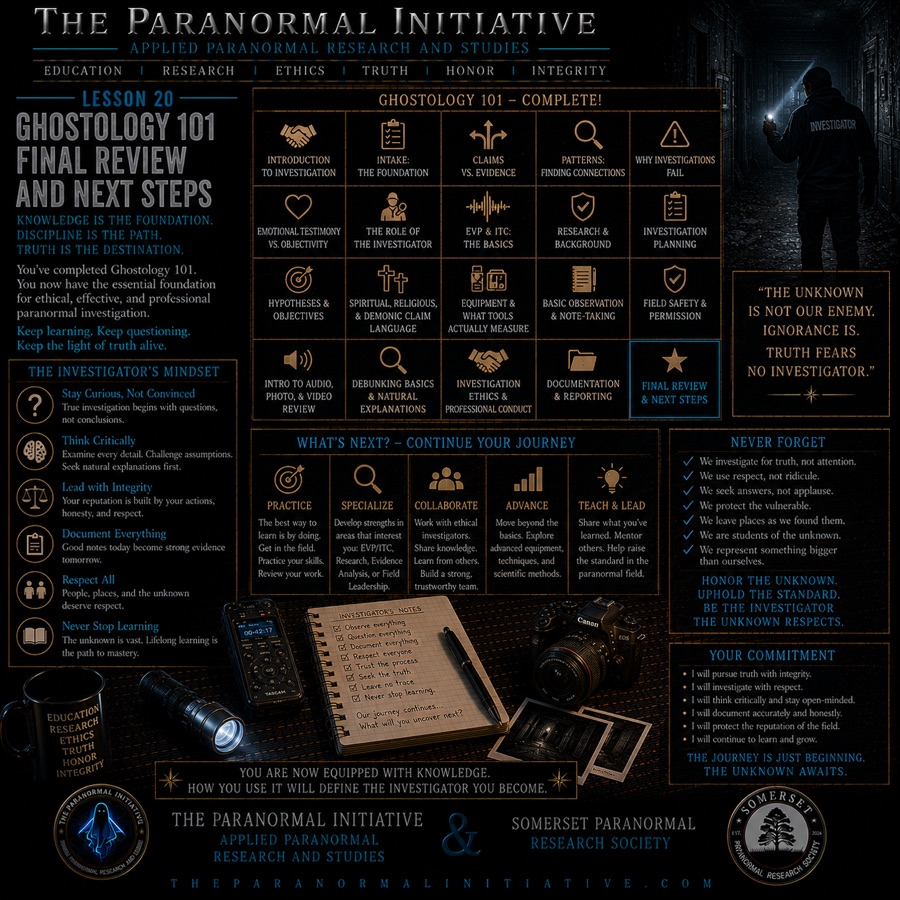
Ghostology 101 is the foundation of a much larger educational structure. The Paranormal Initiative — Applied Paranormal Research and Studies offers several pathways for continued study. These are not upsells or promotional gimmicks. They are genuine opportunities to deepen your knowledge and skills in specific areas of investigation. The following pathways represent the next steps in your education.
Applied Paranormal Research and Studies. This is the professional curriculum that follows Ghostology 101. It covers advanced investigation methodology, historical research, environmental analysis, evidence evaluation, witness assessment, documentation, professional reporting, ethics, long-term research, and interdisciplinary study. This is the natural next step for students who want to move from foundational knowledge to professional practice.
Evidence Analysis. This pathway focuses on the systematic evaluation of investigation media. Students learn advanced techniques for audio, photo, and video analysis, including spectral analysis, enhancement protocols, and chain-of-custody procedures. This track is ideal for students who want to specialize in the technical aspects of evidence review.
EVP / ITC Research. This pathway provides comprehensive instruction in Electronic Voice Phenomena and Instrumental Transcommunication. Students learn recording methods, session structure, blind listening workflows, contamination control, and responsible presentation of audio evidence. This track builds on the foundational review skills taught in Ghostology 101.
Equipment and Instrumentation. This pathway examines every tool used in paranormal investigation in detail. Students learn about audio equipment, cameras, EMF meters, environmental sensors, motion and vibration tools, air quality monitors, and much more. Each lesson covers specifications, calibration, common false positives, advanced use techniques, and how to integrate the tool into a complete investigation.
Environmental Intelligence. This pathway explores the physical environment and its relationship to reported phenomena. Students study weather, building science, geology, electromagnetic theory, and environmental monitoring in depth. This track is essential for investigators who want to understand the natural causes that most commonly mimic paranormal activity.
Field Operations. This pathway teaches the practical skills of conducting site investigations. Students learn pre-investigation planning, site arrival and walkthrough procedures, baseline sweeps, room-by-room documentation, team communication, and post-investigation wrap-up. This track turns classroom knowledge into field-ready skills.
Case Management. This pathway focuses on the administrative and organizational aspects of investigation. Students learn client intake procedures, case file development, evidence management, report writing, and case archiving. This track is essential for investigators who manage their own cases or teams.
Historical Research. This pathway provides advanced instruction in historical research methods. Students learn how to access and interpret newspapers, census records, property deeds, maps, directories, oral history, and archival materials. This track builds on the research foundations established in Ghostology 101.
Client and Residential Investigation. This pathway focuses on the unique challenges of investigating private residences. Students learn about client intake, sensitive communication, working with families, handling vulnerable clients, and managing expectations. This track is essential for investigators who work directly with clients in their homes.
Advanced Documentation and Reporting. This pathway teaches professional standards for investigation documentation and report writing. Students learn how to structure reports, write objective observations, separate facts from interpretations, organize evidence, and build cases that remain credible for years.
Each pathway is designed to build on the foundations established in Ghostology 101. Students may choose one pathway or combine several. The goal is not to complete every track but to find the areas that match your interests and strengths.