Ghostology 101 · Lesson 19

Professional Investigation Documentation and Reporting

This lesson teaches students that an investigation is only as valuable as its documentation. Students learn how to create professional reports that allow others to understand exactly what occurred, what was observed, what was tested, and what conclusions were reached. Topics include report structure, objective observations, separating facts from interpretations, proper use of photographs and audio logs, organizing evidence, and building reports that remain credible years later.

All Lessons Lesson 18 Lesson 20
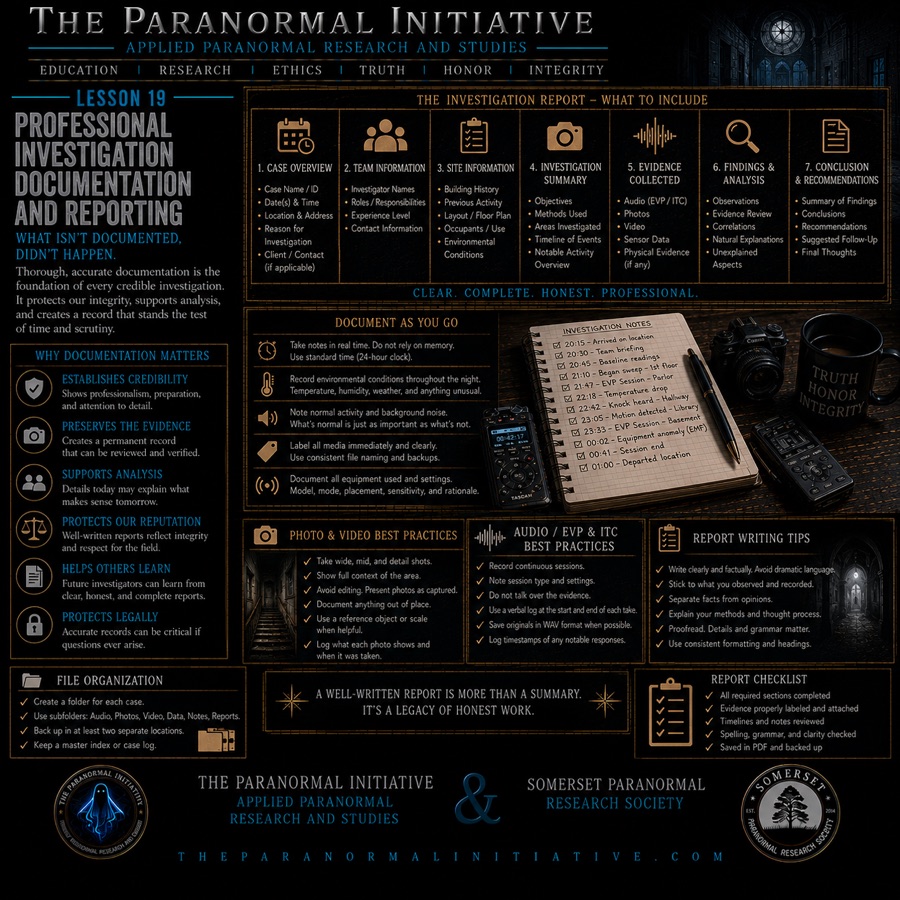
Ghostology 101 lesson 19 visual

Lesson Reading

Lesson Purpose

This lesson teaches students that an investigation is only as valuable as its documentation. Evidence without documentation has little long-term research value. Professional investigators create reports that allow others to understand exactly what occurred, what was observed, what was tested, and what conclusions — if any — were reached. Documentation preserves credibility. It protects the investigator, the client, and the evidence itself. By the end of this lesson, students should understand that the quality of their documentation determines the quality of their investigation, and that a well-written report often becomes more important than the investigation itself.

Learning Objectives

By the end of this lesson, students should be able to:

Why Documentation Matters: Explain why documentation is the permanent record of an investigation and why evidence without documentation has limited value.

Report Structure: Describe the anatomy of a professional investigation report, including case information, objectives, equipment, conditions, timeline, evidence, and conclusions.

Objective Observations: Write observations that describe what occurred without inserting assumptions or interpretations.

Facts vs. Interpretations: Distinguish between facts, opinions, possibilities, hypotheses, and conclusions — and avoid mixing them together.

Photographs and Media: Use photographs, audio logs, and video documentation properly, including captions, logs, and reference objects.

Evidence Organization: Organize evidence using folder structures, naming conventions, version control, and master evidence indexes.

Report Review: Build reports that others can review and understand years later, maintaining transparency and repeatability.

Introduction — The Permanent Record

Every investigation generates data. Audio recordings, photographs, video footage, environmental readings, witness statements, and investigator observations all accumulate over the course of a case. But data alone is not documentation. Data becomes documentation only when it is organized, labeled, contextualized, and preserved in a form that others can understand.

Many investigations lose value because documentation is incomplete. A team captures compelling audio but fails to note the time, location, and environmental conditions at the moment of capture. A photographer takes dozens of images but cannot remember which ones were taken where. An investigator writes notes that mix observations with interpretations, making it impossible to separate what actually happened from what the investigator thought it meant. In each case, the evidence loses its power because the documentation is insufficient.

A well-written report often becomes more important than the investigation itself. The report is what survives. It is what other investigators read years later. It is what allows cases to be compared, patterns to be identified, and knowledge to accumulate. The report is the permanent record of the investigation, and its quality determines whether the investigation makes a lasting contribution to the field.

This lesson teaches you how to create documentation that meets professional standards. You will learn how to structure reports, write objective observations, separate facts from interpretations, use photographs and media properly, organize evidence, and build reports that remain credible for years. By the end of this lesson, you will understand that documentation is not a chore to be completed after the investigation. It is the primary product of the investigation itself.

Why Documentation Matters

Documentation is what separates investigation from storytelling. An investigation without documentation is just a memory, and memories are unreliable. Documentation creates a permanent, reviewable, and verifiable record that can be examined by others long after the investigation is complete. The reasons documentation matters extend across every aspect of investigative work.

Historical Records. Paranormal investigation is a young field. The cases being documented today will be studied by future investigators who want to understand patterns, compare methodologies, and evaluate evidence. Documentation creates the historical record that future researchers will depend on. A case that is thoroughly documented today may become an important reference decades from now. A case that is poorly documented will be forgotten, regardless of how compelling the evidence was.

Future Review. Evidence that seems clear in the moment may look different months or years later. A sound that seemed like a voice may reveal itself as a mechanical noise when reviewed with fresh ears. A photograph that seemed to show a figure may resolve into a shadow when compared with other images. Documentation that captures the context and conditions of the original observation allows future reviewers to reevaluate the evidence with additional information. Without that context, the evidence cannot be properly reviewed.

Evidence Comparison. Cases can be compared only when they are documented in consistent ways. A report that includes temperature, humidity, barometric pressure, EMF background, and ambient sound levels can be compared to another report that uses the same measurements. A report that includes only vague descriptions cannot be compared to anything. Consistent documentation allows investigators to identify patterns across cases, to test hypotheses against multiple data sets, and to build a body of knowledge that transcends individual investigations.

Research Value. Paranormal investigation has the potential to contribute to scientific understanding, but only if the documentation meets research standards. Research-quality documentation includes clear methodologies, consistent measurements, thorough records, and transparent reporting. An investigation that produces research-quality documentation has value even if it finds no evidence of paranormal activity. An investigation that produces poor documentation has no research value, regardless of what it claims to have found.

Credibility. Documentation is the foundation of credibility. An investigator who presents thorough, well-organized documentation is trusted. An investigator who presents vague, incomplete, or disorganized documentation is not trusted, regardless of how compelling their claims may be. Credibility is not built on dramatic evidence. It is built on thorough documentation that allows others to verify and evaluate the work.

Repeatability. One of the fundamental principles of scientific investigation is repeatability. If an investigation documents its methods thoroughly, another investigator should be able to repeat the same procedures and compare the results. Documentation that includes specific information about equipment, settings, locations, times, and conditions makes repeatability possible. Documentation that is vague or incomplete does not.

Transparency. Documentation creates transparency. When all aspects of an investigation are documented, the investigator has nothing to hide. The methods, the observations, the interpretations, and the conclusions are all available for examination. Transparency builds trust with clients, with colleagues, and with the public. An investigator who documents thoroughly is an investigator who has nothing to fear from scrutiny.

Professionalism. Professionalism is demonstrated through documentation. A professional investigator produces professional documentation: clear, organized, complete, and accurate. Documentation that meets professional standards distinguishes serious investigators from hobbyists and entertainers. It signals that the investigator takes their work seriously and expects others to do the same.

Anatomy of a Professional Investigation Report

A professional investigation report follows a consistent structure that allows readers to find information quickly and understand the case thoroughly. While reports may vary depending on the specific case and audience, the following sections form the standard anatomy of a professional report. Each section serves a specific purpose and should be included in every complete report.

Case Information. The opening section identifies the case. Include the case number, case name, the date the report was prepared, and the name of the investigator or team preparing the report. This section allows readers to identify the case immediately and to connect it with any related documentation. Case information should be brief and factual.

Date. Record the date or dates on which the investigation occurred. Include the full date, month, and year. If the investigation spanned multiple days, list all dates. The date allows readers to place the investigation in temporal context and to connect it with weather, seasonal, and other time-related factors.

Time. Record the start and end times of the investigation. Include the time zone. If the investigation included multiple sessions, record the times of each session. Time information allows readers to correlate the investigation with environmental data, witness availability, and other time-dependent factors.

Location. Provide the full address of the investigation location, including street address, city, state, and zip code. If the investigation occurred at a named location — a historic building, a park, a business — include the name as well. For outdoor locations, include GPS coordinates if available. The location allows readers to understand the geographic and environmental context of the investigation.

Weather. Record the weather conditions during the investigation. Include temperature, humidity, barometric pressure, wind speed and direction, precipitation, and cloud cover. Note any significant weather events that occurred during or immediately before the investigation. Weather conditions can affect both the environment and the people within it, and documenting them provides essential context for evaluating observations and readings.

Team Members. List all team members who participated in the investigation, along with their roles. Include the lead investigator, equipment operators, note-takers, witnesses, and any other participants. Knowing who was present and what they were responsible for helps readers evaluate the reliability of observations and the effectiveness of the investigation.

Objectives. State the objectives of the investigation clearly. What claims were being investigated? What questions was the team trying to answer? What specific goals were set before the investigation began? Clear objectives help readers understand why the investigation was conducted and what the team was looking for. They also help the investigator evaluate whether the objectives were achieved.

Equipment Used. List all equipment used during the investigation, including make, model, serial number, and settings. Include audio recorders, cameras, video recorders, EMF meters, thermometers, hygrometers, barometers, motion sensors, and any other tools. Also list any software used for analysis. Documenting equipment allows readers to evaluate the technical aspects of the investigation and to understand the capabilities and limitations of the tools used.

Environmental Conditions. Provide detailed information about the environmental conditions at the location. Include temperature readings from multiple areas, humidity levels, barometric pressure, ambient sound levels, lighting conditions, and EMF background readings. Note any environmental factors that could affect the investigation, such as HVAC operation, open windows, nearby traffic, or construction. Environmental conditions provide the baseline against which all observations and readings are evaluated.

Investigation Timeline. Present a chronological timeline of the investigation. Include the times of arrival, setup, baseline readings, each investigation session, breaks, equipment changes, notable events, and departure. The timeline provides a framework for understanding the sequence of events and for correlating observations from different team members and different data sources.

Evidence Collected. List all evidence collected during the investigation. Include audio recordings, photographs, video footage, environmental readings, witness statements, and any physical evidence. For each item, include a unique identifier, a description, the time and location of collection, and the collector's name. This section serves as the master index for all evidence associated with the case.

Observations. Present all observations made during the investigation. Observations should be written objectively, describing what was perceived through the senses without interpretation. Include observations from all team members. Organize observations chronologically or by location. This section is the raw data of the investigation — the factual record of what occurred.

Natural Explanations Considered. Document the natural explanations that were considered for each reported phenomenon or observation. For each explanation, describe how it was tested and what the results were. This section demonstrates that the investigation was thorough and that natural causes were actively investigated before any paranormal interpretation was considered. It also provides valuable information for future investigators who may revisit the case.

Conclusions. Present the conclusions reached after analyzing all evidence. Conclusions should be clearly stated, supported by evidence, and expressed with appropriate levels of certainty. Use measured language: "explained," "inconclusive," "unexplained," "requires further investigation." Avoid dramatic or absolute language unless the evidence strongly supports it. If no paranormal activity was documented, state that clearly. If findings are ambiguous, acknowledge the uncertainty.

Recommendations. Provide recommendations for next steps. These may include further investigation, environmental remediation, referral to other professionals, or suggestions for the client. Recommendations should be practical, specific, and actionable. They should reflect the findings of the investigation and the needs of the client.

Appendices. Include supporting materials in appendices. These may include full equipment specifications, complete environmental data logs, witness statement transcripts, permission documents, consent forms, and any other documentation that supports the report. Appendices allow the main report to remain concise while providing access to detailed supporting information.
Writing Objective Observations

Objective observation is the foundation of credible investigation. An observation describes what occurred without interpreting what it means. Writing objective observations requires discipline. It requires separating what you perceived through your senses from what you think it means.

Examples of objective observations. "At 9:42 PM, I heard three knocking sounds from the direction of the north wall of the living room. The knocks were evenly spaced, approximately one second apart. I checked the plumbing in that area and found no pipes in the wall. I noted that the HVAC system was not running at the time. No immediate cause was identified during the observation." This observation describes what was heard, when, where, and under what conditions. It does not say "a ghost knocked three times." It reports what was perceived.

Instead of: "A ghost slammed the door." Write: "The door closed rapidly at approximately 9:42 PM. No immediate cause was identified during the observation. I checked for drafts by holding a tissue near the door frame and noted that the window in the room was closed. The door latch appears worn and may not hold securely."

Instead of: "I felt a cold spot near the stairs." Write: "While standing at the bottom of the stairs at 10:15 PM, I noticed a temperature difference on my left side. I checked the thermometer: the temperature near the stairs was 62°F, while the temperature in the adjacent hallway was 67°F. I checked for drafts and found an unsealed gap around the basement door near the stairs. The temperature difference may be caused by air moving from the basement through this gap."

Instead of: "The spirit moved the flashlight." Write: "At 11:05 PM, I observed the flashlight, which had been placed on the table in the center of the room, rolling to the edge of the table and falling to the floor. The table surface is not perfectly level. The flashlight is cylindrical and could roll if placed near the edge. I noted that no one was near the table at the time, but the building's HVAC system cycled on at 11:04 PM, which may have created vibration or air movement."

Instead of: "The ghost answered my question." Write: "At 11:22 PM, I asked, 'Is anyone here with us?' At 11:23 PM, the audio recorder captured a voice-like sound. The sound was approximately one second in duration. I checked for radio interference by scanning the area with an RF detector. No significant RF sources were detected. The sound is documented as an audio anomaly requiring further analysis. It has not been determined whether the sound is related to the question."

Instead of: "The room felt evil." Write: "While in the basement from 10:30 PM to 10:45 PM, I experienced a feeling of unease. I documented the environmental conditions: temperature 58°F, humidity 72%, carbon monoxide level 0 ppm, EMF background 0.5 mG. The basement has no windows, poor ventilation, and a musty odor consistent with mold. The feeling of unease may be related to the environmental conditions rather than to any paranormal cause."

Objective observations share several characteristics. They describe what was perceived through the senses: sight, hearing, touch, smell. They include specific details: time, location, duration, context. They avoid interpretive language: "ghost," "spirit," "entity," "presence." They acknowledge uncertainty: "no immediate cause identified," "may be related to," "requires further analysis." They provide the reader with enough information to evaluate the observation independently.

Facts vs. Interpretations

One of the most important skills in professional documentation is the ability to separate facts from interpretations. Mixing them together creates confusion and makes it impossible for others to evaluate the evidence independently. Understanding the difference between facts, opinions, possibilities, hypotheses, and conclusions is essential for producing credible reports.

Facts are observations that can be verified. They answer the questions: what, when, where, who, and under what conditions. "The temperature was 62°F at 9:15 PM" is a fact. "Three knocking sounds were heard from the north wall at 9:22 PM" is a fact. "The witness said, 'I saw a figure in the hallway'" is a fact. Facts are the raw material of investigation. They should be recorded precisely and preserved accurately.

Opinions are personal beliefs or judgments. "The knocking sounds were caused by a ghost" is an opinion. "The cold spot is paranormal" is an opinion. "The witness is reliable" is an opinion. Opinions have a place in investigation — they can guide further inquiry — but they should be clearly labeled as opinions and not presented as facts.

Possibilities are potential explanations that have not been tested. "The sound could be caused by plumbing" is a possibility. "The temperature drop could be caused by a draft" is a possibility. "The figure could be a reflection" is a possibility. Listing possibilities is an important part of the investigative process, but possibilities should not be presented as conclusions.

Hypotheses are tentative explanations that can be tested. "If the sound is caused by the HVAC system, then it should occur when the system cycles on" is a hypothesis. "If the cold spot is caused by a draft, then sealing the window should eliminate it" is a hypothesis. Hypotheses are valuable because they lead to testing. They should be clearly identified as hypotheses and distinguished from conclusions.

Conclusions are findings reached after evidence has been gathered and analyzed. "The sound was caused by the HVAC system cycling on" is a conclusion. "The temperature drop was caused by a draft from an unsealed window" is a conclusion. "The cause of the audio anomaly could not be determined" is also a conclusion. Conclusions should be supported by evidence and expressed with appropriate levels of certainty.

Why you must never mix these together. When facts, opinions, possibilities, hypotheses, and conclusions are mixed together in documentation, the reader cannot distinguish between what was observed and what was inferred. A report that says "The ghost knocked three times at 9:22 PM" mixes an interpretation ("ghost") with an observation ("three knocks"). The reader cannot tell whether the investigator actually observed three knocks or is interpreting a sound as a ghost. A report that says "At 9:22 PM, three knocking sounds were heard from the north wall" preserves the observation. The reader can evaluate the evidence independently.

Rewritten examples.

Instead of: "The basement is definitely haunted. We captured evidence of spirits on every device." Write: "During the investigation, we documented three EMF spikes in the basement, one audio anomaly in the hallway, and a temperature drop of 4 degrees in the northeast corner. All other data showed no significant anomalies. The EMF spikes were traced to wiring in the wall. The audio anomaly could not be explained after initial review. The temperature drop corresponded to an HVAC cycle. One finding — the audio anomaly — remains unexplained. Further investigation is recommended."

Instead of: "The EVP proves spirits are communicating with us." Write: "An audio recording captured at 11:22 PM contains a voice-like sound approximately one second in duration. The sound was recorded in a room where no team members were present. Possible natural explanations include radio interference, voice carry from an adjacent room, or auditory pareidolia. The sound has been documented as an audio anomaly. It has not been determined whether the sound represents a paranormal phenomenon."

Instead of: "The shadow figure we saw was definitely a ghost." Write: "At 10:05 PM, I observed a dark shape move across the north wall of the hallway. The shape was visible for approximately two seconds. I checked for potential sources: a car passed outside the window at that time, and a team member was walking in the adjacent room. The shape may have been a shadow cast by the car headlights or by the team member's movement. No definitive explanation has been determined."

Instead of: "Nothing paranormal happened. The case is closed." Write: "During the investigation period of approximately four hours, no anomalous phenomena were documented. All environmental readings remained within normal baseline ranges. No witnesses reported unusual experiences. The investigation did not identify any evidence supporting the reported claims of paranormal activity. The case is closed pending any new reports from the client."

Instead of: "The client's house is not haunted." Write: "The investigation found natural explanations for all of the reported phenomena. The knocking sounds were caused by loose plumbing pipes. The cold spots were caused by drafts from unsealed windows. The EMF readings were caused by ungrounded wiring. The feeling of being watched may be related to high carbon monoxide levels, which were detected in the home and referred to the gas company for remediation. Based on the evidence collected, no unexplained phenomena were documented. The client has been provided with a full report and recommendations."

Instead of: "This is the most haunted location we have ever investigated." Write: "This investigation documented more unexplained phenomena than any other case this team has investigated to date. At the time of writing, five audio anomalies, three temperature anomalies, and one visual anomaly remain unexplained after initial analysis. These findings are preliminary and require further review. The team recommends a follow-up investigation to gather additional data and to test alternative hypotheses."

Using Photographs Properly

Photographs are one of the most powerful tools in paranormal investigation documentation. They capture visual information that can be reviewed and analyzed long after the investigation is complete. But photographs can also be misleading if they are not taken and documented properly. Professional use of photography requires attention to technique, documentation, and ethical presentation.

Wide Shots. Always take wide shots that show the overall layout and context of the area being photographed. A wide shot establishes the scene and allows viewers to understand the spatial relationships between objects, walls, windows, and doors. Wide shots should be taken from multiple angles to provide complete coverage of each area.

Context Photos. Context photos show the relationship between a specific area of interest and its surroundings. If you photograph a potential anomaly, take a context photo that shows where the anomaly appeared in relation to the room's features. Context photos help viewers understand whether the anomaly could have been caused by environmental factors such as reflections, shadows, or light sources.

Evidence Photos. Evidence photos document specific items or areas of interest. These may include photographs of equipment setups, areas where phenomena were reported, potential sources of false positives, and any physical evidence collected. Evidence photos should be taken with the highest quality settings available and should be properly exposed and focused.

Reference Objects. Include reference objects in photographs to provide scale. A common reference object is a coin, a ruler, or a team member's hand. Reference objects allow viewers to understand the size of objects or anomalies in the photograph. Without a reference object, a small object can appear large and a large object can appear small, leading to misinterpretation.

Lighting. Document the lighting conditions at the time each photograph was taken. Note whether the flash was used, what ambient light was present, and whether any artificial lighting was added. Lighting conditions significantly affect how a photograph appears, and understanding the lighting is essential for evaluating any anomalies in the image.

Orientation. Document the orientation of each photograph. Note which direction the camera was facing (north, south, east, west) and whether the photograph was taken at eye level, from a low angle, or from a high angle. Orientation information helps viewers understand the spatial context of the image and can be correlated with other documentation such as floor plans and notes.

Numbering Photographs. Assign a unique number to every photograph. The numbering system should be consistent across all investigations and should allow photographs to be referenced easily in reports and analysis. A common system uses the date, a sequential number, and the photographer's initials: 2026-07-06_001_TK.jpg.

Captions. Every photograph should include a caption that describes what is shown, when it was taken, where it was taken, and any relevant conditions. Captions should be factual and objective. "Photograph of the northeast corner of the living room, taken at 9:15 PM with ambient light only. No anomalies visible in the original image." Captions allow viewers to understand the photograph without having to cross-reference other documentation.

Photo Logs. Maintain a photo log during the investigation. The log should record the photograph number, time, location, camera settings, lighting conditions, and any observations about the scene at the time. The photo log provides essential context for reviewing photographs after the investigation and for correlating photographs with other evidence.

Avoiding Misleading Images. Never manipulate photographs in ways that could mislead viewers. Cropping, adjusting brightness and contrast, and color correction are acceptable if they are documented and the original image is preserved. Adding or removing elements, combining multiple images, or applying filters that change the appearance of the image are not acceptable. The goal of photography is to document what was present, not to create an image that supports a preferred interpretation.

Audio and Video Documentation

Audio and video recordings capture information that written notes cannot. They preserve sounds, movements, and events that may be significant. However, audio and video documentation requires the same discipline as any other form of documentation. Recordings without context are of limited value.

Continuous Recording. Whenever possible, use continuous recording rather than starting and stopping the recorder. Continuous recording captures everything that occurs, including periods of silence that provide context for later events. Starting and stopping the recorder risks missing important information and creates gaps in the record that may be questioned later.

File Naming. Use a consistent file naming convention that includes the date, location, device identifier, and a sequential number. For example: "2026-07-06_Hallway_Recorder01_001.wav." A consistent naming convention allows files to be sorted, searched, and correlated with other documentation. Avoid default names assigned by recording devices, which are typically not descriptive and can lead to confusion.

Timestamps. Ensure that all recording devices have synchronized clocks. A time difference of even a few seconds between devices can make correlation difficult or impossible. Before the investigation begins, synchronize all clocks to a common reference, such as time.gov or a GPS time signal. Note the reference time source in the investigation documentation.

Microphone Placement. Document the placement of all microphones. Note where each microphone was positioned, what type of microphone was used, and whether any windscreens or other accessories were used. Microphone placement significantly affects what sounds are captured and how they are recorded. Knowing the placement helps reviewers evaluate whether sounds could have been caused by the recording equipment itself.

Camera Positioning. Document the position and orientation of all cameras. Note whether cameras were mounted on tripods, placed on surfaces, or handheld. Note the field of view and any obstructions. Camera positioning determines what is captured in the frame, and knowing the position helps reviewers evaluate whether visual anomalies could have been caused by camera movement, reflections, or other equipment-related factors.

Environmental Notes. For each recording session, document the environmental conditions. Note the temperature, humidity, lighting, ambient sound levels, HVAC status, and any other relevant factors. Environmental notes provide context for evaluating recordings and help identify potential sources of false positives.

Maintaining Originals. Preserve all original audio and video recordings in their unaltered form. Never edit, enhance, or compress original files. If you need to clip a section for analysis or presentation, work with a copy. The original file is the primary evidence, and its integrity must be maintained. Store originals in a secure location with multiple backups.

Synchronizing Media. When reviewing audio and video from multiple sources, synchronize the files using timestamps. Most media players allow you to align files by time code. Synchronization allows you to correlate events across different recordings and to identify relationships that might not be apparent from a single source.

Metadata. Preserve metadata for all audio and video files. Metadata includes information about the file format, recording date and time, device settings, and other technical details. Metadata can be essential for verifying the authenticity of recordings and for understanding the technical conditions under which they were made. Preserve metadata by keeping original files intact and by documenting technical information in the case file.

Field Notes and Investigation Logs

Field notes and investigation logs are the backbone of investigation documentation. They capture information in real time, preserving observations, conditions, and events as they occur. The quality of field notes determines the quality of the final report.

Written Notes. Written notes remain the most reliable form of field documentation. They do not depend on batteries, signal, or equipment function. They can be made in any environment. Use a bound notebook with numbered pages to prevent pages from being added or removed. Write in pen so entries cannot be erased. If you make a mistake, draw a single line through it so the original entry remains readable.

Digital Notes. Digital notes offer advantages: easy searching, the ability to include photographs and audio clips, and simple sharing with team members. However, digital notes also have disadvantages: batteries can die, screens can be difficult to read in low light, and files can be accidentally deleted. If you use digital notes, maintain a paper backup and back up digital files regularly.

Time Synchronization. Ensure that all team members' watches and devices are synchronized to the same time source before the investigation begins. A simple method is to have all team members set their watches to time.gov at the start of the investigation. Time synchronization is essential for correlating observations from different team members and from different equipment.

Who Records What. Assign documentation responsibilities before the investigation. One team member may be responsible for environmental readings while another records observations and another manages equipment logs. Clear assignments ensure that all aspects of the investigation are documented and that no important information is missed.

Incident Logs. Maintain an incident log that records every significant event during the investigation. Include the time, location, description, and witnesses for each incident. The incident log provides a chronological record of the investigation and serves as the primary reference for writing the final report.

Equipment Logs. Maintain a log of all equipment used during the investigation. For each device, record the make, model, serial number, settings, and time of use. Note any equipment issues, such as low batteries, unexpected behavior, or calibration changes. Equipment logs help investigators evaluate whether readings could have been affected by equipment malfunctions.

Environmental Changes. Record any changes in environmental conditions during the investigation. Note when the HVAC system cycles on or off, when windows are opened or closed, when lights are turned on or off, and when weather conditions change. Environmental changes can affect observations and readings, and documenting them provides essential context.

Witness Statements. Record witness statements verbatim whenever possible. Use the witness's exact words. Do not paraphrase, summarize, or correct their language. Include the context of the interview: who was present, where it took place, what time it occurred, and whether any leading questions were asked. Witness statements are primary evidence and must be preserved accurately.

Chain of Events. Maintain a clear chain of events throughout the investigation. The chain of events connects observations, readings, witness statements, and environmental conditions into a coherent narrative. A well-documented chain of events allows investigators and reviewers to understand what happened, in what order, and under what conditions.

Organizing Evidence

Evidence is only useful if it can be found, accessed, and understood. Organizing evidence is not a separate task from investigation — it is an essential part of the investigative process. Evidence that is disorganized is effectively lost.

Folder Structures. Create a consistent folder structure for every investigation. A recommended structure is: Investigation_Date_Location / Raw_Media / Audio / Photo / Video / Processed / Reports. The Raw_Media folder contains original, unaltered files. The Processed folder contains copies that have been reviewed, clipped, or enhanced. The Reports folder contains analysis documents and the final report. This structure keeps originals separate from working copies and makes it easy to find any file.

Naming Conventions. Use a consistent naming convention for all files. A good file name includes the date, location, device, subject, time, and investigator initials. For example: "2026-07-06_LivingRoom_NorthWall_EMF_Spike_22-14-03_TK.wav." A consistent naming convention allows files to be sorted and searched easily and prevents confusion when files are shared or archived.

Version Control. Maintain version control for all documents. When you update a report or analysis document, save it with a new version number and preserve the previous version. Version control allows you to track changes, revert to earlier versions if necessary, and document the evolution of your analysis. Simple version control can be implemented by adding version numbers to file names: "Report_v1.docx," "Report_v2.docx."

Backups. Back up all investigation files immediately after the investigation. Use at least two separate backup locations: one local (external hard drive) and one off-site (cloud storage or a second physical location). A backup is not a backup if it is stored in the same building as the original. A fire, flood, or theft could destroy both. Regular backups protect against data loss.

Evidence Numbering. Assign a unique evidence number to every piece of evidence in the case. The evidence number should be referenced in all documentation, including field notes, analysis documents, and the final report. A consistent numbering system makes it easy to locate specific evidence and to cross-reference between different documents.

Master Evidence Index. Create a master evidence index that lists all evidence collected in the case. For each item, include the evidence number, description, date and time of collection, collector, file name, and storage location. The master evidence index serves as the table of contents for the case evidence and allows anyone reviewing the case to find specific items quickly.

Preserving Originals. The original file is sacred. It is the primary evidence. Never edit, rename, or alter the original file in any way. If you need to work with a file for analysis or presentation, make a copy and work with the copy. The original remains untouched as a reference point. If your analysis or enhancement produces something that is not present in the original, the original is the truth.

Working Copies. Create working copies of files that you need to analyze or edit. Working copies should be clearly labeled as copies and stored in a separate folder from originals. Document any changes made to working copies, including enhancement settings, cropping, or other modifications. Working copies are analytical tools, not primary evidence.

Archiving. When a case is closed, archive all documentation in a secure, accessible location. The archive should include the final report, all raw media files, all processed files, and all supporting documentation. The archive should be organized so that the case can be reviewed years later by someone who has no prior knowledge of it. A well-organized archive ensures that the investigation makes a lasting contribution to the field.

Case File Package and Deliverables

A professional investigation should end with a complete case file, not a handful of interesting clips and a conversation. The case file is the organized package that preserves the work. It should allow the client, the team, and a future reviewer to understand what was claimed, what was investigated, what was collected, what was tested, what was explained, what remained unresolved, and what recommendations were made. If the case file cannot answer those questions, the investigation is not finished.

The client report is the readable summary prepared for the client. It should be clear, respectful, and useful. It should not overwhelm the client with every raw note, but it should include enough detail to show the method and findings. A good client report includes the case overview, investigation objectives, areas investigated, methods used, key observations, evidence summary, natural explanations tested, findings, limitations, recommendations, and follow-up options. The language should be calm and practical. The client should leave understanding the case better than they did before.

The internal case file is more detailed than the client report. It includes raw notes, full evidence logs, equipment records, witness forms, consent documents, environmental readings, media indexes, reviewer notes, excluded evidence, false positive tests, and working analysis. The client may not need every internal detail, but the team does. Internal files protect the integrity of the work and allow the case to be audited later.

The evidence index is the map of the case. Every recording, photograph, video, reading, form, interview, and report should have a unique identifier. The index should tell the reviewer what the item is, where it came from, when it was collected, who collected it, where it is stored, whether it is original or processed, and whether it is used in the final report. Without an index, evidence becomes difficult to trust because no one can tell whether the report is complete.

The final archive should preserve both the human and technical sides of the case. Include the client-facing report, internal notes, raw media, processed media, logs, consent forms, permissions, investigation timeline, analysis notes, and recommendations. Store it in a stable folder structure and back it up. A case that cannot be reopened six months later without confusion was not archived professionally.

Finding Categories and Conclusion Language

Professional reporting depends on careful conclusion language. The report should not force every finding into "paranormal" or "not paranormal." Real investigations are more nuanced. A case may contain explained findings, likely explained findings, inconclusive findings, unresolved findings, and items that require further review. These categories help investigators avoid exaggeration while still acknowledging material that deserves attention.

Explained means the team identified a natural or ordinary cause that reasonably accounts for the observation. For example, a cold spot traced to an unsealed basement door, a knocking sound matched to plumbing, or an orb recreated with dust and flash photography. Explained findings should be written clearly and respectfully. The point is not to embarrass the client or make the claim seem foolish. The point is to provide an answer.

Likely explained means one ordinary explanation fits best, but the team cannot prove it completely. For example, a wall scratch sound may be consistent with pest activity, but the team did not have attic access to confirm. A flickering light may be consistent with a loose bulb, but a qualified electrician was not present. This category is useful because it allows honest probability without overstating certainty.

Inconclusive means the material cannot support a strong conclusion. A recording may be too noisy. A photo may be too compressed. A video clip may be too short. A witness memory may be too old or too influenced by later discussion. Inconclusive findings should not be treated as weak proof of the paranormal. They are simply not strong enough to decide.

Unresolved means the team could not identify a cause after reasonable review. Unresolved is an important category, but it must be used carefully. It does not mean ghost, spirit, entity, demon, or proof. It means the available information did not identify a cause. A professional report can say, "This audio event remains unresolved after review," but should not say, "This proves communication."

Further review recommended means the team believes the item deserves additional analysis, a return visit, specialist input, environmental monitoring, equipment testing, or client follow-up. This category is especially useful when the case contains interesting material but not enough information for a final conclusion. It keeps the door open without pretending the team knows more than it does.

Use proportional language. The conclusion should be proportional to the evidence. If the strongest finding is one unexplained sound, the report should not claim the property is haunted. If most claims were explained but one event remains unresolved, say that. If no evidence supported the reported claims, say that. A professional investigator does not make a report more dramatic than the case supports.

Privacy, Redaction, and Client-Facing Reports

Documentation does not only protect evidence. It protects people. Residential cases may include names, addresses, children, medical concerns, grief, relationship stress, financial information, religious beliefs, family conflict, photographs of private rooms, and personal conversations captured on audio or video. Business cases may include employee names, customer activity, security systems, inventory, office layouts, proprietary information, and brand concerns. A professional report must handle that material with care.

Separate private records from public material. A client-facing private report may include details that should never appear in a public presentation, class example, social-media post, podcast, or webinar. If evidence is later used for teaching, identifying information should be removed unless the client has specifically consented. Redaction may include names, addresses, faces, license plates, room details, children, documents visible in photos, religious items, medical items, and any details the client asked to keep private.

Consent controls sharing. The fact that a team collected audio, photographs, or video does not automatically mean the team may publish them. Evidence use depends on permission, consent forms, and the client's boundaries. A report should note whether evidence is private, shareable with the client only, shareable with the team, approved for teaching, or approved for public use. Evidence without clear sharing permission should remain private.

Write for the client's well-being. A report should never increase fear without evidence. Avoid language that tells a client their home is haunted, cursed, demonically affected, or dangerous unless there is a responsible basis for the statement and appropriate qualified support. Most Ghostology 101 reports should use practical language: explained, likely explained, unresolved, follow-up recommended, environmental review suggested, or no evidence found. This language respects the client and reduces the risk of psychological harm.

Protect the witness voice. Witnesses should be quoted accurately, but not exploited. If a witness says something emotional, fearful, or personal, the report should treat it with dignity. Do not use witness statements as entertainment. Do not include unnecessary humiliating details. The purpose of documentation is clarity, not drama. If a witness statement is relevant, include it with context. If it is not relevant, protect the person by leaving it out of the final client summary.

Recommendations and Follow-Up

A professional report should help the client know what to do next. Findings without recommendations can leave a client confused, especially if the case remains unresolved. Recommendations should be practical, specific, and tied to the investigation. They should not promise more than the team can provide, and they should never pressure the client into additional services.

Environmental recommendations may include sealing drafts, checking HVAC filters, consulting a pest professional, improving ventilation, monitoring humidity, checking doors and latches, inspecting plumbing, trimming branches, repairing loose fixtures, installing carbon monoxide detectors, or consulting a qualified electrician or building professional. These recommendations can be valuable even when the case was originally framed as paranormal.

Documentation recommendations may include keeping a dated activity log, noting weather and time, recording whether HVAC was running, documenting who was home, capturing photos before moving objects, saving original media files, and avoiding leading labels such as "ghost voice" or "entity shadow." A client who continues logging events carefully may help identify patterns the team could not see during one visit.

Investigation recommendations may include a follow-up visit, longer environmental monitoring, focused audio recording, controlled photography, equipment comparison, historical research, or interviews with additional witnesses. These recommendations should explain why the follow-up is useful. Do not recommend more investigation merely because the story is interesting.

Referral recommendations may be necessary when the case goes beyond the team's role. Electrical hazards, carbon monoxide concerns, mold, structural damage, pest infestation, medical distress, mental-health crisis, legal disputes, domestic conflict, or safety threats should be referred to qualified professionals. Paranormal investigators are not substitutes for electricians, doctors, therapists, clergy, law enforcement, building inspectors, or pest-control professionals unless they are separately qualified.

Follow-up communication should be bounded. Tell the client when the report will be delivered, what follow-up is available, how questions should be submitted, and when the case will be considered closed. A professional ending matters. It prevents dependency, confusion, and endless informal interpretation after the report is complete.

Common Documentation Mistakes

Even experienced investigators make documentation mistakes. Recognizing common errors is the first step to avoiding them. The following mistakes are among the most frequent and most damaging in paranormal investigation documentation.

Missing Timestamps. Failing to record the time of observations, readings, and events is one of the most common documentation errors. Without timestamps, evidence cannot be correlated, sequenced, or verified. Make timestamps a habit. Record the time of every observation, every reading, and every significant event.

Missing Locations. Failing to record the specific location of observations and readings creates ambiguity that undermines the value of the evidence. "The living room" is not specific enough. "The northeast corner of the living room, approximately three feet from the fireplace" is better. Use landmarks, measurements, and floor plans to document locations precisely.

Incomplete Notes. Notes that are vague, abbreviated, or incomplete are of little value. "Heard weird noises" is not documentation. "Heard three tapping sounds from the north wall at 9:22 PM" is documentation. Take the time to write complete notes that others can understand. If you are unsure what to include, err on the side of too much detail rather than too little.

Assumptions. Writing assumptions as facts is a common error that can mislead both the writer and future readers. "The sound was caused by the furnace" is an assumption unless it has been verified. Write observations as observations and assumptions as assumptions. Label assumptions clearly and test them whenever possible.

Poor Organization. Documentation that is disorganized is difficult to use and may be ignored. Establish a consistent organization system before the investigation and follow it rigorously. Use folders, naming conventions, evidence numbers, and an index to keep documentation organized. Time spent organizing is time saved during analysis and report writing.

Editing Originals. Editing original files destroys primary evidence. Once a file is edited, it can no longer be relied upon as an accurate record of what was captured. Always preserve original files untouched. If you need to edit or enhance a file, work with a copy and document all changes.

Missing Metadata. Failing to preserve metadata — information about the file, device, and capture conditions — reduces the value of evidence. Metadata can confirm the date, time, device, and settings used to create a file. Preserve metadata by keeping original files intact and by documenting technical information in the case file.

Poor Photo Labeling. Photographs without labels, captions, or context are difficult to use and may be misinterpreted. Label every photograph with a unique identifier, description, date, time, location, and photographer. Create a photo log during the investigation that captures this information in real time.

Lost Files. Files that are lost due to poor organization, inadequate backup, or equipment failure are effectively destroyed. Implement a backup strategy that includes at least two separate storage locations. Test your backup system regularly to ensure that files can be recovered.

Disorganized Folders. A folder structure that is inconsistent, confusing, or nonexistent makes it difficult to find and use evidence. Establish a standard folder structure for all investigations and use it consistently. Train all team members on the folder structure and enforce its use.

Practical Investigation Examples — Six Detailed Scenarios

The following scenarios compare poor documentation with professional documentation. Each example demonstrates how the quality of documentation affects the value of the investigation. Read each pair and consider why the professional version is better.

Scenario 1: The Unexplained Sound.

Poor documentation: "Heard weird knocking in the basement. Probably haunted."

Professional documentation: "At 9:22 PM, while standing in the center of the basement, I heard three evenly spaced knocking sounds. The sounds appeared to come from the northeast corner. I checked the plumbing: there are no pipes in that wall. I checked the HVAC: the system was not running at the time. I checked the weather: winds were calm, and no storms were in the area. I noted that the basement has a concrete floor and cinder block walls, which could carry sound from other parts of the building. No immediate cause was identified during the observation. The sound is documented as an audio anomaly requiring further analysis."

Why the professional version is better: The professional version includes specific details that allow the observation to be evaluated and compared: time, location, number of sounds, distribution, environmental checks, and building construction. The poor version provides no useful information.

Scenario 2: The Temperature Drop.

Poor documentation: "Cold spot in the bedroom. Felt like a spirit was there."

Professional documentation: "At 10:15 PM, I noticed a temperature difference while standing near the north window of the master bedroom. I measured the temperature with a digital thermometer: 58°F near the window versus 65°F in the center of the room. I checked for drafts by holding a tissue near the window frame — the tissue moved, indicating airflow. I inspected the window and found that the weatherstripping is worn and there is a visible gap in the seal. The HVAC was running at the time, which may have created a pressure difference that drew cold air through the gap. The temperature difference is consistent with a draft from the window. I documented the finding and will recommend weatherstripping replacement to the client."

Why the professional version is better: The professional version includes measurements, testing procedures, multiple possible explanations, and a practical recommendation. The poor version provides no useful data and inserts an unsupported paranormal interpretation.

Scenario 3: The Shadow.

Poor documentation: "Saw a shadow figure in the hallway. It was a ghost."

Professional documentation: "At 10:05 PM, while standing at the east end of the hallway, I observed a dark shape move across the north wall from left to right. The shape was visible for approximately two seconds. It appeared as a dark silhouette with no discernible features. I checked for potential sources: a car passed outside the window at approximately 10:05 PM, and its headlights could have created a moving shadow on the wall. I also noted that a team member was walking in the adjacent room at the same time, which could have created a shadow from the hallway light. The shape is documented as a visual anomaly. The most likely explanations are a shadow from a car headlight or a shadow from a team member's movement. No paranormal interpretation is supported at this time."

Why the professional version is better: The professional version provides a detailed description of what was observed, identifies specific potential sources, and offers measured conclusions. The poor version makes a paranormal claim without evidence.

Scenario 4: The EMF Spike.

Poor documentation: "EMF meter went crazy. Something paranormal is here."

Professional documentation: "At 11:30 PM, the EMF meter registered a reading of 5.2 mG in the northeast corner of the living room. The reading lasted approximately 15 seconds and then returned to baseline (0.5 mG). I traced the source by moving the meter along the wall: the reading was highest near the electrical outlet and decreased as I moved away. I checked the outlet with a circuit tester: the outlet is not properly grounded. I also noted that a space heater was plugged into the outlet and running at the time. The EMF reading is consistent with an ungrounded electrical outlet and the operation of the space heater. The reading has been documented and explained."

Why the professional version is better: The professional version includes specific readings, a methodical tracing process, identification of the source, and a clear explanation. The poor version makes a paranormal claim based on a reading that has a straightforward electrical explanation.

Scenario 5: The Client Interview.

Poor documentation: "Client said she saw a ghost in the kitchen."

Professional documentation: "Interviewed the client at 7:30 PM in her living room. Client stated verbatim: 'I was standing at the kitchen sink last Tuesday around 11 PM when I saw a reflection in the window. It looked like a tall figure standing behind me. When I turned around, no one was there.' I asked the client to describe the figure in more detail. She said: 'It was tall and dark. I couldn't see any features. It was just a shape.' I asked whether she had experienced anything similar before. She said: 'No, this was the first time. But I have been feeling like someone is watching me for about a month.' I documented the client's exact words, the time and location of the interview, and the context. The client appeared calm during the interview. She expressed interest in understanding what caused the experience."

Why the professional version is better: The professional version preserves the client's exact words, documents the context of the interview, and includes relevant details about the client's state and history. The poor version provides only a vague paraphrase that loses the specific information.

Scenario 6: The Investigation Summary.

Poor documentation: "We investigated the Smith house. Heard some noises. Found some cold spots. Not sure if it's haunted or not."

Professional documentation: "Investigation of 123 Main Street, Anytown, conducted on July 6, 2026, from 8:00 PM to 11:30 PM. Team members: Todd Knipple (lead investigator), Sarah Jenkins (equipment operator), Mark Davis (documentation). Objectives: Investigate reports of unexplained sounds and temperature variations in the master bedroom and basement. Equipment used: Tascam DR-05 audio recorder, Flir TG165 thermal camera, K-II EMF meter, Extech humidity/temperature meter. Baseline readings: temperature 68-72°F, humidity 45%, EMF background 0.5-1.5 mG. Findings: Three audio anomalies documented in the basement (times: 9:22 PM, 9:45 PM, 10:10 PM). One temperature variation of 7°F in the master bedroom, traced to a draft from an unsealed window. EMF readings within normal range throughout. No visual anomalies documented. Conclusions: The temperature variation has a natural explanation (draft from unsealed window). The audio anomalies remain unexplained after initial analysis. Further investigation is recommended to gather additional audio data. The client has been provided with recommendations for weatherstripping the window and has been informed of the findings."

Why the professional version is better: The professional version includes specific information about dates, times, team members, objectives, equipment, baseline readings, findings, conclusions, and recommendations. The poor version provides no useful information and cannot be evaluated or compared.

Student Activity — Six Investigation Scenarios

For each of the following six scenarios, determine: What documentation is missing? What should be recorded? How should it be organized?

Scenario 1: An investigator captures an audio recording that sounds like a voice saying "hello." The investigator is excited and wants to share it as EVP. However, the investigator did not note the time of the recording, did not check for radio interference, did not document what equipment was used or what settings were applied, and did not record whether anyone else was present at the time.

Scenario 2: A team photographs several orbs during a night investigation. The photographs were taken with different cameras by different team members. No photo log was maintained. The team cannot remember which photographs were taken in which rooms or under what conditions.

Scenario 3: A witness reports seeing a full-bodied apparition in a historic building. The investigator interviews the witness but does not record the witness's exact words, does not ask follow-up questions about the context of the sighting, and does not document the lighting conditions or the witness's position at the time of the experience.

Scenario 4: During an investigation, the EMF meter spikes multiple times in different locations. The investigator notes the spikes but does not record the locations precisely, does not check for electrical sources, and does not document whether other equipment was running nearby. The investigator concludes the spikes are evidence of paranormal activity.

Scenario 5: A team conducts a four-hour investigation and produces a report that consists of two paragraphs: one describing the location and one saying nothing unusual was found. The report does not include specific times, baseline readings, equipment used, team members, or any other documentation.

Scenario 6: An investigator maintains field notes in a personal notebook but uses abbreviations and shorthand that only they can understand. The notes are not dated, not timed, and not organized in any apparent sequence. When asked to share the notes with the team, the investigator cannot explain what most of the entries mean.

For each scenario, write your analysis in your personal notes. Identify what is missing, what should have been recorded, and how the documentation should have been organized. Then rewrite each scenario with professional documentation that would meet the standards described in this lesson.

Reflection Questions

The following questions are designed to help you think more deeply about the concepts in this lesson. Use these as optional reflection or discussion prompts.

1. Think about your current documentation habits. What do you do well? What could you improve? What is one change you could make to your documentation practice that would have the greatest impact on the quality of your work?

2. Why is it important to separate facts from interpretations in investigation documentation? What problems can arise when they are mixed together? Provide a specific example from your own experience or from the examples in this lesson.

3. Imagine you are reviewing another investigator's report from a case that occurred five years ago. What would you need to find in the report to trust its conclusions? What would make you question the reliability of the documentation?

4. You discover that you made an error in a report that has already been submitted to a client. The error is in the interpretation section, not in the factual observations. How do you handle this situation? What does your response say about your commitment to documentation integrity?

5. How would you explain the importance of documentation to a new investigator who thinks that documentation is boring and just wants to get out in the field? What would you say to convince them that documentation is the most important part of the investigation?

6. A team member insists on using their own documentation system instead of the team's standard system. The team member's system is not compatible with the team's evidence management process. How do you address this situation? What do you say to the team member about the importance of consistency?

7. You are preparing a report for a client who is not familiar with paranormal investigation terminology. How do you adapt your report to be understandable to a non-specialist audience while still maintaining professional documentation standards? What language would you use, and what would you include or exclude?

8. What is the most important lesson you have learned about documentation from this lesson? How will it change the way you approach documentation in future investigations?

Key Takeaways

This lesson has covered the essential principles of professional investigation documentation and reporting. The key takeaways are:

Documentation is the permanent record of an investigation. A well-documented investigation has lasting value. A poorly documented investigation is effectively lost, regardless of how compelling the evidence may be.

Evidence without documentation has little long-term value. A recording without context is just a sound. A photograph without a log is just an image. Documentation turns data into evidence.

A professional report follows a consistent structure. Case information, objectives, equipment, conditions, timeline, evidence, observations, natural explanations, conclusions, recommendations, and appendices form the standard anatomy of a report.

Observations must be written objectively. Describe what occurred through your senses without interpreting what it means. Save interpretations for the analysis phase.

Facts and interpretations must never be mixed. Distinguish clearly between facts, opinions, possibilities, hypotheses, and conclusions. Each has its place, but they must be labeled and separated.

Photographs require proper technique and documentation. Use wide shots, context photos, reference objects, and captions. Maintain a photo log. Never manipulate images deceptively.

Audio and video must be documented with context. Use continuous recording, consistent file naming, synchronized timestamps, and environmental notes. Preserve original files.

Field notes and logs are the backbone of documentation. Assign documentation responsibilities, maintain incident logs and equipment logs, record witness statements verbatim, and preserve the chain of events.

Evidence must be organized systematically. Use consistent folder structures, naming conventions, version control, and backups. Maintain a master evidence index. Preserve originals.

Avoid common documentation mistakes. Include timestamps, specific locations, complete notes, and metadata. Organize everything. Never edit originals.

Build reports that others can review years later. The test of good documentation is whether someone unfamiliar with the case can understand what happened, what was found, and what it means.

Documentation is the primary product of every investigation. The quality of your documentation determines the quality of your investigation. A well written report often becomes more important than the investigation itself.

Repository Connections

The concepts in this lesson connect to several resources within The Paranormal Initiative - Applied Paranormal Research and Studies. Use these links to deepen your understanding of professional documentation and reporting.

Evidence Compendium: For comprehensive standards on evidence classification, documentation, chain of custody, and preservation, see the Evidence Compendium.

Investigation Compendium: For standards on investigation documentation, case file structure, report writing, and professional methodology, see the Investigation Compendium.

Equipment Manual: For guidance on documenting equipment settings, recordings, and readings, see the Equipment Manual.

Investigation Standards: For foundational standards that guide professional investigation practice, including documentation requirements, see the Investigation Compendium.

Evidence Manual: For detailed guidance on evidence handling, documentation, and presentation, see the Evidence Compendium.

Terminology Reference: For definitions of terms used in this lesson, including documentation, evidence, chain of custody, metadata, and objective observation, see the Terminology Reference.

Forensic Analysis Compendium: For advanced guidance on evidence analysis, documentation, and reporting standards, see the Forensic Analysis Compendium.

Legal and Client Forms: For templates of consent forms, permission documents, and client agreements that support professional documentation, see the Legal and Client Forms.

Where You'll Learn More

This lesson has introduced the foundational principles of professional investigation documentation and reporting. These skills will be developed further in several advanced tracks.

Evidence and Analysis Track. The Evidence and Analysis track teaches advanced evidence evaluation, including how to write findings that clearly distinguish between explainable, inconclusive, and unexplained material. You will learn how to document evidence categories, chain of custody, and analysis protocols with professional precision.

Applied Paranormal Research and Studies. The professional curriculum includes advanced instruction on professional case monographs, case file development, and reporting standards. These courses build directly on the documentation foundations established in this lesson and extend them into professional practice.

Research Methods Track. The Research Methods track teaches how to document historical research, source citations, and archival materials. The documentation standards you learn in this lesson will be applied to historical research documentation in that track.

Field Operations Track. The Field Operations track teaches practical skills for conducting site investigations, including pre-investigation planning, documentation during the investigation, and post-investigation report writing. These skills build directly on the documentation principles taught in this lesson.

Capstone and Professional Application. The capstone track includes lessons on building a full report packet, assembling intake forms, research logs, evidence logs, findings, and recommendations into a professional case presentation. This track is the culmination of all the documentation skills you are developing.

Each of these tracks will deepen your ability to document investigations professionally and to produce reports that meet the highest standards of credibility and transparency. The foundation you are building now will support everything you learn in the future.

Next Lesson Connection

Now that you understand how to create professional documentation that preserves the integrity of your investigations, you are ready for the final lesson of Ghostology 101. Lesson 20 — Ghostology 101 Final Review and Next Steps will review the entire Ghostology 101 journey, reinforce core principles, offer a comprehensive final reflection, and prepare you for more advanced study within The Paranormal Initiative - Applied Paranormal Research and Studies. Documentation is the skill that ties everything together — the foundation upon which all credible investigation is built. As you move forward, let this principle guide you: an investigation is only as valuable as its documentation.

Lesson 18 Back to Ghostology 101 Lesson 20