Investigation Development Series

Lesson 11: Baseline Readings: Establishing What Is Normal

Before anything can be identified as unusual, an investigator must first understand what is normal. This is the purpose of baseline readings.

Series Index Walkthroughs & Baselines
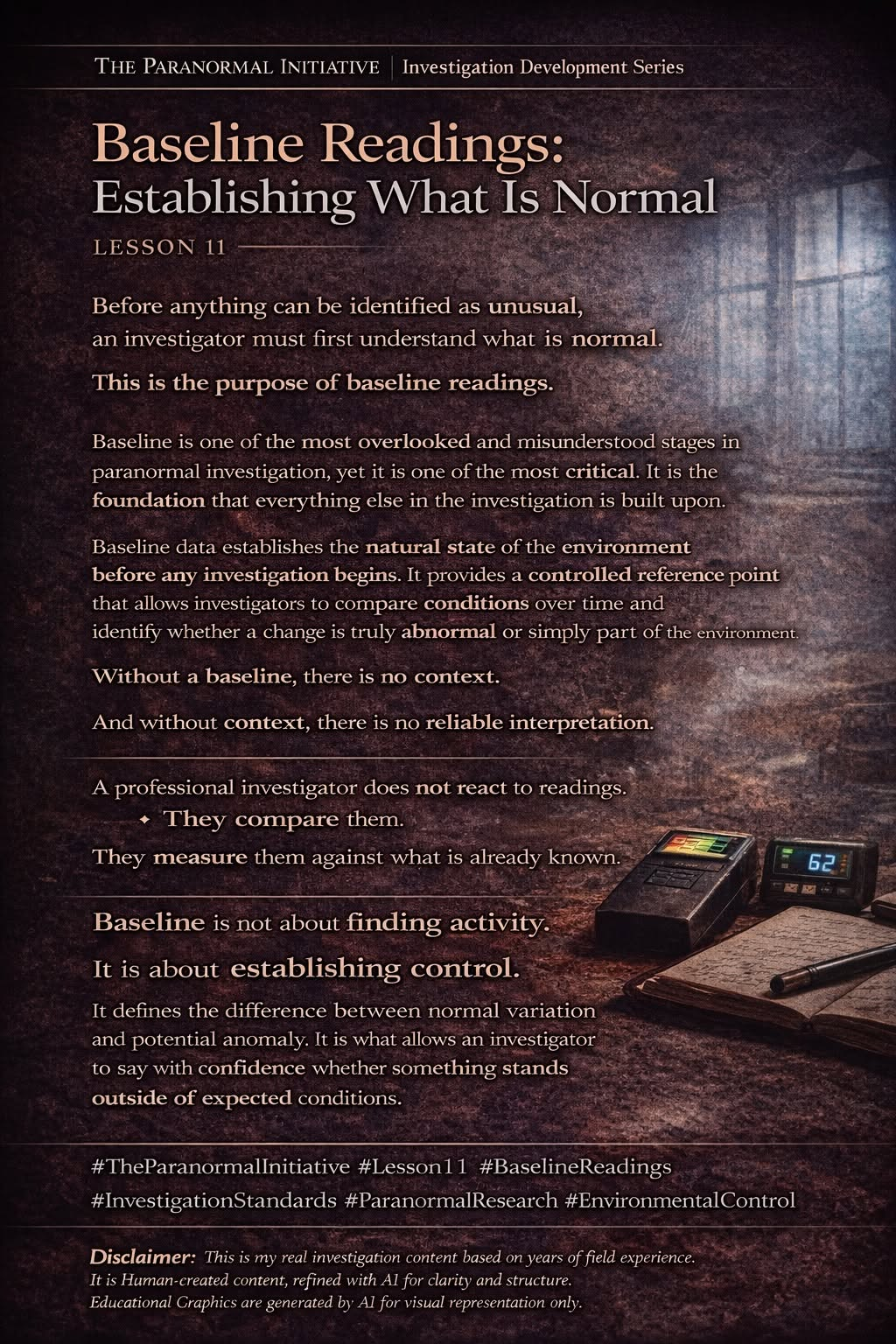
Baseline readings establishing what is normal lesson graphic

The Purpose Of Baseline

Baseline is one of the most overlooked and misunderstood stages in paranormal investigation, yet it is one of the most critical.

It is the foundation that everything else in the investigation is built upon.

Baseline data establishes the natural state of the environment before any investigation begins. It provides a controlled reference point that allows investigators to compare conditions over time and identify whether a change is truly abnormal or simply part of the environment.

Without Context, There Is No Reliable Interpretation

Without a baseline, there is no context.

And without context, there is no reliable interpretation.

A reading only becomes useful when it can be compared against what was already present in the space before the investigation began.

A Proper Baseline Is Structured

A proper baseline is not a single reading taken in one location.

It is a structured process that involves documenting environmental conditions throughout the entire space under normal circumstances.

This includes electromagnetic levels, temperature, humidity, ambient sound, air movement, and light conditions. It also includes observing structural behavior, electrical sources, and natural environmental patterns that may influence readings.

Baseline Comes Before The Investigation Changes The Space

Baseline measurements should be taken before lights are turned off, before equipment is introduced, and before expectation begins to influence perception.

Once the investigation begins, the environment changes. Human presence changes it. Equipment changes it. Awareness changes it.

If investigators do not understand what the environment was doing before those changes occurred, they have no way to accurately interpret what happens after.

Compare Before Interpreting

If an EMF spike occurs later in the investigation, the question is not simply whether it happened. The question is whether it is different from what was already present.

If a temperature change is detected, it must be compared against known drafts, insulation patterns, and natural fluctuations within the structure.

If a sound is captured, it must be evaluated against baseline ambient noise, structural movement, and environmental sources.

Why Many Investigations Lose Credibility

Without baseline data, every reading appears significant. And when everything appears significant, nothing can be properly evaluated.

This is where many investigations lose credibility because readings are often treated as evidence without being compared to known environmental conditions.

A professional investigator does not react to readings. They compare them. They analyze them. They measure them against what is already known.

Baseline Establishes Control

Baseline is not about finding activity.

It is about establishing control.

It defines the difference between normal variation and potential anomaly. It allows an investigator to say with confidence whether something stands outside expected conditions.

Measurable Investigation

Without baseline, interpretation becomes assumption.

With baseline, investigation becomes measurable.

Walkthroughs & Baselines Back to Series Environmental Red Flags