Investigator Development Series

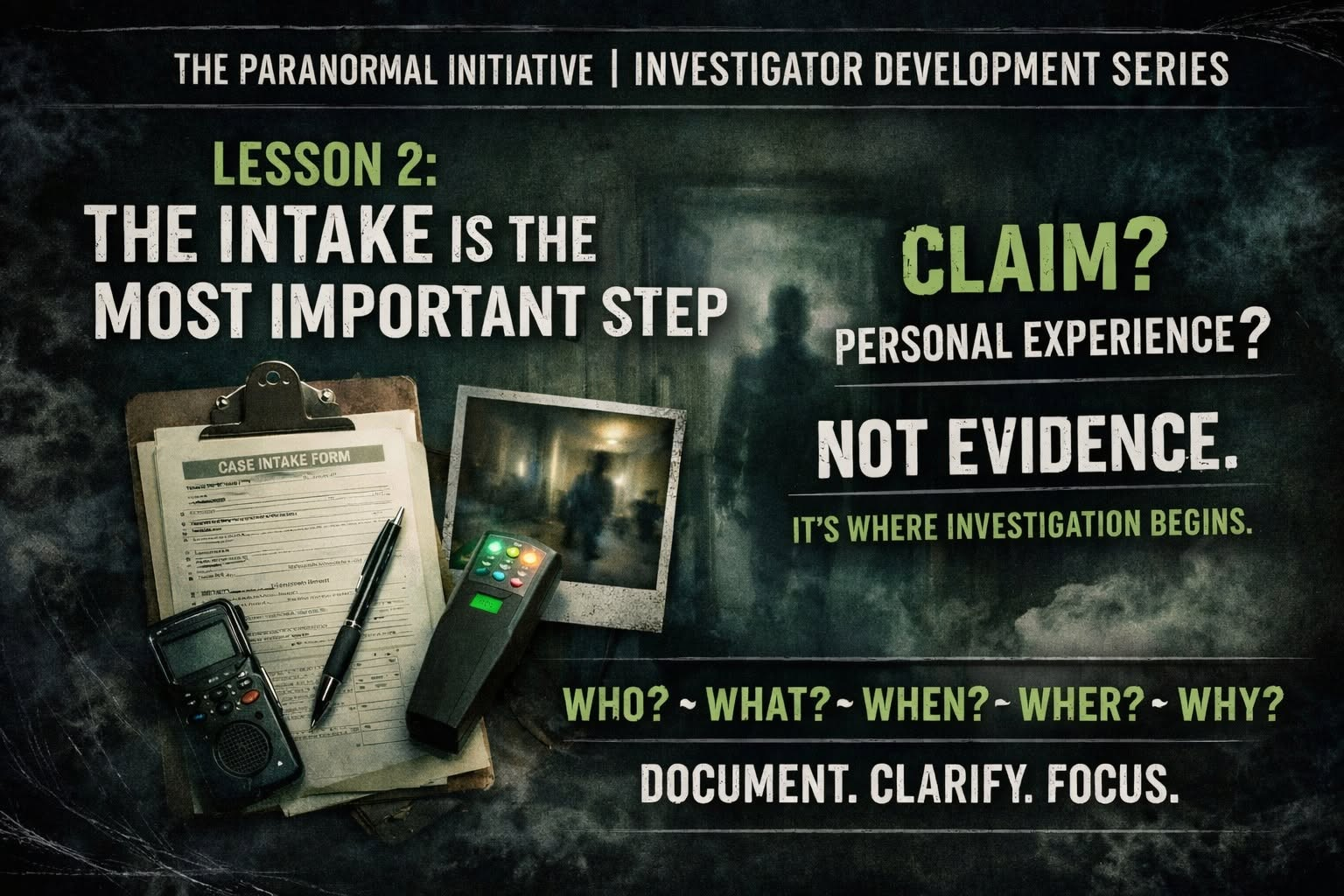
Lesson 2: The Intake Is The Most Important Step

The intake is not simple paperwork. It is the beginning of the investigation, where the foundation of the entire case is built.

Series Index Investigation Methodology
The intake is the most important step graphic

The Investigation Begins At Intake

One of the most common mistakes in paranormal investigation is treating the intake like simple paperwork, something to get through quickly so the real investigation can begin.

In reality, the intake is the beginning of the investigation. Long before a walkthrough, baseline readings, or any piece of equipment is turned on, the intake is where the foundation of the entire case is built.

Everything that follows, every decision, every focus area, and every conclusion, is shaped by the quality of this step. If that foundation is weak, the investigation will be weak.

Document The Claim

At its core, the intake is not just about collecting a story. It is about documenting a claim.

This is a critical distinction. What a client provides during intake is not evidence of the paranormal. It is their personal experience, their perspective of what they believe they have seen, heard, or felt.

That experience may be genuine. It may be emotional. It may be unsettling or even life-altering for them. But from an investigative standpoint, it is not proof. It is a starting point.

It is unverified information that must be carefully documented, clarified, and later evaluated.

Turn Experience Into A Line Of Inquiry

A professional intake takes that experience and begins to organize it into something that can actually be investigated.

Who is experiencing the activity? What exactly is being reported, in clear and specific terms? When did it begin? How often does it occur? Has it changed over time? Where in the location does it happen most frequently?

Are multiple individuals reporting the same experiences, or is it isolated to one person? Are there patterns tied to time of day, environmental conditions, emotional states, or daily routines?

These are not small details. They are the framework of the case. They are what transform a vague experience into a structured line of inquiry.

Rushed Intake Creates Reactive Investigation

When intake is rushed or treated casually, the entire investigation becomes unfocused. Teams arrive on location with equipment, but without direction.

They move from room to room without understanding where activity is actually being reported. They ask questions without knowing what they are trying to confirm or challenge.

At that point, the investigation is no longer structured. It becomes reactive, and reactive investigation leads to misinterpretation.

Clarify Without Challenging

A thorough intake begins to reveal patterns, inconsistencies, and environmental possibilities.

Someone may say, "This happens all the time." But when you slow the conversation down and ask structured questions, a different picture often emerges.

Maybe the sounds only occur near a specific wall that contains plumbing or ductwork. Maybe sightings are reported only during low-light conditions late at night. Maybe one individual reports frequent experiences while others in the same environment report none at all.

This is not about challenging the person. It is about clarifying the claim, because clarity is what allows for proper investigation.

Protect The Integrity Of The Case

The intake is also where investigators begin protecting the integrity of the case. The more precise and structured the intake is, the less likely the team is to introduce contamination later.

A disciplined intake avoids leading questions, shaping the narrative, or unintentionally reinforcing assumptions. Instead, it preserves what was actually reported in its most accurate form.

The Beginning Of Truth-Seeking

Too many teams rush past this step because it is not dramatic. There are no flashing lights, no equipment readings, and no immediate excitement.

But this is where professionalism is established. A disciplined investigator understands that if you do not fully understand the claim, you cannot properly investigate it.

The intake is not a formality. It is the beginning of truth-seeking.

Previous Lesson Back to Series Reporting Standards