Equipment & Technology

Understanding SLS Cameras

What SLS cameras are, how Kinect depth tracking works, and how investigators can use structured light sensor data responsibly during paranormal research.

Series Index Equipment & Technology
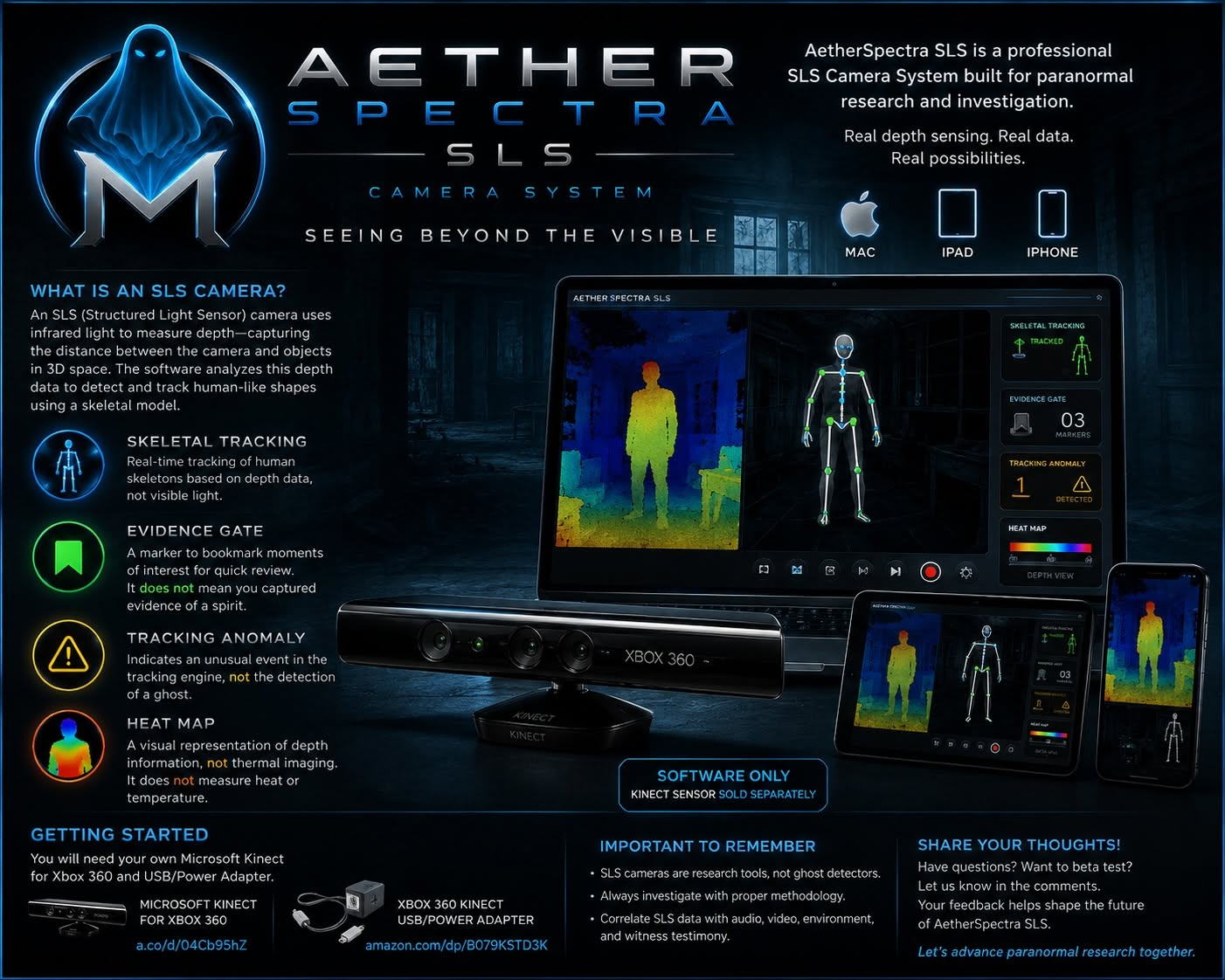
Understanding SLS cameras and AetherSpectra SLS educational graphic

A Misunderstood Tool

With the upcoming release of AetherSpectra SLS for macOS, iPadOS, and iOS, this is a good time to talk about one of the most misunderstood pieces of equipment in paranormal investigation: the SLS Camera.

Many investigators have seen the stick figures on television or social media, but far fewer understand what the camera is actually doing behind the scenes.

Let us change that.

What An SLS Camera Measures

An SLS, or Structured Light Sensor, camera is not looking for ghosts. It is looking at depth.

Unlike a standard video camera that records color, an SLS camera uses infrared structured light to measure the distance between the sensor and objects in front of it.

The result is a three-dimensional depth map of the environment.

Why The Kinect Became Popular

The Microsoft Kinect for Xbox 360 became popular within the paranormal community because it offered an affordable depth sensor originally designed for gaming.

Developers soon discovered that its depth data could be used to recognize and track the shape of the human body.

That is where the familiar stick figure comes from.

What The Stick Figure Means

The software continuously analyzes depth information and compares it against a mathematical model of the human skeleton.

If enough depth points resemble a head, shoulders, arms, torso, hips, and legs, the software attempts to overlay a skeletal model onto those points.

Notice the key word: attempts.

Sometimes that is because a person is actually standing there. Other times, furniture, shelving, doorways, plants, irregular surfaces, reflections, or other environmental conditions may briefly resemble enough human features for the tracking engine to create a skeletal model.

This is why context is so important. A tracked figure is an observation, not a conclusion.

Evidence Gates Are Bookmarks

One feature often found on SLS systems is something labeled an Evidence Gate.

Despite the name, this does not automatically mean you have captured evidence of a spirit or paranormal activity.

An Evidence Gate is simply a marker. Think of it like placing a bookmark in a book.

If something interesting occurs, such as a skeletal track appearing, an object moving unexpectedly, or a moment you want to review later, an Evidence Gate helps you return to that exact point during evidence review.

It helps organize your investigation. It marks the moment for review, but the meaning of that moment still has to be evaluated.

Tracking Anomalies Are Not Conclusions

A Tracking Anomaly notification also does not automatically mean the camera has detected a ghost.

It indicates that the skeletal tracking engine encountered something unusual while trying to interpret depth information.

The software may have briefly lost a tracked body, detected only portions of a skeleton, experienced rapid joint movement, or found depth data that did not fit its normal tracking model.

The anomaly exists within the tracking process itself. Its significance depends on context, corroboration, environmental review, and whether ordinary causes can be reasonably ruled out.

Heat Map Does Not Mean Thermal

Another area that causes confusion is the Heat Map.

Despite its name, this is not thermal imaging. It is not FLIR technology. It is not measuring temperature.

A Heat Map is simply a visual representation of depth. Different colors represent different distances from the camera.

If you are looking for actual heat signatures or temperature differences, you need a true thermal imaging camera. Thermal cameras detect infrared heat energy, which is completely different technology than the depth sensing used by an SLS camera.

Other Depth Cameras

Although the Kinect remains one of the most popular sensors in paranormal research, it is not the only depth camera available.

Industrial-grade depth sensors from companies such as Intel, Orbbec, and Stereolabs can provide higher resolutions, greater accuracy, improved range, and more advanced capabilities.

Many of those professional sensors cost hundreds or even thousands of dollars. For many investigators, the Microsoft Kinect for Xbox 360 continues to offer a strong balance between capability, affordability, and availability.

How To Use SLS Responsibly

Start by documenting your environment before turning the camera on.

Take note of furniture, mirrors, shelving, hanging clothing, plants, decorations, reflective surfaces, and anything else that could influence skeletal tracking.

When a skeletal figure appears, do not immediately assume you have captured something paranormal. Observe whether it remains stable over time. Move to different viewing angles. See if the tracking changes or disappears.

Compare what you are seeing with audio recordings, photographs, environmental readings, witness observations, and any other evidence collected during the investigation.

The strongest investigations are never built around a single piece of equipment. They are built by combining multiple independent observations and evaluating them together.

How AetherSpectra SLS Fits In

That philosophy is exactly what inspired AetherSpectra SLS.

The goal is not simply to display stick figures on a screen. The goal is to provide investigators with a modern research platform that helps document observations, organize investigations, and better understand what the depth sensor is actually reporting.

AetherSpectra SLS is being developed natively for macOS, iPadOS, and iOS, bringing professional SLS software to the Apple ecosystem without requiring Windows.

Getting Started

AetherSpectra SLS is software only. To use the SLS Camera features, you will need your own Microsoft Kinect for Xbox 360 and the Xbox 360 Kinect USB/Power Adapter. These items are not included with the software.

If you already own a Kinect from your Xbox 360, you may only need the USB/Power Adapter. If you are purchasing one for the first time, be sure you are buying the Xbox 360 Kinect sensor, as that is the hardware AetherSpectra SLS is designed to support.

As development continues, real-world feedback from investigators will help shape the platform and its field workflow.

For Apple Users Back to Series Seeing Beyond The Visible