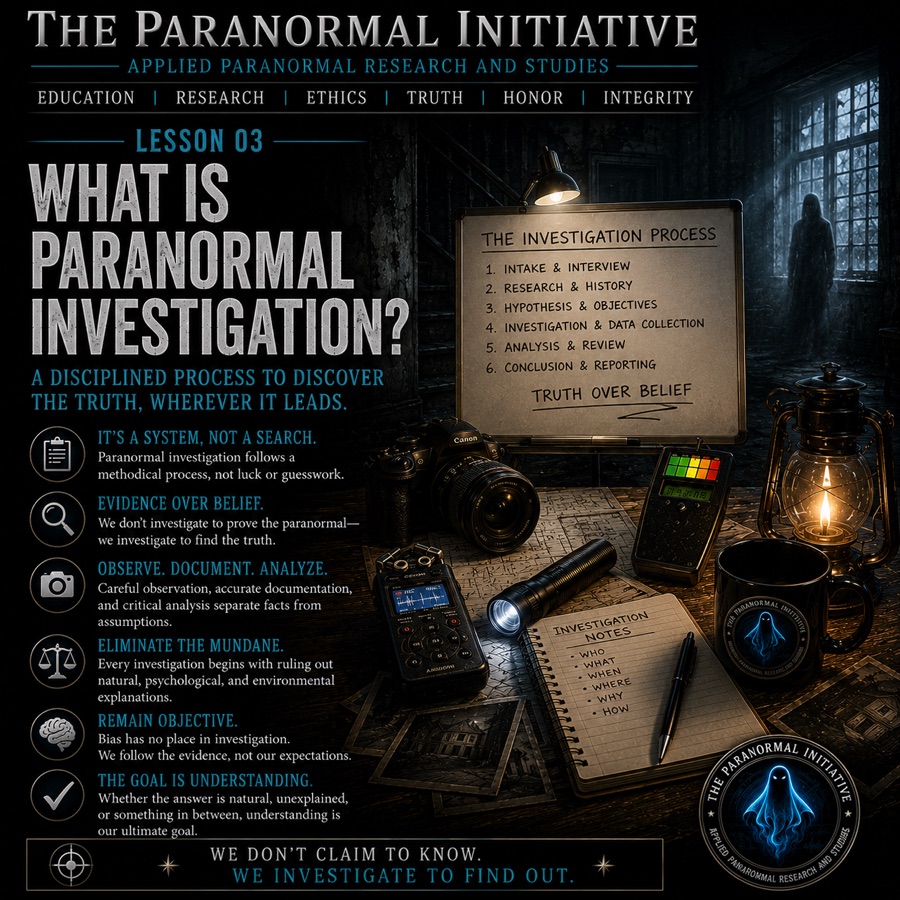
While every case is different, most investigations follow a general sequence. This sequence is not a rigid script, but a framework that adapts to the specific circumstances of each case.
Receive a report. Someone contacts you with a claim. Document the initial contact, the nature of the claim, and the client's concerns.
Research. Before visiting the location, learn its history. Check property records, newspapers, historical societies, and any previous investigation reports.
Interview. Speak with the witnesses or clients. Record their accounts in their own words. Ask open-ended questions. Do not lead them toward a particular explanation.
Observe. Visit the location. Note the environmental conditions: temperature, sounds, lighting, odors, airflow, layout. Document everything before interpreting anything.
Document. Take photographs. Record audio. Note the position of furniture, windows, vents, and appliances. Create a baseline of normal conditions.
Measure. Use equipment to collect environmental data. But remember: equipment measures physical conditions, not spirits. The data is context, not proof.
Analyze. Review all collected data. Compare it against natural explanations. Look for patterns, correlations, and contradictions.
Compare. Compare your findings with the original claim. Does the evidence support the claim, contradict it, or leave it unresolved?
Report. Write a clear summary of what you did, what you found, what you can explain, and what remains unknown. Be honest about uncertainty.
Review. Share your findings with colleagues. Invite critique. Consider what you might have missed. Learn from the process.
Each of these stages will be explored in depth in later tracks. For now, the goal is to understand the overall shape of an investigation.
Students should notice that this process does not begin with equipment. Equipment appears after the claim has been received, the location has been researched, the people have been interviewed, and the team understands what it is trying to document. This is one of the most important beginner corrections. A recorder, camera, or EMF meter cannot fix a poorly defined question.
Students should also notice that the process does not end when the team leaves the location. Evidence review, source organization, file preservation, report writing, client communication, and peer review are part of the investigation. A team that collects files but never reviews them carefully has not completed the work. A team that experiences something strange but never writes a clear report has not created a useful record.