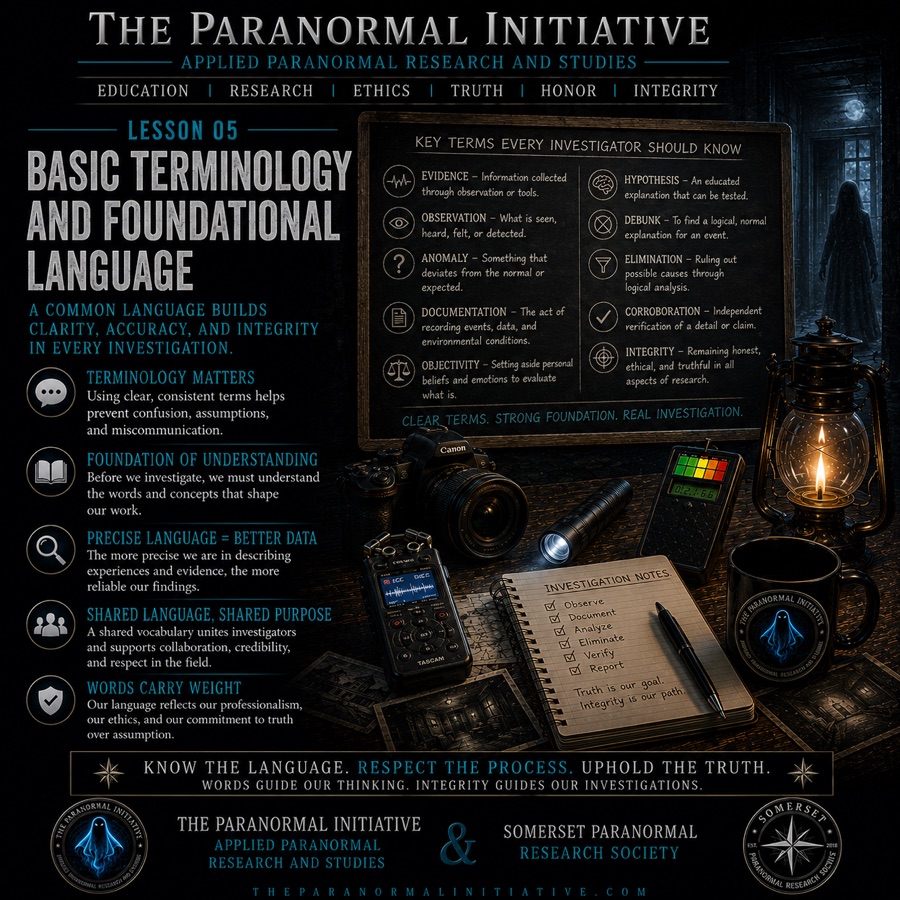
The following terms form the foundation of investigative language. Learn them, use them, and return to this lesson whenever you need a reminder.
Investigation is the structured, evidence-minded process of examining a claim or report. It is not the same as ghost hunting. Investigation follows a method. Ghost hunting follows curiosity. Both have value, but they are different activities.
Observation is something you notice with your senses. "I heard a knock" is an observation. "I felt a temperature change" is an observation. Observations are the raw material of investigation. They must be recorded before they are interpreted.
Documentation is the practice of creating a permanent record of observations, conditions, and evidence. Documentation separates investigation from storytelling.
Evidence is documented, preserved, reviewable material that can be analyzed and challenged by others. A recording of a sound is evidence. The memory of hearing a sound is not.
Claim is what someone reports experiencing. "I heard a voice in the hallway" is a claim. A claim is not evidence. It is the starting point for investigation.
Witness is a person who reports an experience. Witnesses may be sincere and still be mistaken. The investigator's job is to document the witness's account accurately and test it against possible explanations.
Experience is something a person perceives. Experiences can be meaningful and real without being paranormal. An experience is not the same as evidence.
Report is a formal account of an observation, claim, or investigation. Reports should be written clearly and objectively.
Incident is a specific event or occurrence within an investigation. Multiple incidents may be documented within a single case.
Anomaly is something that cannot be immediately explained by known causes. An anomaly is not proof of anything paranormal. It is simply something that requires further investigation.
Hypothesis is a tentative explanation that can be tested. A hypothesis is not a conclusion. It is a starting point for further inquiry.
Conclusion is a finding reached after evidence has been gathered and analyzed. Conclusions should be supported by evidence and expressed with appropriate certainty or uncertainty.
Environmental Factor is a condition in the physical environment that could affect an investigation. Temperature, humidity, light, sound, and electromagnetic fields are all environmental factors.
Natural Explanation is a cause that can be explained by ordinary physical, environmental, or human factors. Finding a natural explanation is not failure. It is the most common outcome of an honest investigation.
Unknown is a finding that remains unexplained after investigation. "Unknown" is an acceptable conclusion. It does not mean paranormal. It means the cause could not be determined.
Correlation is a relationship between two or more events or measurements. Correlation does not prove causation. Two things happening at the same time does not mean one caused the other.
Pattern is a repeated series of events or observations. Patterns can support a hypothesis, but they can also be coincidental.
Contamination is anything that compromises the integrity of evidence or an investigation. Investigator movement, handling noise, environmental interference, and equipment error are all sources of contamination.
Baseline is the normal range of environmental conditions at a location before any unusual activity is considered. Establishing a baseline is essential before looking for anomalies.
Debunking is the process of testing a claim against natural explanations. It is not dismissive. It is a core investigative practice that strengthens the credibility of any finding that remains unexplained.
False Positive is a normal event, device response, image artifact, sound, or sensation that appears paranormal until context explains it. Dust in a photograph, radio bleed in an audio file, a loose door latch, or an EMF reading near wiring can all become false positives if they are not checked.
Control is a condition, sample, or procedure used for comparison. A quiet audio recording made before active questioning can serve as a control sample. A temperature reading in a normal room can be compared to a reported cold spot. Controls help investigators understand what is normal before treating something as unusual.
Chain of Custody is the record of how evidence was collected, stored, copied, reviewed, and transferred. Even beginner investigators should learn the idea: preserve originals, label files, note who collected them, and document changes made during analysis.
Interpretation is the meaning assigned to an observation. "The recorder captured a voice-like sound" is an observation about a file. "A spirit answered the question" is an interpretation. Interpretations must be clearly separated from observations.
Finding is a reported result after review. A finding may be explainable, inconclusive, unresolved, or potentially significant. A finding should be supported by documentation and should not be stronger than the evidence allows.