Ghostology 101 · Lesson 06

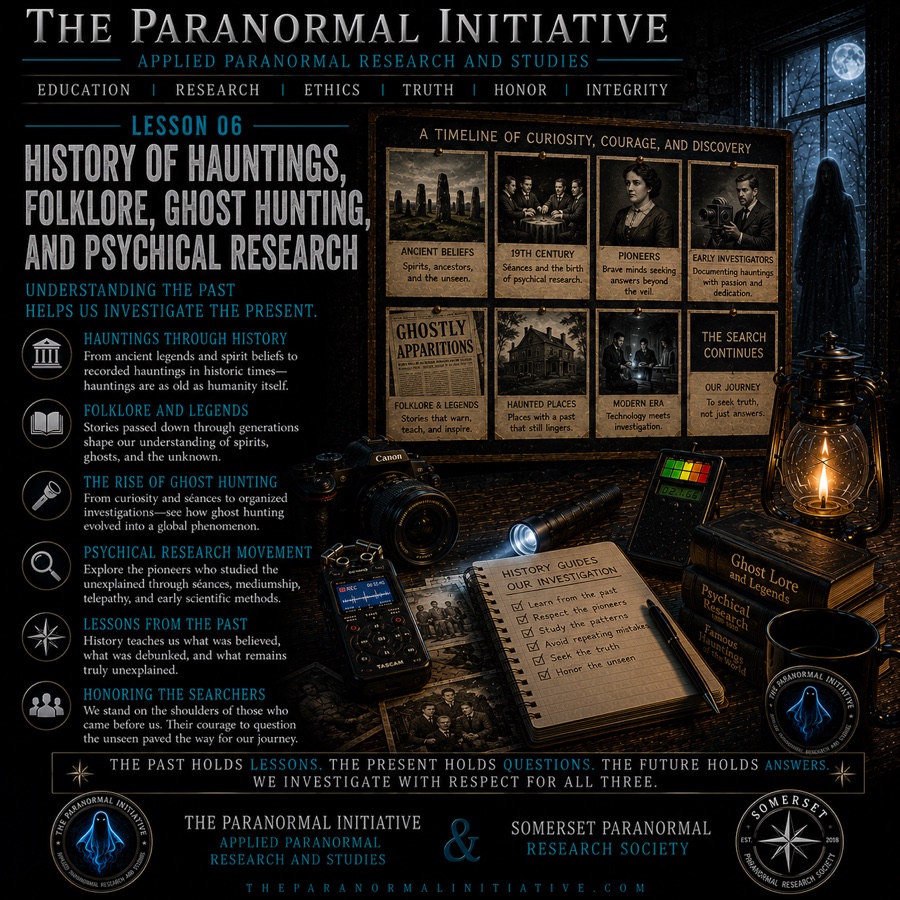
History of hauntings, folklore, ghost hunting, and psychical research

This lesson introduces the long history behind ghost stories, folklore, spiritualism, early psychical research, modern ghost hunting, and contemporary investigation culture.

All Lessons Lesson 05 Lesson 07
Ghostology 101 lesson 06 visual

Lesson Reading

Lesson Purpose

This lesson is the historical cornerstone of Ghostology 101. It traces the human relationship with the unexplained from the earliest recorded history through the modern era of paranormal investigation. Understanding this history is not optional. Every claim you investigate, every location you research, and every witness you interview exists within a cultural and historical context shaped by thousands of years of human experience. This lesson provides that context. By the end, you will understand that today's paranormal investigation is not a new phenomenon. It is the latest expression of a human curiosity that is as old as humanity itself.

The purpose is not to make students historians in one lesson. The purpose is to give them historical awareness. A beginner who knows nothing of folklore, Spiritualism, psychical research, public ghost cases, media influence, and older belief systems may unknowingly repeat old mistakes. They may treat a legend as fact, a repeated story as evidence, or a famous case as proof. Historical awareness slows that process down.

This lesson also teaches humility. Modern investigators have better cameras, recorders, databases, and environmental tools than earlier generations, but the core problems remain familiar: witness memory, belief, fraud, fear, grief, rumor, expectation, documentation, and interpretation. Technology changes. Human meaning does not change as quickly.

Learning Objectives

By the end of this lesson, students should be able to: describe how ancient civilizations understood and documented encounters with spirits and the afterlife; explain how folklore and oral tradition preserved and transformed paranormal accounts across generations; identify the key beliefs and practices of medieval and early modern Europe regarding ghosts and hauntings; describe the rise of Spiritualism in the 19th century and its impact on modern investigation; identify the major figures and organizations in early psychical research; trace the development of ghost hunting from the 19th century through the television era; explain how the internet and social media have transformed paranormal investigation; describe the current state of modern paranormal investigation as a field; and articulate why historical context matters for every investigation they conduct.

Students should also be able to separate three different historical layers: documented history, folklore, and modern interpretation. Documented history is supported by records. Folklore is a traditional story or belief that may preserve cultural memory but may not be factually reliable. Modern interpretation is what present-day witnesses, investigators, guides, writers, or media creators add to the story. A responsible investigator should know which layer they are using.

By the end of this chapter, students should be able to explain why historical research is not just background decoration. It affects interview questions, expectation control, location selection, evidence interpretation, client communication, and final reporting.

Introduction — The Longest Story Ever Told

People have reported strange experiences for as long as there have been people. Ghost stories appear in the earliest written records, from the clay tablets of ancient Mesopotamia to the papyrus scrolls of Egypt, from the philosophical dialogues of classical Greece to the epic poems of Rome. Every culture that has ever existed has developed traditions about spirits, the afterlife, and the boundary between the living and the dead. These traditions are not identical. They differ in their details, their explanations, and their cultural meanings. But the underlying human experience — the sense that something exists beyond the physical world we can see and touch — is remarkably consistent across time and geography.

This lesson traces that long history. It moves from the ancient world through folklore and oral tradition, through medieval and early modern beliefs, through the rise of Spiritualism and the birth of psychical research, through the emergence of modern ghost hunting, and into the internet era and contemporary investigation. The goal is not to prove or disprove any particular belief about spirits. The goal is to understand how we arrived at the present moment in paranormal investigation. Every investigator who understands this history is better equipped to evaluate claims, to understand witnesses, and to place their own work in a context that stretches back thousands of years.

Paranormal investigation is not a new pursuit. It is the latest chapter in a very long story. This lesson tells that story.

Students should pay attention to patterns as they move through the timeline. Many eras contain the same repeated elements: a strange report, a frightened or fascinated community, a cultural explanation, an attempt to verify the event, and a debate over belief, fraud, error, or meaning. The details change. The pattern remains. Understanding that pattern helps modern investigators recognize when a case is being shaped by more than the evidence itself.

Death and the Human Experience

Before examining specific historical periods, it is worth considering the fundamental human experience that underlies all paranormal belief and investigation: death. Every human being who has ever lived has faced the reality of death. Every culture has developed ways of understanding what happens after death. Every person who has lost someone they love has wondered whether that person continues to exist in some form.

This universal experience is the foundation upon which all ghost stories, all beliefs in an afterlife, and all paranormal investigation are built. The fear of death, the grief of loss, the hope for continued existence, and the curiosity about what lies beyond are not cultural artifacts. They are part of being human. Understanding this helps explain why ghost stories appear in every culture, why people report experiences of deceased loved ones, and why the field of paranormal investigation continues to attract serious students.

It also explains why the subject must be treated with respect. Behind every paranormal claim is a person who may be grieving, frightened, or searching for meaning. The history of how humans have responded to death and the unknown is not just academic. It is the context for every investigation you will ever conduct.

This is why Ghostology 101 does not treat history as trivia. A student who studies death beliefs across cultures learns that ghost reports often carry emotional and spiritual weight. A cemetery legend, a deathbed vision, a family apparition, or a reported message from the dead may be part of how people cope with mortality. The investigator should not flatten that meaning into entertainment. At the same time, the investigator should not let meaning replace evidence.

Ancient Civilizations — Mesopotamia, Egypt, Greece, and Rome

The earliest written records of human civilization contain accounts of spirits, ghosts, and interactions with the dead. These records provide our first glimpse into how ancient peoples understood the boundary between the living and the dead.

Mesopotamia. The ancient Sumerians, Babylonians, and Assyrians believed in a underworld called Kur, to which all souls descended after death. Ghosts were taken seriously. If a person died improperly — without proper burial rites, by violence, or before their time — their spirit could return to trouble the living. Mesopotamian texts include rituals for appeasing restless spirits, exorcisms for driving away malevolent ghosts, and even legal documents addressing ghost-related disputes. The Epic of Gilgamesh, one of the oldest surviving works of literature, includes a scene in which Gilgamesh summons the spirit of his deceased friend Enkidu from the underworld. This story, written nearly four thousand years ago, reflects the same human desire to contact the dead that drives modern EVP sessions and seances.

Ancient Egypt. Egyptian civilization developed an elaborate understanding of the afterlife that influenced cultures for millennia. The soul was believed to consist of multiple components: the Ka (life force), the Ba (personality), and the Akh (transformed spirit). Death was a transition, not an end. The elaborate burial practices, tomb paintings, and funerary texts like the Book of the Dead were designed to ensure a successful journey through the underworld. But not all spirits moved on peacefully. Egyptian texts describe ghosts who could return to harm the living, and there are records of priests performing rituals to pacify restless spirits. The Egyptian concern with proper burial and the peaceful transition of the dead echoes in modern haunting claims, where improper burial or unresolved death is often cited as a cause of paranormal activity.

Ancient Greece. Greek civilization produced some of the most influential ideas about ghosts and the afterlife in Western history. Homer's Odyssey, composed around the 8th century BCE, includes a famous scene in which Odysseus travels to the underworld and speaks with the spirits of the dead. The Greek concept of Hades as a shadowy underworld where all souls dwelled after death shaped Western imagination for centuries. But the Greeks also distinguished between different types of spirits. Some were the restless dead who had not received proper burial. Others were heroes or ancestors who could protect the living. The Greek philosopher Plato wrote extensively about the nature of the soul and its survival after death, ideas that would influence later Christian theology and psychical research alike. Greek ghost stories, or "phantasma," were collected and told as cautionary tales, much like modern paranormal accounts shared on social media.

Ancient Rome. The Romans inherited and expanded Greek ideas about ghosts. Roman literature is filled with ghost stories. The writer Pliny the Younger, in the 1st century CE, recorded one of the most famous early ghost stories: the tale of a haunted house in Athens where a ghostly old man with a beard and shackles appeared nightly. The story includes details that would be familiar to any modern investigator: the ghost was seen in a specific location, it appeared at a consistent time, and it was eventually discovered that the ghost's bones were buried on the property. When the bones were given a proper burial, the haunting stopped. This story, nearly two thousand years old, contains the same elements found in countless modern haunting reports: a specific location, a recurring figure, a connection to an unresolved death, and resolution through proper treatment of remains.

The ancient world did not have a single unified belief about ghosts. Different cultures, and different individuals within those cultures, held different views. But the consistent thread across all of them is the recognition that encounters with the dead were real experiences that required explanation, response, and often ritual intervention. This is the earliest form of paranormal investigation.

Modern students should notice that ancient accounts often connect haunting claims to social obligations: proper burial, family duty, respect for the dead, unfinished business, moral wrongdoing, or ritual correction. Those themes still appear in modern reports. A client may believe activity began after a death, a renovation, an antique purchase, or disturbance of a grave. Historical awareness does not prove that explanation. It helps the investigator recognize the story pattern and document it carefully.

Folklore and Oral Tradition

Before written records became common, stories about spirits and strange events were preserved through oral tradition. Folklore — the collected beliefs, stories, and customs of a people — is the oldest and most widespread form of paranormal reporting. It is also the most difficult to verify, because oral stories change with each telling.

Folklore served many purposes in traditional societies. It explained natural phenomena that had no obvious cause: strange sounds in the forest, unexplained illnesses, sudden deaths, unusual weather. It taught moral lessons: stories about ghosts punishing the wicked or rewarding the virtuous reinforced community values. It preserved history: events that actually occurred could be transformed into stories that were remembered and passed down. It provided comfort: belief in an afterlife and the possibility of continued connection with loved ones helped people cope with grief. And it entertained: a good ghost story told around a fire is as compelling today as it was a thousand years ago.

Every culture has its own ghost folklore. In Japan, the yurei are spirits who cannot move on due to unfinished business or violent death. In Ireland, the banshee is a spirit whose wailing foretells death. In Scandinavia, the draugr is a revenant — a dead person who returns to guard their grave or haunt the living. In Africa, ancestor spirits are believed to remain involved in the lives of their descendants, offering guidance or expressing displeasure. In the Americas, Indigenous traditions include a wide range of spirit beliefs, from protective ancestors to trickster figures to nature spirits.

These traditions are not interchangeable. Each reflects the specific cultural context in which it developed. But they share common themes: the dead can interact with the living; some spirits are benevolent and others are dangerous; proper treatment of the dead is essential for peaceful transition; and certain places or circumstances are more likely to produce spiritual encounters.

For the modern investigator, folklore is both valuable and dangerous. It is valuable because it preserves the history of a location and the experiences of people who lived there. It can provide leads for research and context for understanding witness reports. It is dangerous because folklore is not evidence. A story that has been told for generations may bear little resemblance to the original event. Details are added, exaggerated, or forgotten with each retelling. The investigator's job is to respect folklore as cultural heritage while testing it against documented evidence.

A useful method is to write folklore in the case file as folklore. Do not erase it, and do not promote it to fact. A report might say: "Local legend describes a woman in white near the bridge; no primary source has yet been located for the death story connected to the legend." That sentence preserves the tradition without overstating the evidence.

Folklore can also influence witnesses before an event occurs. If visitors are told that a staircase is haunted, they may pay special attention to every sound near the staircase. If a guide says a room feels heavy, later visitors may report heaviness. The folklore becomes part of the environment. It must be documented as a source of expectation.

Medieval and Early Modern Beliefs

The medieval period in Europe (roughly 5th to 15th centuries) saw a significant transformation in how ghosts and spirits were understood. The Christian Church became the dominant institution in European life, and its theology shaped beliefs about the afterlife, the soul, and the nature of spiritual encounters.

Medieval Christian Theology of Ghosts. The medieval Church taught that after death, souls went to one of three places: Heaven, Hell, or Purgatory. Purgatory, a temporary state of purification for souls who died in a state of grace but were not yet pure enough for Heaven, became particularly important for ghost beliefs. A soul in Purgatory could, under certain circumstances, return to ask for prayers, masses, or other acts of charity that would hasten its journey to Heaven. This created a theological framework for ghosts that was both acceptable and useful: ghosts were not demons or illusions, but souls of the dead seeking help from the living.

Medieval literature is filled with ghost stories that reflect this theology. The English monk Bede, writing in the 8th century, recorded accounts of the dead appearing to the living. The 12th-century historian William of Malmesbury wrote about a ghost that appeared to a bishop and asked for masses to be said for his soul. The most famous medieval ghost story collection, the Dialogus Miraculorum (Dialogues on Miracles) by Caesarius of Heisterbach, written around 1220, contains dozens of accounts of ghosts, apparitions, and spiritual encounters, all interpreted through a Christian lens.

The Reformation and Changing Beliefs. The Protestant Reformation of the 16th century dramatically changed ghost beliefs in Europe. Protestant reformers rejected the concept of Purgatory as unbiblical. If there was no Purgatory, then souls could not return from it. This created a theological problem: what were ghosts, if not souls from Purgatory? Some Protestant theologians argued that ghosts were demons impersonating the dead. Others argued that they were illusions or natural phenomena. Still others maintained that some ghostly encounters might be genuine, but they were rare and required careful discernment.

This theological uncertainty created a more skeptical environment in some quarters, but it did not eliminate belief in ghosts. If anything, the Reformation's emphasis on personal interpretation of scripture and individual spiritual experience may have encouraged people to trust their own encounters rather than relying solely on Church authority. Ghost stories continued to be told, collected, and debated throughout the early modern period.

The Witch Hunts and Spectral Evidence. The early modern period (16th-17th centuries) was also the era of the European witch hunts, during which tens of thousands of people were executed for witchcraft. The concept of "spectral evidence" — testimony that the accused person's spirit or specter had appeared to the witness in a dream or vision — played a role in some witch trials, most famously in the Salem witch trials of 1692-1693 in colonial Massachusetts. The use of spectral evidence was controversial even at the time, and its role in the witch trials serves as a powerful historical warning about the dangers of accepting unverifiable testimony as evidence. The Salem trials remain a cautionary tale for investigators: when fear, belief, and social pressure override careful evaluation of evidence, the results can be tragic.

The Cock Lane Ghost. One of the most famous ghost cases of the 18th century was the Cock Lane Ghost in London (1762). A family reported strange knocking sounds, scratching, and other disturbances in their home. The case attracted enormous public attention, with crowds gathering outside the house and newspapers publishing daily updates. A committee of investigators, including the noted writer and lexicographer Samuel Johnson, examined the case. Johnson concluded that the phenomena were fraudulent, and the case eventually collapsed when the alleged source of the disturbances — a young girl named Elizabeth Parsons — was discovered to be producing the sounds herself. The Cock Lane case is significant because it represents one of the first widely publicized paranormal investigations, complete with public scrutiny, skeptical examination, and eventual exposure of fraud. It set a pattern that would repeat many times in the centuries to come.

The medieval and early modern periods show why investigators must understand the belief system surrounding a claim. A ghost report in a Catholic medieval village, a Protestant household after the Reformation, a Puritan community during witchcraft fears, and an eighteenth-century newspaper culture would each be interpreted differently. The event might be similar, but the explanation offered by the community would change. Modern investigators face the same issue when working with families from different religious, cultural, or skeptical backgrounds.

The Rise of Spiritualism

The 19th century witnessed one of the most significant developments in the history of paranormal belief: the rise of Spiritualism. Spiritualism was a religious movement based on the belief that the dead could communicate with the living through mediums — individuals with the ability to receive messages from spirits. The movement began in the United States in the 1840s and spread rapidly across the world, reaching Europe, Australia, and beyond.

The Fox Sisters and Hydesville. The Spiritualist movement is traditionally dated to 1848, when two young sisters, Margaret and Kate Fox, reported hearing mysterious knocking sounds in their family home in Hydesville, New York. The knocks seemed to respond to questions. A code was developed: one knock for yes, two for no. The sisters claimed that the spirit of a murdered peddler was communicating with them. The case attracted enormous attention, and the Fox sisters became famous as the first modern mediums.

The Fox case is complex and controversial. Years later, Margaret Fox publicly confessed that the knocks had been produced by cracking the joints of her toes — a trick she demonstrated for reporters. She later recanted her confession, and the debate over the authenticity of the Fox sisters continues among Spiritualists to this day. Regardless of the truth of the original case, the Fox sisters' story ignited a movement that would transform Western culture's relationship with the paranormal.

The Spread of Spiritualism. Spiritualism spread rapidly through the United States and Europe. Mediums offered seances in which they communicated with the dead, producing messages, physical phenomena like table-tilting and levitation, and materializations of spirit forms. The movement attracted followers from all social classes, including intellectuals, artists, politicians, and scientists. Mary Todd Lincoln, the wife of President Abraham Lincoln, held seances in the White House. The writer Arthur Conan Doyle, creator of Sherlock Holmes, became a devoted Spiritualist and wrote extensively in defense of the movement.

Spiritualism appealed to many people for several reasons. It offered comfort to the grieving by promising continued connection with loved ones. It provided a scientific-seeming framework for spiritual experience, with mediums as investigators and seances as experiments. It challenged the authority of established religion by offering direct, personal access to the spirit world. And it was genuinely exciting — the possibility of witnessing a materialized spirit or receiving a message from a deceased loved one was compelling in a way that traditional religious services often were not.

Fraud and Investigation. Spiritualism also attracted fraud. Many mediums were exposed as charlatans who used trickery to produce their phenomena: hidden wires, accomplices, ventriloquism, and simple sleight of hand. The exposure of fraudulent mediums became a minor industry in itself, with investigators like the magician Harry Houdini devoting significant effort to debunking mediumship claims. Houdini, who desperately wanted to believe in an afterlife after his mother's death, was uniquely qualified to expose fraud because he knew how magic tricks were performed. He spent years attending seances and demonstrating how mediums produced their effects through trickery.

The tension between genuine belief and deliberate fraud that characterized Spiritualism is still present in modern paranormal investigation. Every investigator must be aware that fraud exists, that it damages the credibility of the field, and that honest investigation requires vigilance against it. But the existence of fraud does not prove that all paranormal claims are fraudulent. It simply means that investigators must apply rigorous standards to every claim they encounter.

Spiritualism also changed public expectations. It suggested that contact with the dead might be repeatable, interactive, and even testable in a sitting or seance. Modern EVP sessions, spirit-box sessions, trigger-object experiments, and question-response formats echo that older desire for interaction. Students should understand that today's tools may look different, but the underlying hope is familiar: ask a question, receive a response, and interpret that response as communication.

This history should make students careful. Communication formats are vulnerable to suggestion, fraud, ambiguous signals, and emotional need. A knock, a table movement, a radio fragment, or a voice-like sound can feel like an answer because the session structure invites people to hear it as an answer. That does not mean every response is meaningless. It means the method needs controls.

Birth of Psychical Research

The rise of Spiritualism created a demand for serious, systematic investigation of paranormal claims. If mediums could genuinely communicate with the dead, that fact would have profound implications for our understanding of consciousness and the nature of reality. If they could not, it was important to understand why so many people believed they could. Either way, the subject deserved serious study.

The Society for Psychical Research (SPR). The Society for Psychical Research was founded in London in 1882 by a group of distinguished scholars, scientists, and philosophers. Its purpose was to investigate "that large body of debatable phenomena designated by such terms as mesmeric, psychical, and Spiritualistic" using scientific methods. The SPR's founders included Henry Sidgwick, a prominent philosopher and economist; Frederic W. H. Myers, a poet and classicist; Edmund Gurney, a psychologist; and William Barrett, a physicist. The SPR established a model for psychical research that would influence the field for generations.

The SPR conducted systematic investigations of mediums, collected and analyzed reports of apparitions and hauntings, studied telepathy and other forms of claimed extrasensory perception, and published its findings in a series of journals and proceedings. The Society's methods were rigorous for their time: they required multiple witnesses, controlled conditions, and detailed documentation. They were not always successful in preventing fraud, but they established the principle that paranormal claims could and should be investigated scientifically.

William James. The American philosopher and psychologist William James was one of the most important figures in early psychical research. James, who taught at Harvard University, was both a rigorous scientist and a genuinely open-minded investigator of paranormal claims. He served as president of the Society for Psychical Research and conducted extensive investigations of mediums, most notably the Boston medium Leonora Piper. James was convinced that some of Piper's communications contained information that could not be explained by normal means. At the same time, he remained cautious in his conclusions, acknowledging the difficulty of proving paranormal phenomena to the satisfaction of skeptical scientists.

James's approach to psychical research exemplifies the balance that the field requires: open-minded enough to consider extraordinary possibilities, skeptical enough to demand rigorous evidence, and honest enough to acknowledge uncertainty. His famous statement about the study of psychic phenomena — "I am not a believer, but I am an investigator" — could serve as a motto for every student of paranormal investigation.

Frederic W. H. Myers. Frederic Myers was one of the most influential thinkers in early psychical research. He coined the term "telepathy" and developed a comprehensive theory of the subliminal self — the idea that human consciousness extends beyond the ordinary waking awareness. Myers collected and analyzed hundreds of cases of apparitions, telepathic experiences, and mediumistic communications. His two-volume work, Human Personality and Its Survival of Bodily Death, published posthumously in 1903, remains a landmark in the field. Myers argued that the evidence for survival of death was strong enough to warrant serious consideration, but he also acknowledged the limitations of the evidence and the need for continued research.

The American Society for Psychical Research (ASPR). The American Society for Psychical Research was founded in 1885, modeled on the SPR. It attracted many of the leading intellectuals of the day, including William James. The ASPR conducted investigations of mediums, hauntings, and other paranormal phenomena, and published its findings in its own journal. The ASPR continues to exist today, maintaining archives and supporting research in parapsychology.

J. B. Rhine and Duke University. In the 1930s, the botanist and psychologist J. B. Rhine established the Parapsychology Laboratory at Duke University in North Carolina. Rhine's work marked a shift from the case-study approach of the SPR to a more experimental, laboratory-based methodology. He conducted controlled experiments in telepathy, clairvoyance, and precognition using card-guessing tests (the famous Zener cards). Rhine's work was controversial from the start, with critics questioning his experimental controls and statistical methods. But his research brought parapsychology into the academic mainstream and established a model for experimental research that continues to influence the field.

What Psychical Research Achieved. The early psychical researchers did not prove the existence of spirits or psychic phenomena to the satisfaction of mainstream science. But they achieved something almost as important: they demonstrated that paranormal claims could be investigated systematically, that fraud and error could be identified, and that honest investigation required both open-mindedness and rigorous standards. They established the principle that the study of unexplained phenomena was a legitimate intellectual pursuit, not merely a matter of superstition or entertainment. Every modern investigator who documents a case, interviews a witness, or reviews evidence is building on the foundation laid by the SPR, William James, Frederic Myers, and their colleagues.

For Ghostology 101 students, the practical lesson is this: psychical research was an attempt to move from story to method. Researchers collected testimony, compared cases, studied mediums, debated controls, and published arguments that others could examine. Even when their conclusions remain disputed, the habit matters. They treated extraordinary claims as something that required records, not merely excitement.

This is one reason the course emphasizes documentation so heavily. A case that is only remembered cannot become part of a serious body of study. A case that is recorded, sourced, dated, reviewed, and preserved can teach future students even when its conclusion is uncertain.
The Television Era — Paranormal Investigation Goes Mainstream

The late 20th century brought a transformation that would change paranormal investigation forever: television. Paranormal content had appeared on television before, but the 1990s and 2000s saw an explosion of paranormal programming that brought ghost hunting into millions of homes.

In Search Of... and Earlier Programs. The 1970s and 1980s saw paranormal-themed programs like In Search Of... (1977-1982), hosted by Leonard Nimoy, which explored a wide range of unexplained phenomena including UFOs, cryptids, and ghosts. These programs were documentary-style and relatively restrained in their presentation. They introduced a generation of viewers to the idea that paranormal phenomena could be studied seriously.

Ghostwatch (1992). A significant milestone was the BBC's Ghostwatch, a 1992 television drama presented as a live investigation of a haunted house. The program was so convincing that it caused widespread panic, with viewers calling the BBC to report that they had seen a ghost on television. Ghostwatch demonstrated the power of the investigation format to create a sense of immediacy and authenticity. It also raised ethical questions about blurring the line between entertainment and reality — questions that would become increasingly relevant as paranormal television proliferated.

Ghost Hunters (2004-2016). The Syfy channel's Ghost Hunters, which premiered in 2004, was arguably the most influential paranormal television show ever produced. The show followed the Atlantic Paranormal Society (TAPS), a team of investigators led by plumbers Jason Hawes and Grant Wilson. Ghost Hunters presented a more restrained, evidence-focused approach than many later shows. The team used scientific equipment, documented their investigations, and often concluded that reported phenomena had natural explanations. The show's popularity spawned numerous imitators and established the template for paranormal investigation television.

Ghost Adventures (2008-Present). Ghost Adventures, which premiered in 2008 on the Travel Channel, took a different approach. The show's host, Zak Bagans, and his team used more aggressive investigation methods, including provocation — deliberately challenging spirits to manifest. The show emphasized dramatic moments, personal experiences, and intense reactions from the team. Ghost Adventures was enormously popular, but it also drew criticism from investigators who felt that provocation was unprofessional and that the show prioritized entertainment over accuracy.

The Impact of Television. Paranormal television had both positive and negative effects on the field. On the positive side, it introduced millions of people to the concept of paranormal investigation, inspired many to start their own groups, and brought attention to historic locations. It also normalized the use of equipment and documentation, even if the television versions were often simplified or exaggerated.

On the negative side, television created unrealistic expectations. Real investigations are often quiet, uneventful, and inconclusive. Television compresses hours of nothing into minutes of drama. Equipment readings that would be questioned in a real investigation are presented as definitive evidence. The pressure to produce entertaining content can lead to exaggeration, staging, and the prioritization of drama over accuracy. Many viewers came to believe that real paranormal investigation looks like what they see on television — a misconception that serious investigators still work to correct.

The Rise of Paranormal Tourism. Television also fueled a boom in paranormal tourism. Historic locations featured on popular shows saw dramatic increases in visitors. Public ghost hunts became a common offering at historic sites, hotels, and prisons. While this brought revenue to historic preservation efforts, it also created challenges: locations became crowded, investigation conditions became less controlled, and the line between genuine investigation and entertainment became increasingly blurred.

The Internet Era — Community, Information, and Misinformation

The internet transformed paranormal investigation in ways that earlier generations could not have imagined. It created new opportunities for research, collaboration, and community. It also created new challenges for evidence evaluation and credibility.

Online Communities. The 1990s and early 2000s saw the rise of online paranormal communities. Bulletin boards, forums, and mailing lists allowed investigators from around the world to share experiences, discuss cases, and debate methods. Websites like About.com's paranormal section, the Paranormal News Network, and countless personal sites created a global conversation about paranormal investigation. For the first time, an investigator in rural Ohio could discuss a case with an investigator in London or Sydney in real time.

YouTube and Social Media. The rise of YouTube in the mid-2000s transformed paranormal investigation again. Investigators could now share their evidence — audio recordings, video footage, photographs — with a global audience instantly. Channels dedicated to paranormal investigation grew to millions of subscribers. Social media platforms like Facebook, Twitter, and later TikTok and Instagram allowed investigators to build followings, share findings, and connect with witnesses.

But the same platforms that enabled sharing also enabled misinformation. Videos could be edited to create false evidence. Audio recordings could be manipulated. Photographs could be altered. The ease of creating and sharing content meant that the signal-to-noise ratio in paranormal media became increasingly poor. For every genuine investigation shared online, there were dozens of hoaxes, misinterpretations, and outright fabrications.

Digital Research Tools. The internet also provided powerful research tools for investigators. Online newspaper archives like Newspapers.com and GenealogyBank made historical research faster and more accessible. Property records, census data, and historical maps became available online. Websites like DiedInHouse.com allowed investigators to check whether deaths had occurred at a specific address. Google Earth and Street View enabled virtual site surveys. These tools transformed the research phase of investigation, making it possible to gather historical context that would have taken weeks or months of library work in the pre-internet era.

The Challenge of Information Quality. The internet's greatest strength — the free flow of information — is also its greatest weakness for paranormal investigation. Anyone can post anything, regardless of its accuracy. A story that begins as speculation on a forum can be repeated as fact on a dozen websites within days. A manipulated photograph can be shared thousands of times before it is debunked. An investigator's reputation can be built on a single viral video, regardless of whether the evidence in that video is genuine.

The internet era has made critical thinking more important than ever. Investigators must evaluate not only the evidence they collect in the field but also the information they find online. The same standards of verification that apply to physical evidence must apply to digital information. A story that appears on multiple websites is not necessarily true. A video with millions of views is not necessarily authentic. The investigator's job is to verify, not to assume.

Modern Paranormal Investigation — A Field in Transition

Today, paranormal investigation exists at the intersection of several traditions: the academic rigor of psychical research, the exploratory spirit of ghost hunting, the entertainment demands of television and social media, and the serious ethical responsibilities of client work. The field is in transition, and its future depends on the choices that today's investigators make.

Professionalization and Standards. One of the most significant developments in modern paranormal investigation is the push toward professionalization. Organizations like The Paranormal Initiative — Applied Paranormal Research and Studies, the Rhine Research Center, and various independent training programs offer structured education in investigation methods, ethics, and evidence evaluation. The goal is to establish standards that all investigators can follow, regardless of their personal beliefs or the specific cases they work on.

Professionalization means developing consistent terminology, documentation standards, ethical guidelines, and investigation protocols. It means treating investigation as a discipline that can be taught, learned, and improved. It means holding investigators accountable for their work and their conduct. The curriculum you are studying now is part of this professionalization effort.

Evidence and Technology. Modern investigators have access to technology that earlier generations could not have imagined. High-definition video cameras, digital audio recorders with vast storage capacity, thermal imaging cameras, full-spectrum photography, environmental sensor arrays, and sophisticated analysis software are all available at relatively low cost. But technology is not a substitute for methodology. A high-definition camera can capture a clear image of a dust particle. A sensitive audio recorder can capture the sound of a passing car. The technology amplifies both genuine evidence and false positives. The investigator's skill lies in distinguishing between them.

Ethics and Client Care. One of the most important developments in modern paranormal investigation is the growing emphasis on ethics and client care. Earlier generations of investigators sometimes treated clients as sources of interesting cases rather than as people in need of help. Modern standards recognize that the client's wellbeing comes first. Ethical investigators protect client privacy, avoid fear-based claims, never exploit grief, and refer clients to appropriate professionals when needed. This ethical framework is not an afterthought. It is the foundation of credible investigation.

The Role of Skepticism. Modern paranormal investigation has also developed a more nuanced relationship with skepticism. The old binary — believers versus skeptics — is increasingly recognized as unhelpful. The goal is not to be a believer or a skeptic. The goal is to be an honest investigator who follows the evidence wherever it leads. Scientific skepticism — the willingness to question claims, demand evidence, and change one's mind in response to new information — is an essential tool for every investigator. Dismissive skepticism — the automatic rejection of all paranormal claims without examination — is as unhelpful as uncritical belief.

The Continuing Questions. Despite all the advances in technology, methodology, and professional standards, the fundamental questions that have driven paranormal investigation for thousands of years remain unanswered. Do spirits exist? Can the dead communicate with the living? What causes the experiences that people report as hauntings? These questions have not been settled, and they may not be settled in our lifetimes. But the process of investigating them — of documenting experiences, testing explanations, and reporting findings honestly — has value regardless of the answers we ultimately find.

Modern investigators inherit both the best and worst parts of this history. They inherit curiosity, compassion, case collection, witness listening, and the desire to understand. They also inherit sensationalism, fraud, overclaiming, poor controls, and public pressure. Ghostology 101 asks students to choose which inheritance they will carry forward.

Why Historical Context Matters

Understanding the history of paranormal investigation is not an academic exercise. It has practical implications for every investigation you conduct.

It prevents reinvention. Many ideas that seem new in paranormal investigation — the concept of residual hauntings, the distinction between intelligent and non-interactive phenomena, the use of controlled experiments — have roots in earlier research. Knowing this history prevents you from reinventing concepts that have already been developed and tested.

It reveals patterns. The history of paranormal investigation reveals patterns that repeat across centuries. Fraud appears in every era. Sincere witnesses report experiences that cannot be easily explained. The tension between belief and skepticism drives both progress and conflict. Understanding these patterns helps you recognize them in your own work.

It teaches humility. Every generation of investigators has believed that they were on the verge of definitive answers. Every generation has been humbled by the complexity of the phenomena they studied. Knowing this history teaches humility about your own conclusions. The evidence that seems convincing today may look different in the light of future research.

It connects you to a tradition. When you conduct an investigation, you are participating in a tradition that stretches back thousands of years. You are connected to the ancient Mesopotamians who performed rituals for restless spirits, to the Greeks who told stories of ghosts and heroes, to the medieval monks who recorded accounts of apparitions, to the Spiritualists who sought contact with the dead, to the psychical researchers who applied scientific methods to extraordinary claims, and to the television investigators who brought paranormal investigation into the mainstream. This connection is meaningful. It reminds you that you are part of something larger than your own cases and your own conclusions.

It informs your methods. The history of paranormal investigation is also a history of methodological development. Each generation has refined the tools and techniques of investigation. Understanding this development helps you appreciate why certain methods are used and why others have been abandoned. It helps you evaluate new methods critically. And it helps you contribute to the ongoing development of the field.

It protects against expectation. Many famous locations come with stories already attached. A student who understands folklore, media influence, and repeated case patterns is less likely to mistake expectation for evidence. Historical context helps the investigator ask, "What did the witness know before the event?" and "How much of this report may be shaped by the story already circulating?"

It improves client communication. A client may use historical claims to explain what is happening: a death in the home, an old cemetery, a former owner, a local tragedy, or a legend. The investigator can respond respectfully by saying, "That history may be relevant context. We will document it and compare it with the reported events." This is much safer than confirming the history as a paranormal cause.

Practical Scenarios

The following scenarios illustrate how historical context can inform modern investigation.

Scenario 1: The Ancient Burial Ground. A team is called to investigate a home where the owners report footsteps, cold spots, and the feeling of being watched. Historical research reveals that the home was built on land that was once a Native American burial ground. The owners are convinced that the spirits of the buried individuals are responsible. An investigator with historical awareness would recognize that this narrative — a home built on sacred or burial ground — is a common folklore motif that appears in countless ghost stories. The investigator would document the claims, check environmental factors, and avoid validating the burial ground narrative without evidence. The history of the location is relevant, but it is not an explanation.

Scenario 2: The Victorian Seance Room. A historic home museum reports that visitors have experienced strange phenomena in a room that was once used for seances. The museum staff are excited about the paranormal potential. An investigator with historical knowledge would recognize that Victorian seances were often theatrical performances, complete with special effects and trickery. The investigator would research whether the original owner was a known medium or a performer. The history of Spiritualism provides context for understanding what might have occurred in that room and what modern visitors might be experiencing.

Scenario 3: The Television-Inspired Investigation. A new team conducts their first investigation at a historic prison that was featured on a popular paranormal television show. They use the same equipment and methods they saw on the show. When they capture an EVP, they immediately post it online as proof of spirits. An experienced investigator would recognize that the team has been influenced by television's dramatic presentation of investigation. The experienced investigator might mentor the new team, teaching them that real investigation requires documentation, baseline readings, independent review, and measured conclusions — elements that television often omits.

Scenario 4: The Psychical Research Archive. A team investigating a historic library discovers that the building was once used by a local psychical research society in the early 1900s. The society's records are stored in the library's archive. The team has an opportunity to study the original case files, compare historical accounts with modern reports, and contribute to the ongoing documentation of the location. This scenario illustrates how historical research can enrich a modern investigation and connect contemporary work to earlier traditions.

Scenario 5: The Folklore Trap. A team investigates a location with a well-known legend: a ghostly woman in white who appears at a specific spot on the anniversary of her death. The team arrives on the anniversary date, and several members report seeing a white figure. The investigator with historical awareness would recognize that expectation and suggestion are powerful forces. The team expected to see the woman in white, and their perception was shaped by that expectation. The investigator would document the reports but would also note the influence of the legend on the team's expectations. The folklore is part of the case, but it is not evidence.

Scenario 6: The Old Newspaper Claim. A restaurant owner says a murder occurred in the building in 1898 and believes the victim is responsible for reported activity. A student investigator searches newspaper archives and finds a death nearby, but not in the building itself. The responsible report distinguishes between the owner's tradition, the documented newspaper record, and the current claims. The historical correction does not insult the owner. It improves the case file.

Scenario 7: The Repeated Legend Across Locations. A team notices that several unrelated towns claim to have a woman in white, a crying child, and a former caretaker haunting local landmarks. Historical awareness helps them recognize common motifs. The team should still document local claims, but they should avoid assuming each story is unique evidence. Folklore patterns can travel.

Common Misconceptions

"Ghost stories are a modern phenomenon." Ghost stories appear in the earliest written records of human civilization. The human experience of encountering spirits is thousands of years old.

"Ancient people were more superstitious than modern people." Ancient people had different frameworks for understanding unexplained experiences, but they were not necessarily more superstitious. They observed, documented, and developed explanations for phenomena, just as we do today.

"Folklore is reliable history." Folklore preserves cultural memory, but it is not reliable as historical evidence. Stories change with each retelling. Details are added, exaggerated, or forgotten. Folklore should be respected as cultural heritage but tested against documented evidence.

"Spiritualism was entirely fraudulent." Spiritualism included both genuine believers and deliberate frauds. The movement was complex and cannot be reduced to either category. Many sincere people found comfort and meaning in Spiritualist practices.

"Early psychical research was unscientific." Some early psychical research was methodologically weak, but much of it was rigorous for its time. Researchers like William James and Frederic Myers applied systematic methods and were aware of the limitations of their work.

"Television shows accurately represent paranormal investigation." Television shows are entertainment products, not training materials. They compress investigations, emphasize dramatic moments, and often present speculation as fact. Real investigation is quieter, slower, and more methodical.

"The internet has made paranormal investigation easier." The internet has made research easier, but it has also made misinformation more prevalent. Investigators must apply the same critical standards to online information that they apply to physical evidence.

"Modern technology has solved the problems of paranormal investigation." Technology has provided better tools for documentation, but it has not solved the fundamental challenges of interpretation, bias, and evidence evaluation. The questions that drove ancient investigators are still unanswered.

"A story repeated for generations must be true." Repetition shows cultural importance, not factual certainty. A repeated story may preserve a real event, but it may also preserve exaggeration, symbolism, or entertainment.

"Historical research ruins the mystery." Historical research does not ruin mystery. It clarifies it. If a legend is unsupported, the investigator learns something important. If records support part of the legend, the case becomes stronger and more precise.

Student Activity — Historical Research Project

Choose a historically reported haunting case from any period before 1900. Research the case using available sources. Write a two-page report that includes: the original account (what was reported, when, where, and by whom); the historical context (what was happening in the culture and society at the time); the explanations that were offered at the time (both paranormal and natural); how the case was investigated or documented; what modern investigators might do differently; and what lessons the case offers for contemporary investigation.

Some suggested cases for research: the haunted house described by Pliny the Younger (1st century CE); the ghost of the Berkeley Square house in London (18th century); the Cock Lane Ghost (1762); the Bell Witch haunting in Tennessee (1817-1821); the Fox Sisters and the Hydesville rappings (1848); the Borley Rectory investigation by Harry Price (1929-1940s).

This exercise will help you practice historical research skills and develop a deeper appreciation for the long history of paranormal investigation.

When writing your report, separate your sources into categories: primary sources, secondary sources, folklore or oral tradition, and modern commentary. This source separation matters. A newspaper from the time of the event is not the same as a modern blog post. A local tour story is not the same as a death certificate. A family memory is not the same as a deed record. Each may be useful, but each carries different weight.

Reflection Questions

1. How does knowing that ghost stories appear in the earliest human records change the way you think about paranormal investigation? Does it make the field seem more legitimate, or does it raise new questions?

2. The Cock Lane Ghost case from 1762 involved public excitement, media coverage, investigation by prominent figures, and eventual exposure of fraud. How is this similar to modern paranormal cases that attract public attention? What has changed, and what has remained the same?

3. The Fox Sisters case raises difficult questions about belief, fraud, and the reliability of witnesses. How do you evaluate a case where the primary witnesses may have been both sincere and deceptive? Can a case contain elements of both genuine experience and deliberate fraud?

4. Early psychical researchers like William James and Frederic Myers applied scientific methods to paranormal claims. Why do you think their work has not been more widely accepted by mainstream science? What would it take for paranormal investigation to be recognized as a legitimate academic discipline?

5. Television has brought paranormal investigation to millions of people, but it has also created unrealistic expectations. How do you balance the positive aspects of media exposure with the need for accurate representation of investigation methods?

6. The internet has made it possible to share evidence instantly with a global audience. How does this change the responsibility of the investigator? What ethical obligations do you have when posting evidence online?

7. If you could travel back in time and observe one historical paranormal case, which would you choose and why? What would you hope to learn from observing it directly?

8. How do you think future generations will look back on today's paranormal investigation? What will they recognize as valuable contributions, and what will they see as limitations or errors?

9. The history of paranormal investigation includes both impressive achievements and embarrassing failures. What can you learn from the failures that will help you avoid repeating them?

10. How does understanding the long history of human engagement with the paranormal affect your personal approach to investigation? Does it make you more confident, more humble, or something else?

11. How can folklore be useful to an investigator without being treated as evidence?

12. What historical mistakes do modern investigators still repeat today?

13. How should a report describe a location legend when no primary source has been found?

Key Takeaways

Paranormal investigation has a history that stretches back thousands of years, from ancient Mesopotamia to the modern era. Every culture has developed traditions about spirits, the afterlife, and the boundary between the living and the dead. Folklore preserves cultural memory but must be tested against documented evidence. The rise of Spiritualism in the 19th century created both genuine belief and widespread fraud. Early psychical researchers established systematic methods for investigating paranormal claims. Television brought paranormal investigation to a mass audience but created unrealistic expectations. The internet has enabled global sharing of evidence and misinformation alike. Modern paranormal investigation is a field in transition, moving toward professional standards and ethical practice. Understanding this history prevents reinvention, reveals patterns, teaches humility, connects you to a tradition, and informs your methods. The fundamental questions that have driven investigation for thousands of years remain unanswered, but the process of investigating them has value regardless of the answers we find.

The most important practical takeaway is source awareness. Know the difference between a legend, a witness report, a historical record, a media retelling, and an investigative finding. Do not collapse them into one story. When those layers are separated, history becomes a tool instead of a trap.

Students should leave this lesson with humility and responsibility. You are not the first person to ask these questions. You are joining a long, complicated, inspiring, and sometimes messy tradition. Your job is to carry it forward with better documentation, better ethics, and clearer language.

Repository Connections

For a deeper exploration of the history of psychical research, see the Investigation Compendium. For terminology related to historical case types and haunting classifications, see the Terminology Reference. For guidance on historical research methods, see the Research Methods track, particularly Lesson 2: Historical Source Types and Lesson 3: Newspaper and Obituary Research. For the history of EVP and ITC, see the ITC and EVP Track, particularly Lesson 3: Early History of Recorded Spirit-Communication Ideas. For the history of equipment use in paranormal investigation, see the Equipment Studies track, particularly Lesson 1: Equipment Philosophy.

Next Lesson Connection

Now that you understand the long history of paranormal investigation, the next lesson introduces the different types of hauntings and claim categories that investigators use today. You will learn about residual hauntings, intelligent hauntings, poltergeist activity, and other categories that help investigators organize and communicate about the phenomena they encounter. These categories are working labels, not verdicts, and understanding their historical development will help you use them appropriately.

Lesson 05 Back to Ghostology 101 Lesson 07