Lesson Purpose
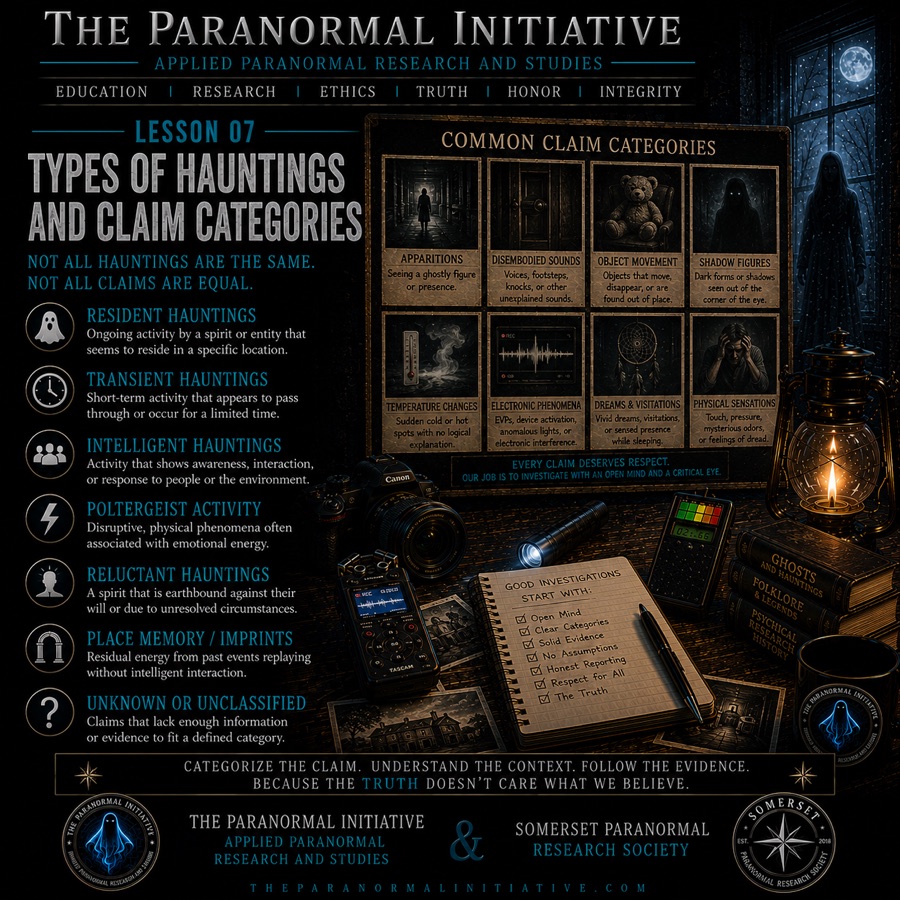
This lesson introduces the most commonly recognized categories of hauntings and paranormal reports that investigators encounter. These categories are organizational tools. They help investigators describe what witnesses report, compare cases across locations, communicate clearly with colleagues, and determine what kind of investigation approach may be appropriate. The purpose of this lesson is not to prove that any category represents an established paranormal reality. The purpose is to teach you the traditional classifications used by investigators, authors, researchers, and paranormal organizations so you can recognize, document, discuss, and investigate reports consistently. Later courses in Applied Paranormal Research and Studies and Parapsychology will revisit these categories in greater depth, discussing where researchers agree, disagree, overlap, and where classifications become more complex.
The central standard for this lesson is simple: classify reports, not realities. If a witness reports footsteps that repeat every night, the investigator may describe the report as residual-like. That does not prove that a past event is replaying. If a knock appears to answer a question, the investigator may describe the report as responsive or intelligent-like. That does not prove the presence of an intelligent spirit. A category helps organize the case file. It does not solve the case.
This matters because labels can change how people feel. Calling a report demonic, intelligent, poltergeist, or haunted too early can increase fear and create expectation. Calling something "only environmental" too quickly can make a witness feel dismissed. The goal is to use labels carefully enough that they clarify the investigation instead of taking control of it.