Ghostology 101 · Lesson 08

How beginners choose and research a location

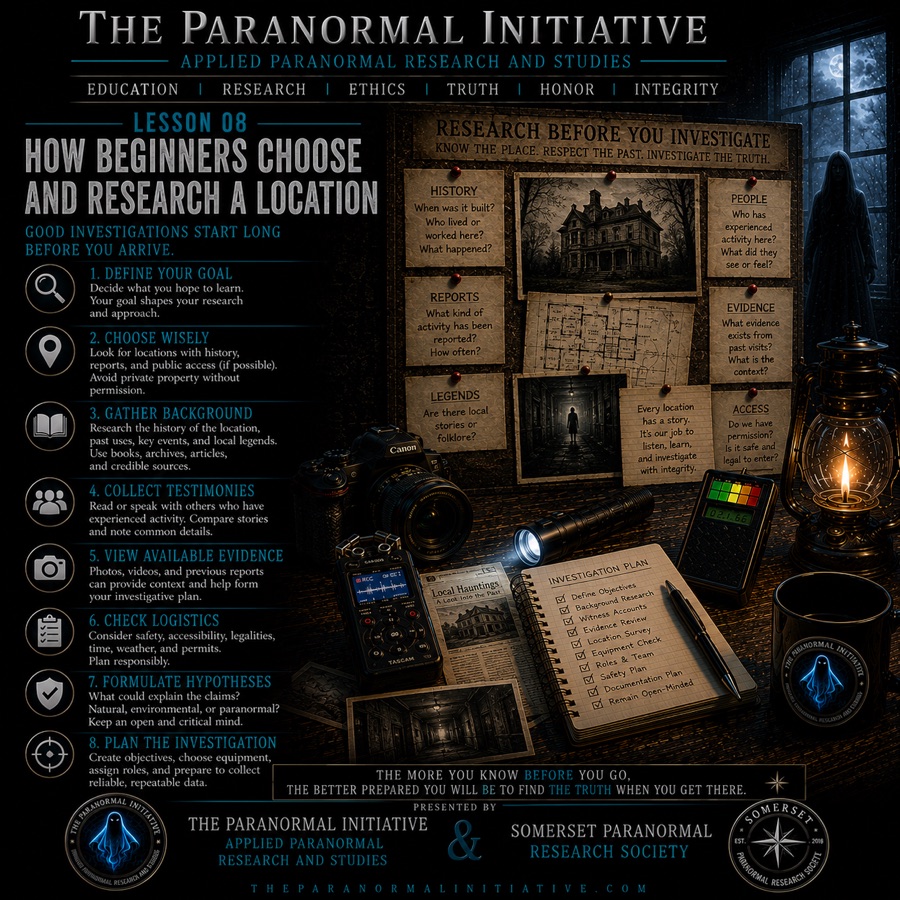
This lesson teaches beginners how to choose a location responsibly, get permission, start with public history, and avoid turning rumor into fact.

All Lessons Lesson 07 Lesson 09
Ghostology 101 lesson 08 visual

Lesson Reading

Lesson Purpose

This lesson teaches students how to responsibly choose an investigation location before they ever step onto the property. Successful investigations begin long before equipment is unpacked. Good research, planning, permissions, safety, and realistic expectations form the foundation of responsible field work. This is one of the primary foundational lessons of Ghostology 101 because the decisions you make before an investigation often determine the quality and integrity of everything that follows. By the end of this lesson, you will understand how to select appropriate locations, conduct preliminary research, secure proper permission, prepare for a site visit, and avoid the mistakes that compromise most beginner investigations.

Learning Objectives

By the end of this lesson, students should be able to: explain how to choose an appropriate location for a beginner investigation; identify where to begin researching a location's history and claims; describe why written permission is non-negotiable; list the safety considerations that must be addressed before any site visit; identify common beginner mistakes and how to avoid them; prepare a practical investigation plan that includes research, permissions, safety, and equipment; and distinguish between productive preparation and wasted effort.

Introduction — The Investigation Begins Long Before You Arrive

Beginners often believe the investigation starts when they arrive at a haunted location. They pack their equipment, drive to the site, and step through the door expecting something to happen. This is one of the most common misconceptions in paranormal investigation.

In reality, investigations begin days or weeks beforehand. The work of choosing a location, researching its history, securing permission, assessing safety, preparing equipment, and setting realistic expectations is not separate from the investigation. It is the investigation. The time you spend preparing determines how much you will learn, how credible your findings will be, and whether you conduct yourself as a professional or as a curious visitor.

A well-prepared investigator arrives at a location knowing what to expect, what to look for, and what questions to ask. An unprepared investigator arrives hoping something interesting will happen. The difference between these two approaches is the difference between investigation and wishful thinking.

This lesson will teach you how to be the first kind of investigator. You will learn how to choose a location wisely, research it thoroughly, navigate the permission process, prepare for your visit, and set expectations that lead to honest results. By the time you finish this lesson, you will understand that preparation is not a chore you have to complete before the real work begins. Preparation is the real work.

Choosing Your First Investigation Location

Selecting your first investigation location is a decision that deserves careful thought. Beginners often choose locations for the wrong reasons: because they look dramatic in photographs, because they have famous ghost stories attached to them, or because they are easy to access without permission. These are not good reasons. A good first investigation location is one where you can learn the process safely, legally, and productively.

Start with familiar locations. Your own home, the home of a willing friend or family member, or a location you know well can be an excellent first investigation. Familiarity reduces the number of variables you need to manage. You already know the normal sounds, the layout, the environmental conditions, and the history of the space. This baseline knowledge makes it easier to identify genuine anomalies. If you hear a knock in a friend's basement and you know the water heater is on the other side of that wall, you have a head start on finding a natural explanation.

Consider historical sites open to the public. Many historic homes, museums, libraries, and public buildings offer guided investigations or welcome researchers. These locations often have documented histories, known claims, and staff who can provide context. Public sites are also safer than abandoned buildings, and the permission process is straightforward. A historic site that offers public ghost tours or investigation events can be an excellent training ground.

Look for guided investigation opportunities. Some paranormal groups and historic sites offer guided investigations where beginners can learn from experienced investigators. These events provide supervised experience, access to locations that might otherwise be unavailable, and the chance to observe proper procedure in action. Participating in a guided investigation before conducting your own is one of the best investments you can make in your development as an investigator.

Seek educational opportunities. Museums, historical societies, libraries, and community colleges sometimes offer programs that combine local history with paranormal investigation. These programs can teach you research methods, historical context, and investigation techniques in a structured setting. They also connect you with people who share your interests and can become valuable colleagues.

Avoid locations that encourage trespassing. Abandoned hospitals, factories, schools, and asylums are popular in paranormal media, but they are almost always private property. Entering them without permission is trespassing, which is illegal, unsafe, and unethical. A location that requires you to break the law to investigate it is not a location you should investigate. There are plenty of legal, safe, and productive locations available. No investigation is worth compromising your ethics or your safety.

Types of Investigation Locations

Paranormal investigations can occur in many different types of locations. Each type presents unique challenges, research opportunities, and considerations. Understanding these categories will help you choose appropriate locations and prepare for what each type requires. This list is not exhaustive, but it represents the most common categories investigators encounter.

Private residences. Homes are the most common investigation locations. People experience strange phenomena in their own homes and reach out to investigators for help. Residential investigations require sensitivity, as the client's home and daily life are involved. Privacy concerns are paramount. Research focuses on the property history, the family's history in the home, and any environmental factors that could explain the reports.

Businesses. Restaurants, shops, offices, and other commercial locations may request investigations. Business investigations add considerations around operating hours, customer privacy, and employee concerns. Permission must come from the business owner or corporate office. Research may include the building's commercial history and any prior tenant experiences.

Historic homes and museums. Historic properties open to the public are popular investigation locations. They often have well-documented histories, established ghost lore, and staff who can provide context. Public access hours, preservation concerns, and visitor safety must be considered. Research opportunities are excellent because historic sites typically maintain archives.

Hotels and inns. Many hotels have reputations for paranormal activity. Guest rooms, hallways, and common areas may all be sites of reported experiences. Hotel investigations require coordination with management to avoid disturbing guests. Research may include guest registers, staff accounts, and historical ownership records.

Theaters. Performance venues are among the most commonly reported haunted locations. The combination of old buildings, extensive histories, late-night activity, and creative energy seems to produce many claims. Theater staff, including actors and stagehands, often have stories to share. Research can include performance histories, building renovations, and the lives of people associated with the theater.

Schools and universities. Educational institutions, particularly older ones, often have ghost stories associated with them. Dormitories, libraries, auditoriums, and older classroom buildings may be reported as active. Permission must come from school administrators. Research may include school histories, yearbooks, and student newspapers.

Hospitals and medical facilities. Hospitals, particularly older or closed facilities, are frequently investigated. Active hospitals present significant privacy and operational concerns. Closed hospitals are often unsafe and legally off-limits. If you investigate a medical facility, ensure it is open to researchers and that you have clear permission to access the areas you plan to examine.

Prisons and jails. Former correctional facilities are popular investigation locations, and many offer public investigation events. These locations have intense histories and strong emotional atmospheres. They also have extensive documentation: inmate records, incident reports, staff accounts, and historical archives. Prisons that operate as museums or historic sites are the safest and most appropriate options.

Battlefields. Military battlefields, particularly those from the Civil War era in the United States, are frequently investigated. These locations present unique challenges: they are often large, outdoor, and exposed to weather. Research focuses on troop movements, casualties, and documented events. Battlefields on public land, such as national parks, may have specific rules about after-hours access and equipment use.

Cemeteries. Cemeteries are common investigation locations, but they require particular care. Many people find cemetery investigations disrespectful, and some jurisdictions have laws restricting night access. If you choose to investigate a cemetery, do so with permission from the managing authority, during permitted hours, and with respect for the deceased and their families. Research opportunities include burial records, cemetery maps, and historical newspapers.

Outdoor locations. Parks, forests, trails, and other outdoor areas can be investigation sites. Outdoor investigations add significant variables: weather, wildlife, terrain, and ambient noise. Research may include land-use history, indigenous significance, and local folklore. Safety considerations are amplified in outdoor settings, and communication can be challenging.

Urban exploration locations and discovered historical remains. Students may encounter abandoned-looking buildings, old stone foundations, forgotten cemeteries, mill ruins, farmstead remains, cabins, bridges, tunnels, industrial sites, or other historical traces while walking through a city, hiking a trail, visiting public land, or exploring a rural area. These places can be valuable for historical interest, photography, mapping, preservation awareness, and research leads, but they must be handled with caution. Urban does not automatically mean public, and abandoned-looking does not automatically mean ownerless. A dilapidated cabin in the woods, a foundation beside a trail, or an old industrial structure may still be private property, protected land, a hazardous site, or a culturally sensitive location. Beginners should not enter unstable structures, cross posted boundaries, remove artifacts, disturb graves, or treat historical remains as thrill-seeking investigation sites. The responsible approach is to document from permitted areas, note the location carefully, research ownership or managing authority, contact the appropriate land office, historical society, park service, municipality, or property owner, and treat the site first as history rather than as a paranormal target.

Public landmarks. Monuments, squares, bridges, and other public landmarks may have associated ghost stories. Investigating public locations requires awareness of public activity, legal considerations around after-hours access, and the potential for interference from passersby. Permission may come from the municipal authority that manages the landmark.

Every type of location presents different challenges. A cemetery requires different preparation than a theater. A private residence requires different considerations than a historic museum. Part of becoming a skilled investigator is learning to adapt your approach to the specific location you are investigating.
Permission Always Comes First

Permission is not a formality. It is a legal, ethical, and professional requirement that protects everyone involved: the investigator, the property owner, the client, and the integrity of the investigation itself. This section explains the different types of permission and why each matters.

Written permission. Written permission is the gold standard. A document signed by the property owner or authorized representative should specify the date and time of the investigation, the names of all team members, the areas that may be accessed, any restrictions or conditions, and a liability clause. Both parties should keep a copy. Written permission protects you legally and demonstrates professionalism to clients and colleagues. For templates, see the Legal and Client Forms.

Verbal permission. Verbal permission is better than no permission, but it is not sufficient for a professional investigation. Verbal agreements can be misunderstood, forgotten, or disputed. Always follow up verbal permission with a written document. If the property owner is unwilling to provide written permission, consider whether the investigation is worth pursuing.

Public property. Public property, such as parks, sidewalks, and public buildings, may be accessible without explicit permission, but this does not mean there are no rules. Check local ordinances regarding after-hours access, equipment use, and group gatherings. Some public locations require permits for organized activities. Ignorance of local laws is not a defense.

Private property. Private property requires explicit permission from the owner or authorized representative. This includes homes, businesses, vacant buildings, and land. Even if a building appears abandoned, it is still private property. "Abandoned" is a legal status determined by courts, not by the condition of the building. Never assume a property is abandoned and available for investigation.

Restricted locations. Some locations are restricted by law or regulation. Government buildings, military installations, schools during operating hours, hospitals with active patients, and locations with historical or environmental protections may require special permits or may be entirely off-limits. Research the legal status of any location before planning an investigation.

Reinforcement of core principles. Never trespass. Trespassing is illegal, unethical, and dangerous. It damages your reputation, the reputation of the field, and the trust that property owners place in investigators. Never investigate illegally. Operating outside the law compromises every piece of evidence you collect and every conclusion you draw. An investigation conducted without permission is not an investigation. It is a violation.

If you cannot obtain permission to investigate a location, choose a different location. There are always more locations than you can investigate in a lifetime. No single location is worth compromising your integrity.

Safety Before Curiosity

Safety is not separate from investigation. It is part of it. Every investigation plan should include a safety assessment that identifies potential hazards and establishes protocols for addressing them. Curiosity must never override safety. No piece of evidence, no matter how compelling, is worth an injury.

Structural hazards. Unstable floors, collapsed ceilings, exposed wiring, broken stairs, and deteriorating structures pose serious risks. If a building shows signs of structural damage, do not enter. A location that has been closed for years may look stable but be dangerously compromised. Water damage, mold, pest infestation, and weather exposure can all weaken a structure in ways that are not immediately visible.

Wildlife. Animals can pose significant risks during investigations. In abandoned or rural locations, you may encounter raccoons, rats, snakes, spiders, bats, or larger animals like coyotes or stray dogs. Animal droppings can carry diseases. Disturbing a nesting animal can provoke an attack. Always check a location for signs of animal activity before entering, and know what wildlife is common in the area.

Weather. Weather conditions affect both safety and investigation quality. Rain can make surfaces slippery and create hazards. Cold temperatures can cause hypothermia during long investigations. Heat can cause dehydration. Lightning poses a risk in outdoor or exposed locations. Check the weather forecast before every investigation and plan accordingly. Have contingency plans for weather changes.

Unstable buildings. Abandoned and neglected buildings are particularly dangerous. They may have rotting floors, falling debris, exposed nails, broken glass, or hazardous materials. Never assume an abandoned building is safe because it looks solid from the outside. Many investigators have been injured by floors that gave way or ceilings that collapsed.

Hazardous materials. Older buildings may contain asbestos, lead paint, mold, or chemical residues. These materials can cause serious health problems with prolonged exposure or in high concentrations. If you suspect a location contains hazardous materials, do not investigate until the location has been professionally assessed. Your health is not worth the risk.

Emergency planning. Every investigation should include an emergency plan. Identify the nearest hospital, have a first aid kit on site, ensure all team members have fully charged phones, establish a meeting point in case of evacuation, and assign someone to be responsible for emergency communication. If someone is injured, stop the investigation and provide aid. If the situation is serious, call emergency services immediately. Never delay medical care out of concern for the investigation.

Before every investigation, walk through the location with your team and identify potential hazards. Discuss what each team member should do in an emergency. Review the safety plan. If conditions change during the investigation, reassess. Safety is not a checklist you complete once. It is an ongoing practice.

Beginning Historical Research

Historical research is the foundation of credible investigation. Before you can interpret what you find at a location, you need to understand what the location is, who lived there, what happened there, and how it has changed over time. This section introduces the basic research methods that every investigator should know. Deeper research techniques will be taught in the Research Methods track, but the fundamentals begin here.

Local history. Start with the broad history of the area where the location is situated. When was the area settled? What industries were dominant? What major events occurred? Understanding the local context helps you place the location's history in a larger framework. Local history books, community websites, and historical markers are good starting points.

Libraries. Public and university libraries are invaluable resources for paranormal research. Most libraries have local history sections with books, maps, photographs, and documents that are not available anywhere else. Librarians are trained researchers who can help you find sources you did not know existed. Do not overlook this resource.

Newspapers. Historical newspapers are among the most valuable sources for paranormal research. They contain records of deaths, accidents, crimes, events, and community stories that might be connected to a location's claims. Online archives like Newspapers.com, Chronicling America (Library of Congress), and local library digital collections make historical newspapers increasingly accessible. Search for the location's address, previous owners, and any notable events associated with it.

Historical societies. Local historical societies maintain collections of documents, photographs, maps, and artifacts related to the area's history. Historical society staff and volunteers are often knowledgeable about local stories and can point you to sources you might not find on your own. Membership in a historical society is an excellent investment for any investigator.

Archives. Government archives, university archives, and specialized collections hold documents that may be relevant to your research. Property records, court records, probate files, and other legal documents can reveal who owned a property, when it was built, and what changes were made over time. Some archives require appointments or have access restrictions, so plan ahead.

County records. County recorder and clerk offices maintain property deeds, marriage licenses, death certificates, and other official documents. Many counties have online databases, but older records may only be available in person or on microfilm. Deeds can reveal the chain of ownership for a property, which is useful for understanding who lived there and when.

Digital tools. Online research tools have made historical research faster and more accessible. Websites like DiedInHouse.com can check whether deaths have occurred at a specific address. FindAGrave.com and similar sites provide cemetery records. Google Earth and Street View allow virtual site surveys. Sanborn fire insurance maps, available through many library databases, show building layouts and construction details from the late 19th and early 20th centuries.

This introduction to research methods is intentionally brief. The goal is to get you started, not to make you an expert. Deeper research techniques — including source verification, citation standards, oral history collection, and advanced archival methods — are taught in the Research Methods track and explored further in Lesson 09 of Ghostology 101.

Separating History from Legend

Every investigation location has stories attached to it. Some of these stories are based on documented facts. Others are folklore, local legends, or outright fabrications that have been repeated so often they are accepted as true. One of the most important skills an investigator develops is the ability to distinguish between verified history and unverified legend.

Folklore. Folklore includes the traditional beliefs, stories, and customs of a community. Ghost stories passed down through generations are a form of folklore. Folklore is valuable because it preserves cultural memory and reveals what a community finds meaningful. But folklore is not evidence. A story that has been told for a hundred years may contain elements of truth, but it has also been shaped by each person who told it. Details are added, exaggerated, or forgotten with each retelling.

Ghost stories. Many locations have ghost stories that circulate widely. These stories often include dramatic details: violent deaths, tragic love stories, mysterious disappearances. While these stories can be compelling, they are frequently inaccurate when checked against historical records. A legend about a murder may turn out to be based on a death from natural causes. A story about a hundred-year-old haunting may actually date from the 1970s.

Local legends. Every community has legends about specific locations: the haunted house on the hill, the ghostly hitchhiker on a particular road, the cemetery where strange lights appear. These legends are part of the location's cultural history, and they should be documented as such. But they should not be treated as factual accounts of paranormal activity. The investigator's job is to document the legend and then investigate whether there is any verifiable evidence behind it.

Historical documents. Historical documents — property deeds, census records, newspapers, death certificates, court records — provide a different kind of information. They are not immune to error, but they are created closer to the events they describe, and they can be verified and cross-referenced. When a local legend says a woman was murdered in a house in 1880, and the historical record shows she died of pneumonia and is buried in the local cemetery, the historical record is more reliable.

Why both deserve documentation. Both history and legend deserve to be documented, but they should be clearly distinguished in your investigation records. When you write your research notes, label information as "documented" or "legend" or "unverified account." This distinction protects you from building conclusions on unreliable foundations. It also preserves the cultural richness of the location's stories while maintaining investigative integrity.

How to tell the difference. To separate history from legend, ask: Can this information be traced to a specific source? Is the source a primary document created at the time of the events? Can the information be confirmed by multiple independent sources? Is the story consistent with the historical context of the location? If the answer to these questions is no, the information belongs in the "legend" category. That does not mean it is worthless. It means it is not verified.

Talking to People

Some of the most valuable information about a location comes from the people who know it best. Property owners, caretakers, witnesses, neighbors, and local historians can provide context, stories, and details that no document can capture. Learning how to talk to people respectfully and effectively is an essential investigative skill.

Property owners. The property owner is your primary contact. They can tell you about the location's history, the claims that have been made, any previous investigations, and any changes that have been made to the property. Establish a respectful, professional relationship with the owner from the beginning. Be clear about what you will and will not do during the investigation. Provide them with a copy of your permission document and your investigation plan.

Caretakers. If a property has a caretaker, janitor, or maintenance person, they often know the location better than anyone. They have spent hours in the building, often at night. They know which doors stick, which floors creak, and which rooms feel different. A caretaker's observations can be invaluable. Treat them with the same respect you would give the property owner.

Witnesses. People who have experienced something unusual at the location are your primary sources of claim information. Interview them carefully. Use open-ended questions: "Can you describe what you saw?" rather than "Did you see a ghost?" Record their exact words. Do not correct their language or suggest explanations. Document the context of the interview: who was present, where it took place, what time, and whether any leading questions were asked.

Neighbors. Neighbors can provide information about a property's history that the current owner may not know. They may remember previous tenants, past events, or changes to the property. They may also have their own stories. Approach neighbors respectfully and explain why you are conducting research. Respect their privacy if they do not wish to participate.

Local historians. Historical society members, museum staff, librarians, and local authors are often excellent sources of information. They may have documents, photographs, or knowledge that is not available through public records. They can also help you distinguish between documented history and local legend. Building relationships with local historians is one of the best investments a paranormal investigator can make.

Respectful interviewing practices. When interviewing anyone about a location, be respectful, professional, and clear about your purpose. Explain who you are, why you are conducting research, and how the information will be used. Ask permission before recording an interview. Do not pressure anyone to share information they are uncomfortable sharing. Thank them for their time and offer to share your findings with them if they are interested. Remember that you are representing not only yourself but also the broader paranormal investigation community. The impression you leave will affect whether future investigators are welcomed.

Preparing for Your Visit

Once you have chosen a location, obtained permission, conducted preliminary research, assessed safety, and spoken with relevant people, it is time to prepare for your visit. Thorough preparation ensures that you can focus on the investigation itself rather than scrambling to address logistical problems.

Maps. Obtain a map of the location and the surrounding area. Mark the areas you have permission to access, potential hazards, parking areas, and emergency routes. If the location is large, a floor plan or property map will help you navigate and document your movements. Google Maps, Google Earth, and Sanborn maps are useful resources.

Weather. Check the weather forecast for the date and time of your investigation. Plan your clothing and equipment accordingly. Rain, cold, heat, and wind can all affect the investigation and your comfort. If severe weather is forecast, consider rescheduling. An investigation conducted in unsafe weather is not worth the risk.

Daylight planning. Plan your investigation around daylight hours. Arriving while it is still light allows you to walk the property, identify hazards, note environmental conditions, and take reference photographs. Many investigations begin during daylight with a walkthrough and continue into the evening for active sessions. Know when the sun will set and plan accordingly.

Parking. Confirm where you can park and whether any permits or fees are required. If you are investigating a residential location, do not block the homeowner's driveway or the neighbor's access. If you are investigating a business, park in designated areas. Parking issues can create tension with property owners and neighbors before the investigation even begins.

Access. Confirm how you will access the location. Will the property owner be present to let you in? Will you have a key or access code? Is there a security system that needs to be disarmed? Knowing the access plan in advance prevents confusion and delays. If the property owner will not be present, ensure you have clear instructions for entering and securing the location.

Emergency contacts. Before the investigation, share emergency contact information with all team members. Identify the nearest hospital and urgent care facility. Program emergency numbers into your phone. Establish a communication protocol for emergencies: who will call for help, who will provide first aid, and where the team will gather if evacuation is necessary.

Clothing. Wear appropriate clothing for the location and weather. Dark, comfortable clothing that allows freedom of movement is standard for night investigations. Sturdy, closed-toe shoes are essential. Avoid clothing that makes noise, such as nylon jackets or jangling jewelry. Dress in layers so you can adjust to temperature changes. Bring rain gear if there is any chance of precipitation.

Equipment checklist. Create an equipment checklist before the investigation and use it to pack and confirm your gear. Essential items include flashlights, extra batteries, a first aid kit, a notebook and pen, a camera, an audio recorder, and any specialized equipment you plan to use. Also bring water, snacks, and any personal items you may need. Check that all equipment is working before you leave. Charge batteries. Clear memory cards. Test recorders. Nothing is more frustrating than arriving at a location and discovering your equipment is not ready.

A good preparation checklist answers the question: What will I need to conduct this investigation safely, comfortably, and professionally? The answer will vary depending on the location, the season, and the type of investigation you are conducting. Create a master checklist that you can adapt for each investigation, and use it every time.

Managing Expectations

One of the most important lessons a new investigator can learn is that not every investigation produces unusual experiences. In fact, most investigations produce nothing that could be considered paranormal. This is not failure. This is normal. Understanding what constitutes a successful investigation is essential for maintaining perspective, credibility, and motivation.

Not every investigation produces unusual experiences. The majority of investigations are uneventful. You may spend hours in a location and experience nothing more than creaking floors and settling foundations. This does not mean you did something wrong. It means the location did not produce anomalous phenomena during your observation period. That is a valid result.

A successful investigation may produce no paranormal evidence. Success in paranormal investigation is not measured by how many EVPs you capture, how many EMF spikes you record, or how many dramatic experiences you have. Success is measured by how thoroughly you documented the conditions, how carefully you tested natural explanations, and how honestly you reported your findings. An investigation that documents a location thoroughly and finds no evidence of paranormal activity is just as successful as one that documents unexplained phenomena.

Honest documentation is success. The most important product of any investigation is the documentation. If you have thorough notes, clear photographs, well-labeled audio files, and a honest written summary, you have succeeded regardless of what you found. Documentation is what separates investigation from storytelling. An investigation that produces no anomalous data but has excellent documentation is more valuable than one that produces dramatic claims but has poor documentation.

Why expectations matter. Expectations shape perception. If you arrive at a location expecting dramatic activity, you are more likely to interpret ordinary events as paranormal. You may hear voices in static, see figures in shadows, and feel presences in drafts. Your expectation creates the experience. If you arrive expecting nothing, you may be less attentive and miss subtle anomalies that deserve investigation. The ideal mindset is open and observant: neither expecting nor excluding any outcome.

The pressure of media expectations. Paranormal television and social media have created unrealistic expectations. Real investigations are quiet, slow, and methodical. Hours pass with nothing happening. Equipment readings are mundane. The most interesting finding of the night might be a weird sound that turns out to be a loose pipe. If you measure your success by what you see on television, you will be disappointed. Measure your success by the quality of your process, not the drama of your results.

What to tell clients and team members. Be honest about expectations before the investigation begins. Tell your team and any clients that most investigations do not produce dramatic results. Explain that you will document everything thoroughly, whether it seems paranormal or not. Set the expectation that "nothing happened" is an acceptable outcome. This honesty protects everyone from disappointment and creates space for genuine anomalies to be recognized when they do occur.

Common Beginner Mistakes

Every investigator makes mistakes, especially at the beginning. The goal is not to avoid all mistakes but to learn from them. The mistakes listed below are the most common ones that beginners make. Recognizing them is the first step to avoiding them.

Going in unprepared. The most common beginner mistake is arriving at a location without research, without a plan, and without knowing what to expect. An unprepared investigator cannot distinguish between a genuine anomaly and a normal building sound. They waste time investigating things that could have been explained with five minutes of research. Preparation is not optional. It is the foundation of credible investigation.

Relying only on ghost stories. Beginners often base their entire understanding of a location on ghost stories and local legends. They repeat these stories as if they were facts, building their investigation on a foundation of unverified claims. A location's ghost stories are part of its cultural history, but they are not reliable evidence. Always check stories against primary sources before treating them as factual.

Bringing too much equipment. New investigators often bring every piece of equipment they own, convinced that more tools will produce more evidence. The opposite is usually true. Too much equipment creates clutter, noise, and distraction. It increases the chances of contamination and makes it harder to focus on observation. Start with the basics: a notebook, a pen, a flashlight, an audio recorder, and a camera. Add equipment as you learn how to use each tool effectively.

Ignoring safety. In their eagerness to investigate, beginners sometimes ignore obvious safety hazards. They enter unstable buildings, walk through areas with exposed wiring, or investigate alone. These decisions can have serious consequences. No investigation is worth an injury. If a location is unsafe, do not investigate it. If conditions become unsafe during an investigation, stop.

Expecting immediate evidence. Many beginners expect to capture compelling evidence on their first investigation. When they do not, they may feel disappointed or doubt their abilities. Realistic expectations protect you from this disappointment. Most investigations produce no clear evidence. The investigators who succeed are those who are patient, persistent, and methodical.

Investigating alone. Beginners sometimes investigate alone because they are eager to start or do not have team members available. Investigating alone is dangerous. If you are injured, there is no one to help you. If you have a medical emergency, there is no one to call for assistance. If you experience something frightening, there is no one to ground you in reality. Always investigate with at least one other person. A team of two is the minimum. Larger teams are better for safety and for cross-checking observations.

Posting findings before verification. Beginners often post their evidence online immediately after an investigation, before they have reviewed it thoroughly or tested natural explanations. This can damage their credibility if the evidence turns out to have a natural explanation. It can also create legal problems if the property owner did not authorize public sharing. Develop the discipline of review before release. Wait at least 24 hours before posting any findings. Review everything. Test natural explanations. Then share.

Failing to document properly. Poor documentation is one of the most common problems in amateur investigation. Notes are vague or missing. File names are meaningless. Times are not recorded. Without good documentation, evidence is meaningless. A sound on an unlabeled audio file is not evidence. It is noise. Develop strong documentation habits from the beginning.

Practical Investigation Examples

The following scenarios illustrate how the principles in this lesson apply to real situations. Each example involves a different type of location and presents different challenges. Read each one and consider how you would apply what you have learned.

Example 1: The Historic House Museum. A team of beginner investigators has permission to investigate a historic house museum that has operated in the community since the 1920s. The museum staff report that visitors have occasionally seen a woman in period clothing on the second floor. The investigators begin by researching the house's history at the local historical society. They find property deeds, census records, and newspaper articles about the original owners. They discover that a woman lived in the house for forty years and died there in 1912. The investigators compare this documented history with the ghost stories told by staff and find that some details match and others do not. They prepare a research brief before their visit, plan their equipment, and review safety considerations. During the investigation, they document environmental conditions, interview staff, and set up audio recorders in the areas where sightings have been reported. They leave with thorough documentation, regardless of whether they capture anything unusual.

Example 2: The Cemetery at Dusk. A pair of investigators wants to practice their skills at a local cemetery. They obtain permission from the cemetery office, which allows after-hours access with a signed agreement. They research the cemetery's history, noting notable burials and historical events. They check the weather forecast and dress appropriately. They arrive while it is still light, walk the grounds, and take reference photographs. They document environmental conditions: temperature, humidity, wind, and ambient sounds. As dusk falls, they conduct observation periods in different sections of the cemetery. They record audio and take photographs. They leave before midnight, respecting the cemetery's rules and the neighbors. Their investigation summary documents that no anomalous activity was observed. This is a successful investigation because it was conducted legally, safely, and thoroughly.

Example 3: The Abandoned Factory (Why Permission Matters). A group of friends wants to investigate an abandoned factory on the edge of town. The building has been vacant for twenty years, and local teenagers tell stories of strange sounds and lights. The building is on private property with clear "No Trespassing" signs. The investigators cannot identify the property owner, so they cannot obtain permission. Despite the building's dramatic appearance and compelling stories, they choose not to investigate. They find a different location — a historic hotel that welcomes investigators — and conduct a legal, safe, and productive investigation there. This is a mature decision that demonstrates ethical judgment. The abandoned factory remains a story, not a case. The investigators protected their integrity, avoided legal risk, and found a better location for their work.

Example 4: The Private Residence. A family contacts investigators because their young daughter has been reporting that she sees a man in her bedroom at night. The family is frightened and concerned for their child. The investigators take the case seriously. They meet with the family, interview the parents and the child separately, and document the reports in the child's own words. They research the home's history, finding that a previous owner died in the house ten years earlier. They conduct a daylight walkthrough, checking for environmental factors: lighting, shadows, reflections, sounds, and HVAC. They also suggest that the parents consult with the child's pediatrician to rule out sleep-related phenomena. During the night investigation, they set up cameras in the child's room and record audio. They find no evidence of paranormal activity. The child's reports decrease after the parents address a nightlight issue that was casting strange shadows. The investigators provide the family with a thorough report and follow up a month later. The case was handled with care, professionalism, and attention to the family's wellbeing.

Example 5: The Historic Hotel. A beginner team books a public investigation event at a historic hotel that is known for paranormal activity. The hotel requires all participants to sign liability waivers and follow specific rules. The team arrives early, walks the property during daylight, and reviews the hotel's published history. They speak with hotel staff and learn that several rooms have recurring reports. They set clear expectations among themselves: they will document everything, test natural explanations, and accept whatever results they obtain. During the night, they conduct vigils in the reportedly active areas. They capture some audio anomalies that warrant review. They also document several sounds that they trace to the hotel's old plumbing system. After the investigation, they review their evidence carefully before sharing any findings. They produce a balanced report that acknowledges both the unexplained sounds and the natural explanations they identified.

Example 6: The Outdoor Battlefield. A team wants to investigate a Civil War battlefield that is now a public park. They obtain permission from the park authority, which requires a special use permit for after-hours access. They research the battle that occurred there, reading firsthand accounts, casualty reports, and historical analyses. They check weather conditions and prepare for an outdoor investigation: warm clothing, rain gear, insect repellent, flashlights, and communication devices. They arrive before sunset, walk the terrain, and document the landscape. They note ambient sounds: traffic from a nearby road, aircraft overhead, wind through the trees. They conduct observation periods at several locations associated with heavy fighting. They capture nothing anomalous but produce thorough documentation of the environmental conditions and their methodology. Their report is valuable because it establishes a baseline for future investigations at the same location.

Common Misconceptions

The following misconceptions are particularly common among beginners. Understanding them will help you avoid the most frequent pitfalls in location selection and preparation.

"Older always means haunted." Age does not equal paranormal activity. Old buildings make sounds because they are old. They settle, creak, and have drafts. A building's age is a relevant fact, but it is not evidence of haunting. Historical research may reveal events that could be associated with claims, but the age of the building alone proves nothing.

"Cemeteries are automatically haunted." Cemeteries are places where bodies are buried, but there is no evidence that this makes them more likely to produce paranormal phenomena than any other location. The association between cemeteries and haunting is cultural and folkloric, not investigative. If you investigate a cemetery, do so with respect and for legitimate reasons, not simply because it is a cemetery.

"Abandoned means legal to enter." "Abandoned" is not a legal status that grants access. A property may appear abandoned but still be owned by someone who has not granted permission to enter. Trespassing is illegal regardless of the condition of the property. If you do not have permission, do not enter.

"Television locations guarantee activity." Locations featured on paranormal television shows are not guaranteed to produce activity. Television shows edit hours of footage into minutes of content, emphasize dramatic moments, and sometimes present speculation as fact. A location that appeared active on television may be quiet during your visit. Investigate because you are interested in the location, not because you expect a television experience.

"More investigators produce more evidence." Large groups create noise, contamination, and distraction. A small, coordinated team of two to four people is often more effective than a large group. Each additional person adds variables that must be managed. Quality of investigation matters far more than quantity of investigators.

"You need permission only for private property." Even public property may have rules about after-hours access, equipment use, and group gatherings. Always check local ordinances and obtain any required permits. Assuming you can do whatever you want on public property is a mistake that can lead to legal trouble.

Student Activity — Choosing and Preparing a Location

For this activity, you will choose a real location near you and prepare a complete investigation packet. Do not conduct the actual investigation. The goal is to practice the preparation process.

Choose a location that you could potentially investigate with permission. A friend's home, a family member's property, a public park, or a historic site that welcomes visitors are all good options. Do not choose a location that would require trespassing or that presents obvious safety hazards.

Prepare the following four checklists. Write each one in your personal notes and be as specific as possible.

Research checklist: What do you already know about this location? What historical sources would you consult? Where would you find property records, newspaper archives, or historical society materials? What questions would you want to answer before your visit?

Permission checklist: Who owns the property? How would you contact them? What information would you provide when requesting permission? What would your written permission document include?

Safety checklist: What potential hazards exist at this location? What would you include in your safety plan? What emergency contacts would you prepare? What first aid supplies would you bring?

Investigation preparation checklist: What equipment would you bring, and why? What would your investigation schedule look like? What environmental conditions would you document? Who would be on your team, and what roles would they fill? What expectations would you set with your team beforehand?

After completing your checklists, write a one-page investigation brief that summarizes your preparation. Include the location's basic information, your research findings, your permission status, your safety plan, and your investigation goals. This brief is the document you would share with your team and the property owner before the investigation.

Reflection Questions

The following questions are designed to help you think more deeply about the concepts in this lesson. Use these as optional reflection or discussion prompts.

1. Think about a location you have always wanted to investigate. What makes it appealing to you? Is it the history, the stories, the atmosphere, or something else? How would you evaluate whether it is appropriate for a beginner investigation?

2. Imagine you are asked to investigate a location that has a compelling ghost story but very little documented history. How would you approach this case? What would you tell the client about the difference between the story and the evidence?

3. A friend invites you to investigate an abandoned building without permission. The friend says no one will know and it will be an adventure. How do you respond? What do you say to explain why you will not participate?

4. You spend four hours at a location and nothing unusual happens. You have thorough documentation of your methods and conditions. Was this a successful investigation? Why or why not? How would you explain your answer to someone who expects dramatic results?

5. What is the most important thing you can do before an investigation to ensure you are prepared? What is the most common preparation mistake you think beginners make, and how will you avoid it?

6. How do you balance the need for safety with the desire to investigate interesting locations? Are there locations you would refuse to investigate for safety reasons? Where do you draw the line?

7. A client tells you that their home is haunted based on stories they heard from the previous owner. How would you explain the importance of verifying those stories against historical records? How would you handle the client's expectations?

8. If you could only bring three items to an investigation, what would they be and why? How does this exercise help you think about what is truly essential in the field?

Key Takeaways

This lesson has covered the essential principles of choosing, researching, and preparing an investigation location. The key takeaways are:

Preparation is part of the investigation. The work you do before you arrive determines the quality of everything that follows.

Choose locations wisely. Start with familiar, safe, legal locations with genuine claims. Avoid locations that require trespassing or present unnecessary risks.

Permission is non-negotiable. Written permission from the property owner protects everyone involved and is the mark of a professional investigator. Never investigate without it.

Safety comes first. Assess hazards, create an emergency plan, and never prioritize evidence over wellbeing. No investigation is worth an injury.

Research the location before you visit. Use libraries, newspapers, historical societies, archives, and county records to build a foundation of verified information.

Separate history from legend. Both deserve documentation, but they are not the same thing. Always distinguish between verified facts and unverified stories.

Talk to people who know the location. Property owners, caretakers, witnesses, neighbors, and local historians can provide information that no document can capture.

Prepare thoroughly. Maps, weather, daylight planning, parking, access, emergency contacts, clothing, and equipment should all be addressed before you arrive.

Manage expectations. Not every investigation produces unusual experiences. Honest documentation is success, regardless of what you find.

Avoid common beginner mistakes. Go in prepared, rely on research not just stories, bring only what you need, prioritize safety, be patient, never investigate alone, verify before posting, and document thoroughly.

These principles are not just for beginners. Every experienced investigator returns to them before every case. Preparation, permission, safety, research, and honest expectations are the foundation of every credible investigation, at every level of experience.

Repository Connections

The concepts in this lesson connect to several resources within The Paranormal Initiative - Applied Paranormal Research and Studies. Use these links to deepen your understanding and to prepare for real investigations.

Investigation Compendium: For comprehensive standards on investigation methodology, permission procedures, and safety protocols, see the Investigation Compendium.

Research Methods: The Research Methods track provides detailed instruction on historical research techniques, source verification, archival methods, and oral history collection. This track builds directly on the research foundations introduced in this lesson.

Legal Forms: For templates of permission documents, liability waivers, media release forms, and client agreements, see the Legal and Client Forms.

Equipment Manual: For detailed guidance on what equipment to use, how to use it, and what it actually measures, see the Equipment Manual.

Terminology Reference: For definitions of terms used in this lesson and throughout the curriculum, see the Terminology Reference.

Where You Will Learn More

This section introduces a recurring feature in Ghostology 101 that connects each lesson to the broader curriculum. The concepts you have learned here will be developed further in several advanced tracks.

Research Methods. The entire Research Methods track is dedicated to the skills introduced in this lesson. You will learn how to use primary and secondary sources, conduct newspaper research, access census and property records, use maps and directories, collect oral history, separate legend from fact, build timelines, cite sources properly, and turn research into a practical investigation brief.

Field Operations. The Field Operations track teaches the practical skills of conducting a site visit, including pre-investigation planning, site arrival and walkthrough, baseline sweeps, room-by-room documentation, and post-investigation wrap-up. These skills build directly on the preparation principles taught in this lesson.

Applied Paranormal Research and Studies. The professional curriculum that follows Ghostology 101 includes advanced instruction in site analysis, environmental baselining, client intake, and legal considerations. These courses assume the foundational knowledge you have gained in this lesson and extend it into professional practice.

Equipment Studies. The Equipment Studies track provides detailed instruction on every tool mentioned in this lesson. You will learn how audio recorders, cameras, EMF meters, environmental sensors, and other tools work, what they measure, and how to use them effectively in the field.

As you progress through the program, you will find that each lesson builds on the ones that came before. The foundation you are building now in Ghostology 101 will support everything you learn in the future.

Next Lesson Connection

You have now learned how to choose, research, and prepare for an investigation location. These skills are the foundation of responsible fieldwork. The next lesson, Lesson 09, will teach you how to deepen your research using historical records, local legends, cemeteries, and oral history. You will learn how investigators use documents, archives, maps, deeds, directories, and oral traditions to build a complete picture of a location's past. You will also learn how to separate documented history from folklore and how to present your research findings clearly.

Together, Lesson 08 and Lesson 09 form the research core of Ghostology 101. Understanding how to choose a location is the first step. Understanding how to research it thoroughly is the second. These two skills will serve you in every investigation you ever conduct, from your first case to your most advanced work.

Field Application

In the field, how beginners choose and research a location becomes visible through small decisions. The investigator decides what questions to ask, what details to write down, what assumptions to avoid, and what language to use when speaking with others. A student who understands this lesson should be able to enter a location and behave differently because of it. The learning should change conduct, not simply add information. A student wants to investigate an abandoned hospital because local videos make it look active, but the building is privately owned, unsafe, and full of rumors that cannot be verified. A better first case might be a historic house museum with public hours, staff stories, written rules, local archives, and safe access. The second location may feel less dramatic, but it teaches the student how to request permission, research ownership, compare legend to records, create a safety plan, document environmental conditions, and write a clean report. The point of the example is not to give the student a script to memorize. It is to show how the concept works under real pressure. Fieldwork is rarely neat. People interrupt each other. Equipment fails. Weather changes. A witness remembers something after the interview is over. A teammate gets excited. A client asks for certainty. A responsible investigator uses the foundation from this lesson to stay oriented when the situation becomes messy. When teaching this section live, ask students to describe what they would do first, second, and third. If they jump straight to a paranormal explanation, bring them back to the process. What exactly was reported? Who reported it? When did it happen? What changed in the environment? What was documented? What can be checked? That sequence is the difference between curiosity and investigation.

Documentation Standard

Documentation is the way this lesson becomes reviewable. The student should not merely say that they understand the concept. They should be able to record it in a case file. Notes should include the claim, the setting, the people present, the relevant environmental conditions, the questions asked, the actions taken, and the limits of what was learned. If a later reviewer cannot reconstruct the reasoning, the documentation is incomplete. Build a beginner location packet for one real place you could legally research. Include the location name, address or general area, ownership or managing authority, why it is appropriate for beginners, what permission would be needed, which safety concerns must be checked, and at least eight research sources you would consult. Include online sources such as Find a Grave, BillionGraves, local newspaper archives, public library databases, county GIS maps, assessor records, deed or recorder offices, historical societies, city directories, cemetery records, Sanborn maps when available, and oral history interviews. This optional practice can be discussed, demonstrated, or written privately. The student should focus on clear separation between observation and interpretation. The goal is to build the habit of writing like an investigator rather than narrating like a storyteller. A good entry should allow someone who was not present to understand what happened and how the student thought through it. The documentation should also include what was not known. Beginners often omit uncertainty because they think it makes them look unprepared. In reality, uncertainty is one of the most professional things an investigator can preserve. Write down what remains unknown, what still needs to be checked, and what would be required before a stronger conclusion could be reached.

Common Failure Points

The common failure is letting a location's reputation do the thinking. Beginners may say a place is worth investigating because it is old, dark, abandoned, famous, sad, or rumored to be haunted. Those qualities may make a location interesting, but they do not create an investigation plan. A responsible student asks who owns it, what is being claimed, what records exist, what hazards are present, what access is legal, what ordinary explanations are likely, and what can be documented without exaggeration. This mistake is common because the paranormal field rewards certainty, confidence, and dramatic language. Social media rewards the strongest claim, not the most careful one. A classroom, however, must reward process. The student should learn to recognize when excitement is pushing them ahead of the evidence. Another common failure is treating the lesson as theory only. A student may agree with the principle in class but abandon it during a case because the situation feels unusual. The entire purpose of Ghostology 101 is to make the principle strong enough to survive the field. The lesson should therefore include examples, examples and optional practice prompts that invite the student to apply the idea rather than simply admire it. The instructor should also watch for language that hides assumptions. Words such as "definitely," "obviously," "evil," "spirit," "energy," "proof," and "debunked" can all be useful in some contexts, but they can also smuggle conclusions into the record. Students should be trained to replace conclusion-heavy language with descriptive language whenever the evidence is still being evaluated.

Additional Applied Detail

This topic benefits from one more applied layer. Students should be able to explain how how beginners choose and research a location changes the way they prepare for a case, speak with witnesses, choose equipment, take notes, and review evidence. If the topic remains only a definition, it will not help them in the field. For practice, students should create a small table with three columns: claim, possible ordinary explanation, and documentation needed. The table should include at least five entries. This forces the student to move from a label to a process. A claim category, equipment response, sound, image, or feeling becomes useful only when it can be connected to context and reviewable records. The instructor should close this section by reminding students that careful investigation is not a lack of openness. It is the discipline that allows openness to be responsible. The unknown deserves better than rushed certainty.

Student Reflection and Instructor Use

This final section gives the instructor a practical way to close how beginners choose and research a location without reducing it to a summary slide. Students should be asked to pause and identify one idea from the lesson that changed how they would handle a real case. The answer should be specific. "Be careful" is not enough. A stronger answer might say, "I would avoid naming a haunting type until I separated the visual report, sound report, environmental condition, and witness interpretation into different notes." The instructor can also use this section as a bridge into discussion. Ask students what part of the lesson feels easy to accept and what part feels difficult to practice. Some students may find careful language natural but struggle with uncertainty. Others may be good at listing ordinary explanations but need more practice speaking gently with frightened people. The purpose is not to embarrass anyone. The purpose is to make the learning honest. For self-guided students, this section should become a notebook entry. They should write one paragraph describing how the lesson protects evidence, one paragraph describing how it protects people, and one paragraph describing how it protects the credibility of the field. Those three protections are central to Ghostology 101. Evidence without care becomes distorted. People without care can be harmed. The field without care becomes noise. Close by reminding students that foundation work is repeated work. A responsible investigator does not learn this once and move on forever. They return to the basics before every case: define the claim, check the context, document the conditions, look for ordinary explanations, preserve uncertainty, and speak with respect. That repetition is what turns a beginner's interest into a disciplined practice.

Lesson 07 Back to Ghostology 101 Lesson 09