Ghostology 101 · Lesson 09

Historical records, local legends, cemeteries, and oral history

This lesson teaches how to use records, cemeteries, old newspapers, historical societies, maps, deeds, directories, and oral accounts while separating documented history from legend.

All Lessons Lesson 08 Lesson 10
Ghostology 101 lesson 09 visual

Lesson Reading

Lesson Purpose

This lesson introduces students to one of the most important principles of paranormal investigation: every location has a history. Understanding that history can explain reported experiences, uncover new investigative leads, reveal forgotten events, and help distinguish documented facts from community folklore. Historical research is not a separate activity you complete before the real investigation begins. It is an essential part of the investigation itself. By the end of this lesson, you will understand why history matters, where historical information comes from, how to separate folklore from documented fact, how oral history can enrich your cases, and why cemeteries deserve respect as historical places.

Learning Objectives

By the end of this lesson, students should be able to: explain why historical research is one of the most valuable tools an investigator possesses; identify where historical information comes from, including libraries, newspapers, historical societies, archives, and government records; distinguish between folklore and documented history; describe how oral history interviews can contribute to an investigation; explain why cemeteries should be treated as historical places rather than automatically haunted locations; and list at least three ways that historical context can change how a case is understood.

Introduction — Every Location Has a Story

Many investigations begin with a story. A homeowner hears footsteps in the attic. A hotel guest sees a figure in the hallway. A family experiences cold spots and strange sounds. These stories are the starting point. But good investigators do not stop at the story. They ask: What evidence supports this story? What historical context might explain it? What actually happened at this location before the current residents arrived?

The answers to these questions come from historical research. Before you pick up an EMF meter or set up a camera, the most important tool you can use is your ability to find, read, and interpret historical records. History provides context. It reveals who lived at a location, what happened there, and how the property has changed over time. It can confirm a witness's account, challenge a local legend, or reveal events that were forgotten for generations.

This lesson is your introduction to historical research as a paranormal investigator. It will teach you where to look for information, how to evaluate what you find, and how to use history to strengthen your investigations. The Research Methods track in the curriculum will build on these foundations with advanced techniques, but the principles you learn here will serve you in every case you ever work on.

Why History Matters

History matters in paranormal investigation for several important reasons. Understanding these reasons will help you appreciate why research is not optional — it is essential.

Context. Every location exists within a larger historical context. The neighborhood, the town, the region all have histories that shaped what the location is today. A house that was built during a period of rapid industrial growth will have a different history than one built during an agricultural depression. Understanding the broader context helps you ask better questions about the specific location.

Timelines. Historical research helps you build a timeline of a location. When was it built? Who owned it? What changes were made? Who lived there and when? A timeline reveals patterns. You might discover that reported experiences began after a specific renovation, which could point to an environmental cause. You might learn that multiple families reported similar phenomena, which strengthens the case for further investigation. You might find that a location changed hands frequently, which could suggest something about the property that made people leave.

Ownership. Knowing who owned a property and when can provide valuable leads. Previous owners may have experienced the same phenomena. They may have made changes that affect the current residents. They may have stories that were never recorded in official documents. Property deeds, census records, and city directories can help you trace the chain of ownership.

Major events. Deaths, births, marriages, accidents, crimes, and other significant events in a location's history may be connected to reported paranormal experiences. A death on the property, especially a sudden or violent one, is often cited in haunting claims. Historical records can confirm whether such events actually occurred, and they can reveal details that stories have distorted over time.

Renovations. Buildings change over time. Additions, remodeling, new construction, and repairs can alter the environment in ways that affect what people experience. A room that was once a porch may have different temperature characteristics. A wall that was moved may change sound patterns. New wiring can introduce electromagnetic fields. Knowing what has changed helps you interpret what you observe.

Disasters. Fires, floods, storms, and other disasters can leave lasting marks on a location and the people connected to it. Historical research can reveal whether a location experienced a disaster that might be related to reported phenomena. It can also help you understand the condition of the building and the surrounding environment.

Social history. The people who lived in a location were part of their time. Their lives were shaped by the social, economic, and cultural conditions of their era. Understanding social history helps you understand the people behind the paranormal claims. It humanizes the investigation and reminds you that you are dealing with real lives, not just data points.

Historical Sources

Historical information comes from many sources. Some are obvious. Others require digging. The best investigators learn to use a wide range of sources and to cross-reference information across multiple records. This section introduces the most common and valuable sources for paranormal research.

Libraries. Public and university libraries are among the most valuable resources for historical research. Most libraries have local history sections that contain books, maps, photographs, and documents specific to the area. Reference librarians are trained researchers who can help you find sources you did not know existed. Many libraries also provide access to online databases, newspaper archives, and genealogy resources that would otherwise require paid subscriptions.

Newspapers. Historical newspapers are a treasure trove of information. They contain records of deaths, births, marriages, accidents, crimes, community events, court proceedings, and everyday life. A single newspaper article can confirm or challenge a story that has been told for decades. Online archives like Newspapers.com, Chronicling America (from the Library of Congress), and local library digital collections make searching historical newspapers easier than ever. Search for the location's address, the names of past residents, and any notable events associated with the property.

Historical societies. Local historical societies are dedicated to preserving the history of a specific area. They maintain collections of documents, photographs, maps, and artifacts that are not available anywhere else. Historical society staff and volunteers are often deeply knowledgeable about local stories and can point you to sources you would never find on your own. Many historical societies also publish journals and books that contain detailed local history. Membership in your local historical society is one of the best investments a paranormal investigator can make.

Archives. Government archives, university archives, and specialized collections hold primary source documents that may be essential to your research. Property records, court records, probate files, and other legal documents can reveal who owned a property, when it was built, and what legal issues arose. Some archives require appointments or have access restrictions, but the information they contain is often irreplaceable.

Museums. Local museums often have exhibits and collections related to the area's history. Museum curators can be excellent sources of information and can often direct you to additional resources. Even a small local museum may hold photographs, documents, and artifacts that are relevant to your research.

Government records. County recorder and clerk offices maintain property deeds, marriage licenses, death certificates, and other official documents. Many of these records are now available online, but older records may only be accessible in person or on microfilm. Property deeds can reveal the chain of ownership. Death certificates provide cause of death, which can be relevant to paranormal claims. Census records show who lived at a location, their ages, occupations, and family relationships.

Online address and death-history tools. Online tools can help beginners find leads quickly, but they should be treated as starting points rather than final proof. DiedInHouse.com and similar address-history services may help identify reported deaths, incidents, ownership clues, or public-record leads connected to an address. Genealogy and cemetery tools such as FindAGrave.com and BillionGraves.com can help connect names, dates, burial locations, family relationships, military markers, and cemetery records to a case. These services are useful because they can point you toward names and dates that deserve deeper research, but they can contain gaps or errors. Always verify important findings through county records, death certificates, obituaries, cemetery offices, newspapers, deeds, historical societies, archives, or other independent sources before using them in a case report.

Photographs. Historical photographs can reveal how a location looked at different points in time. They can show changes to the building, the surrounding landscape, and the people who lived there. Libraries, historical societies, and online archives like the Library of Congress and local digital collections are good sources of historical photographs. A photograph from 1900 showing a building that looked very different from today can prompt important questions about what changed and when.

Diaries and letters. Personal writings offer a window into the lives of people who lived at a location. Diaries and letters can reveal events, emotions, and experiences that never made it into official records. These sources are rare and often difficult to access, but when they are available, they can provide invaluable context. Local historical societies and archives may hold collections of personal papers.

This introduction is intentionally kept at a beginner level. The Research Methods track in the curriculum provides detailed instruction on how to access, interpret, and cite each of these source types. For now, the goal is to understand what is available and to develop the habit of seeking out historical context for every location you investigate.
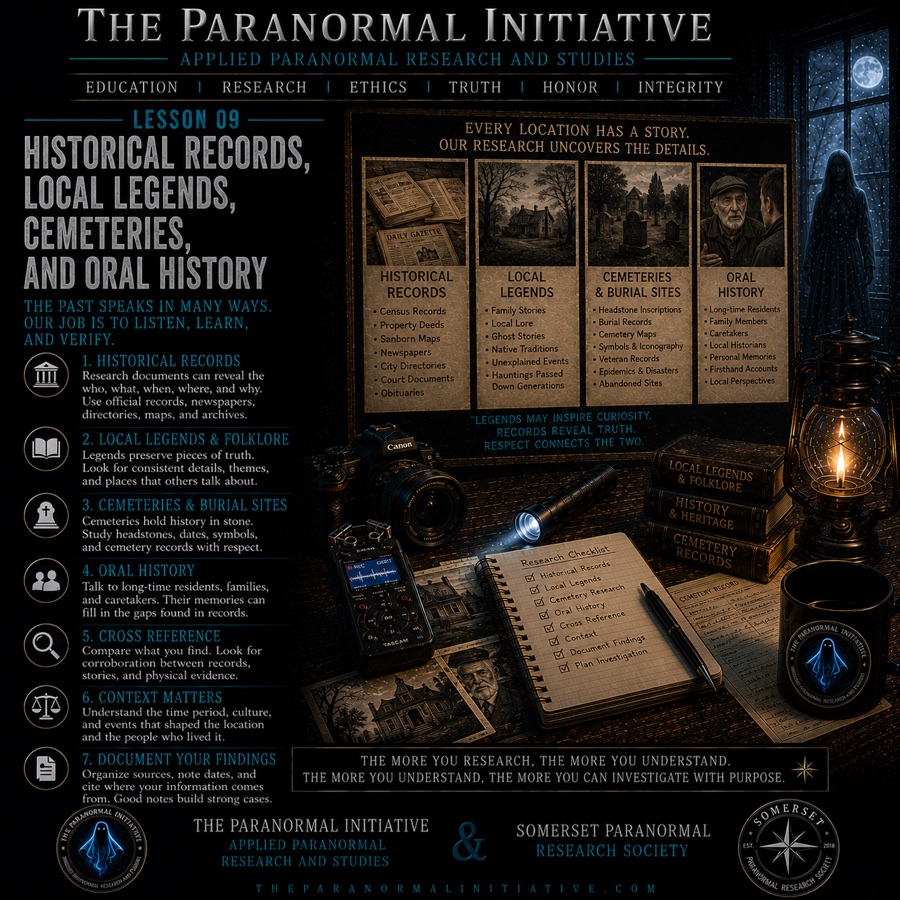
Local Legends

Every community has stories. The haunted house on the hill. The ghostly hitchhiker on a particular road. The cemetery where strange lights appear on certain nights. The old hotel where a tragic death occurred. These stories are part of the cultural fabric of a place. They are told and retold, shared around campfires, posted on websites, and passed down through generations.

What legends are. A local legend is a story that has been told within a community for a significant period. Legends often contain elements of the extraordinary: ghosts, spirits, unexplained events, mysterious figures. They are usually attached to specific locations: a house, a road, a bridge, a cemetery, a body of water. Some legends have a kernel of historical truth. Others are entirely fictional but have been repeated so often that they are accepted as fact.

What legends are not. Legends are not evidence. No matter how compelling a story, no matter how many people have repeated it, a legend is not proof that anything paranormal occurred at a location. Legends can contain misinformation, exaggeration, and outright fabrication. Details change with each retelling. The emotional impact of a good story often overwhelms the accuracy of its details.

Why legends still matter. Despite their limitations, legends are valuable to investigators. They preserve cultural memory about a location. They can contain fragments of historical truth that have been preserved in story form. They provide leads for further research. A legend about a death on a property may send you to the historical records that confirm or challenge the story. A legend about strange lights in a cemetery may prompt you to research the cemetery's history and environmental conditions. Without the legend, you might never have looked.

How to use legends responsibly. Document the legend in your investigation records. Note where you heard it, who told it, and how long it has been circulating. Then research the historical record to see if the legend is supported by documented evidence. If the legend contains elements of truth, note what is confirmed and what remains unverified. If the legend is contradicted by historical records, note that as well. Both the legend and the historical record should be part of your case file, but they should be clearly distinguished.

Folklore and community traditions. Folklore encompasses a broader range of traditional beliefs and customs than individual legends. Community traditions around death, burial, and the supernatural can provide context for understanding how people in a particular time and place interpreted their experiences. A community that strongly believed in ghosts in the 19th century may have interpreted ordinary events as paranormal. Understanding that context helps you evaluate historical accounts more carefully.

Urban legends. Some ghost stories are urban legends — modern folklore that circulates widely but has little basis in fact. Stories about haunted hospitals, asylums, and prisons often fall into this category. They are repeated so often that they seem credible, but when investigated, they often turn out to be adaptations of stories from other locations or entirely fictional. Be particularly cautious with stories that appear in multiple locations with only minor changes. This is a sign that the story is a migrating legend rather than a location-specific account.

Oral History

Some of the most valuable information about a location never appears in any written record. It exists only in the memories of people who know the place. Oral history — the practice of collecting and preserving spoken accounts — is an essential skill for paranormal investigators. This section introduces the basics. Advanced oral history methods are taught in the Research Methods track.

Why oral history matters. Written records capture only a fraction of what happens at a location. They record births, deaths, property transfers, and major events. They do not record the everyday sounds, the feeling of a room at night, the stories that families tell each other, or the experiences that people hesitate to share with officials. Oral history captures what written records miss. It preserves the human dimension of a location's story.

Who to interview. The most valuable oral history sources are people who have spent significant time at the location. Current and former residents, property owners, caretakers, neighbors, employees (for commercial locations), and local historians can all provide information that is not available elsewhere. Long-time residents of a community often know stories that have never been written down. Elderly residents may remember events from decades ago that have no other surviving record.

Conducting interviews. When conducting an oral history interview, preparation is essential. Research the location before the interview so you can ask informed questions. Prepare a list of open-ended questions that encourage detailed responses. "Can you describe what the house was like when you first moved in?" is better than "Did you experience anything strange?" Record the interview with the participant's permission. Take notes as backup in case the recording fails.

Understanding memory limitations. Memory is not a perfect recording. It changes over time. Details are forgotten, altered, or merged with other memories. A witness who is completely sincere may still be mistaken about what they remember. This does not mean their account is worthless. It means it must be evaluated carefully. Compare oral accounts with documented evidence whenever possible. Note inconsistencies without dismissing the witness. Memory limitations are part of being human, not a character flaw.

Respectful practices. Always obtain permission before recording an interview. Explain how the information will be used. Respect the participant's privacy. If they share something they do not want published, honor that request. Thank them for their time and offer to share your findings with them. Remember that you are representing the broader paranormal investigation community. The impression you leave will affect whether future investigators are welcomed.

Transcribing and preserving. After the interview, create a written transcript or summary as soon as possible. Label the recording with the date, location, and participant name. Preserve the original recording. Note the context of the interview: who was present, where it took place, and any relevant conditions. This documentation will be valuable when you write your investigation report.

Cemeteries

Cemeteries occupy a unique place in paranormal investigation. They are among the most commonly investigated locations, and they are also among the most misunderstood. This section teaches you how to approach cemeteries with the respect they deserve and how to use them as historical resources.

Cemeteries are historical places first. A cemetery is a record of a community's history. It contains information about the people who lived in the area: their names, dates of birth and death, family relationships, military service, and sometimes causes of death. Cemetery records are valuable for genealogical research and for understanding who was connected to a particular location. Before a cemetery is a place of paranormal investigation, it is a place of historical significance and, for many people, personal meaning.

Genealogy and historical context. Cemetery records can help you trace the people associated with a location. A death date on a headstone may confirm or contradict a local legend. A family plot may reveal relationships that are not recorded elsewhere. Military markers may indicate that a resident served in a particular war. The symbols and inscriptions on headstones can provide information about the deceased's beliefs, social status, and community connections.

Symbolism. Headstone symbolism is a language of its own. A lamb represents innocence, often marking the grave of a child. A hand pointing upward indicates aspirations for heaven. A broken column represents a life cut short. An anchor symbolizes hope. Learning to recognize common cemetery symbols can add depth to your research and help you understand how a community remembered its dead.

Preservation. Cemeteries are fragile historical resources. Headstones can be damaged by weather, vandalism, and well-meaning but improper cleaning. When visiting a cemetery, treat it with care. Do not climb on headstones. Do not touch fragile markers. Do not leave litter. If you are conducting research, photograph headstones rather than making rubbings, which can damage older stones. Respect the cemetery's rules and visiting hours.

Respect for the deceased and their families. For many people, cemeteries are sacred spaces. They are places of grief, memory, and connection with loved ones who have died. Treating a cemetery as a place of entertainment or thrill-seeking is disrespectful. If you investigate a cemetery, do so with a clear purpose: to conduct historical research, to document conditions, or to investigate specific claims. Never investigate a cemetery simply because it is a cemetery.

Cemeteries are not automatically haunted. One of the most persistent misconceptions in paranormal investigation is that cemeteries are inherently haunted. They are not. A cemetery is a place where bodies are buried, but there is no evidence that burial sites are more likely to produce paranormal phenomena than any other location. The association between cemeteries and hauntings is cultural and folkloric, not investigative. If you investigate a cemetery, do so because you have a specific reason, not because of an assumption.

Online tools. Websites like FindAGrave.com and BillionGraves.com provide searchable databases of cemetery records. These tools can help you locate graves, find biographical information, and connect individuals to specific locations. They are useful starting points, but they should be verified against physical cemetery records when possible, as online databases can contain errors.

Reading Historical Documents

Historical documents are the foundation of credible research. This section introduces the most common types of documents you will encounter and explains what they can tell you. Detailed instruction on how to access and interpret these documents is provided in the Research Methods track. For now, the goal is to understand what is available and how it can help your investigations.

Newspapers. Historical newspapers contain a wealth of information relevant to paranormal investigation. Beyond obvious items like obituaries and death notices, newspapers also report on accidents, crimes, court cases, community events, building permits, and everyday life. A death reported as mysterious in local legend may have a mundane explanation in the newspaper of record. A fire that destroyed a building may explain why a location feels different from its original description. Learn to search newspapers using date ranges, addresses, names, and keywords related to the location.

Census records. Census records provide a snapshot of who lived at a location at a specific point in time. They list names, ages, occupations, places of birth, and family relationships. Comparing census records across decades can reveal how a household changed over time. Census records are available through the National Archives, online genealogy services, and many libraries.

Death certificates. Death certificates provide official information about a person's death: date, location, cause, and sometimes circumstances. They are valuable for verifying or challenging legends about deaths on a property. Death certificates are maintained by state or county vital records offices. Access policies vary, but many are available online through state archives or genealogy services.

Maps. Historical maps show how a location and its surroundings have changed over time. Sanborn fire insurance maps, created for American cities from the 1860s through the 1960s, provide detailed information about building footprints, construction materials, and property boundaries. They can reveal additions, outbuildings, and changes that are not recorded anywhere else. Plat maps show property boundaries and ownership. Topographic maps show the physical landscape. Comparing maps from different eras can reveal significant changes that may affect an investigation.

Photographs. Historical photographs provide visual evidence of what a location looked like at a specific time. They can show building conditions, landscape changes, furnishings, and the people who lived there. Photographs can be found in library collections, historical society archives, online databases, and family albums. A photograph from 1910 showing a building with features that no longer exist can prompt important questions about what changed and when.

Property deeds. Deeds document the transfer of property ownership. They can reveal the chain of ownership for a location, often going back to the original land grant. Deeds may also contain descriptions of the property, including boundaries, buildings, and easements. Deed research is detailed work, but it can provide information that is not available anywhere else.

Court records. Court records document legal proceedings that may be relevant to a location. Probate records reveal what happened to a person's estate after death. Civil cases may document disputes over property, noise, or other issues. Criminal cases may record events that occurred at the location. Court records are maintained by county clerk offices and may be available online or on microfilm.

This introduction is intentionally brief. The goal is to give you a working understanding of what is available. The Research Methods track provides detailed instruction on how to access, interpret, and cite each type of document. For now, focus on developing the habit of seeking out historical records for every location you investigate. The more you practice, the more natural it becomes.

Confirming Information

One piece of information is not enough. A single source can be wrong. A newspaper can misreport details. A census taker can make errors. A death certificate can contain incorrect information. A memory can be faulty. Responsible investigators confirm information by comparing multiple independent sources.

Cross-referencing. When you find a piece of information, look for at least one other source that confirms it. If a local legend says a death occurred in a house, check the death certificate, the newspaper obituary, and the cemetery record. If all three sources agree, the information is more reliable. If they conflict, you have discovered something that needs further investigation. The conflict itself may be the most interesting finding of your research.

Primary vs. secondary sources. A primary source was created at the time of the events it describes. A death certificate is a primary source for a death. A newspaper article written the day after a fire is a primary source for that fire. A secondary source interprets or summarizes primary sources. A book written fifty years later about the same fire is a secondary source. Primary sources are generally more reliable, but they can still contain errors. Secondary sources are useful for context and interpretation, but they should be verified against primary sources whenever possible.

Independent verification. Whenever possible, have someone else verify your research. Another investigator reviewing your sources may notice something you missed. A historian at the local historical society may be able to confirm or challenge your findings. Independent verification is not a sign of weakness. It is a sign of professional practice.

What to do when sources conflict. When sources provide conflicting information, do not ignore the conflict. Document it. Note what each source says and why they might disagree. The conflict may point to an error in one source, or it may reveal something more complex about the location's history. Conflicting information is not a problem to be solved. It is data to be documented and investigated further.

Separating Fact from Tradition

One of the most important skills a paranormal investigator develops is the ability to distinguish between verified historical fact and community tradition. Both are valuable. Both deserve documentation. But they are not the same thing, and treating them as if they are can lead to serious errors.

How legends change over time. Stories change with each telling. A story about a death in a house may begin as a factual account of a person who died of illness. Over time, details are added. The illness becomes mysterious. The death becomes sudden. A tragic backstory develops. After several generations, the story bears little resemblance to the original event. This is not dishonesty. It is the natural evolution of oral tradition. The investigator's job is to trace the story back to its earliest verifiable form.

Example: The legend of the murder that was not. A historic home has a local legend that a woman was murdered by her husband in the 1880s. The story is told on ghost tours and repeated in online articles. An investigator researches the property and finds the death certificate, which lists cause of death as pneumonia. The newspaper obituary confirms that the woman died after a long illness. Her husband is listed as the informant on the death certificate and lived on the property for another twenty years. The legend is not true. But it is still part of the location's cultural history. The investigator documents both the legend and the historical records, noting the discrepancy.

Example: The battlefield ghost that was not a soldier. A Civil War battlefield is reported to be haunted by the ghost of a soldier who died in battle. The story is compelling and widely believed. Research reveals that the land was a farm before the battle, and the farmer who owned it died of natural causes in 1860. The "soldier" described by witnesses — a man in a hat and coat — may actually be a memory of the farmer, not a soldier. The legend attached a dramatic story to a figure that may have a completely different origin.

Example: The phantom hitchhiker. Many communities have a version of the phantom hitchhiker legend: a driver picks up a hitchhiker who later vanishes, only to learn that the hitchhiker died years earlier. These stories appear across the United States and around the world with only minor changes. They are migrating legends, not location-specific accounts. An investigator who encounters such a story should recognize it as a folklore motif rather than a unique paranormal claim.

Example: The asylum legend. Abandoned asylums and hospitals are frequent subjects of paranormal legends. Stories of torture, unethical experiments, and mass deaths are common. When investigated, these stories often turn out to be exaggerated or entirely fictional. A real asylum may have had difficult conditions and tragic stories, but the legends that circulate about it are often based on movies and television rather than historical records. The investigator must separate the documented history from the cinematic fiction.

Documdenting both. Your investigation records should include both historical facts and local traditions, clearly labeled. Use terms like "documented," "verified," "legend," "unverified account," and "folklore" to distinguish between different types of information. This clarity protects your conclusions and preserves the cultural richness of the location's stories.

Practical Investigation Examples

The following scenarios illustrate how historical research can inform paranormal investigations. Each example involves a different type of location and different research challenges. Read each one and consider how you would apply the principles from this lesson.

Example 1: The Historic Hotel. A historic hotel has been operating for over a century. Guests and staff report unusual sounds, temperature changes, and the feeling of being watched in specific rooms. The hotel management asks a team of investigators to look into the claims. The investigators begin by researching the hotel's history. They find newspaper articles about the hotel's grand opening, records of renovations, and obituaries of former owners. They discover that one of the rooms where reports are concentrated was originally a private parlor used by the hotel's founder, who died in the building. The investigators also find that a renovation in the 1970s changed the layout of that floor, which may have altered the acoustics and airflow. With this research, the investigators can enter the location with a clear understanding of its history and can focus their investigation on specific environmental factors that may be causing the reported experiences.

Example 2: The Rural Cemetery. A rural cemetery has a local legend about a ghostly woman who appears near a specific grave at dusk. The legend says she died of a broken heart after her fiancé was killed in the war. Investigators research the cemetery records and find the grave in question. The headstone shows the woman's name, dates of birth and death, and an inscription. Death records show she died of tuberculosis. Newspaper archives confirm this and reveal that she was never engaged — the fiancé story was a later addition. The investigators document the legend and the historical facts separately. They walk the cemetery during daylight, photograph the grave and surrounding area, and note environmental conditions. They find no evidence of paranormal activity but produce thorough documentation of the location and its history.

Example 3: The Historic Courthouse. A county courthouse built in the 1890s has reports of footsteps in empty hallways and doors that open and close on their own. Staff members believe the building is haunted by a former judge. The investigating team researches the courthouse history, finding photographs of the original construction, records of renovations, and newspaper articles about the building's dedication. They learn that the building originally had a coal furnace that was replaced in the 1950s, and the old furnace room is directly below the area where footsteps are reported. The footsteps may be caused by the current HVAC system cycling through the old ductwork. The team documents this possibility as a natural explanation to be tested. They also find that the judge associated with the haunting died in 1930, not at the courthouse, and there is no record of any connection between him and the building beyond his service there. The research provides both historical context and a clear natural explanation to investigate.

Example 4: The Farmhouse. A family moves into a farmhouse built in 1870 and begins experiencing strange phenomena: objects moving, sounds in the walls, and a feeling of being watched. A local legend claims the house was built on land where a Native American burial ground once existed. The investigators recognize this as a common folklore motif. They research the property history, finding deeds that trace the land back to an 1840s land grant to a European settler. They find no evidence of a burial ground. They also discover that the house was renovated in the 1990s, when new wiring and plumbing were installed. The investigators check the wiring and find that some outlets are not properly grounded, creating EMF readings. They also find that the basement has a rodent infestation, which could explain sounds in the walls. The legend about the burial ground was a story, not a fact. The natural explanations for the phenomena are documented and shared with the family.

Example 5: The Battlefield. A Revolutionary War battlefield is the site of annual ghost tours. Visitors report seeing figures in period clothing, hearing musket fire, and feeling sudden cold spots. An investigation team researches the battle that occurred there, reading firsthand accounts, military records, and modern historical analyses. They learn the exact date of the battle, the units involved, and the casualty figures. They map the battlefield and identify the locations where the heaviest fighting occurred. They conduct observations during the anniversary of the battle, documenting weather conditions, ambient sounds, and visitor experiences. They find that many of the reported experiences — particularly the cold spots and sounds — correspond to natural features of the landscape: a creek that creates temperature variations, a road that carries traffic sounds that could be mistaken for distant battle noise, and a clearing where wind creates unusual acoustic effects. The team documents both the historical significance of the location and the natural explanations for the reported phenomena.

Example 6: The Family Residence. A family contacts investigators because their young daughter has been talking to someone they cannot see. The child describes a man who lived in the house before them. The family is understandably concerned. The investigators take the case seriously. They interview the parents and the child separately, documenting everything carefully. The father mentions that the previous owner died in the house a few years before they moved in. The investigators research the property records and find the previous owner's name. They search newspaper archives and find an obituary. The obituary confirms that the previous owner was a man who lived in the house for thirty years and died there. The description the child has given — an older man with glasses who liked to sit by the window — matches photographs of the previous owner that the family finds online. The investigators cannot explain what the child is experiencing. They document everything thoroughly and provide the family with resources for support. The case remains open, with no clear natural or paranormal explanation. But the historical research confirmed that the person the child described actually existed, which is a significant finding.

Common Beginner Mistakes

Historical research has its own set of common mistakes. Recognizing them will help you avoid them.

Believing everything you read online. The internet is a powerful research tool, but it is also full of misinformation. A story that appears on multiple websites is not necessarily true. It may be a story that has been copied from site to site without any verification. Always trace online information back to its original source. If you cannot find a primary source that confirms an online story, treat it as unverified.

Ignoring local history. Many investigators focus on the specific location and ignore the broader local context. A location's history is shaped by the community around it. Understanding the local history — the industries, the population changes, the major events — can provide important context for understanding the location itself. Do not skip the broader research.

Relying on a single source. One source is not enough. Even the best sources can contain errors. Confirm every important piece of information with at least one other independent source. If you cannot confirm it, note the uncertainty in your records.

Overlooking renovations. Buildings change. Additions, renovations, and repairs can alter the environment in ways that affect an investigation. A room that was added in 1950 may have different construction and different environmental characteristics than the original structure. Research the building's history to learn what has changed and when.

Assuming every death creates a haunting. Not every death on a property is connected to paranormal reports. Most deaths are ordinary, natural, and not associated with any unusual phenomena. A death on a property is a historical fact, not evidence of a haunting. It should be documented and considered, but it should not be assumed to be the cause of any reported experiences.

Failing to cite sources. When you find information, record where you found it. A source citation should include the title, author, date, and location of the source (for documents) or the URL and access date (for online sources). Proper citations allow others to verify your work and protect you from accusations of fabrication. Keep a source log for every investigation.

Letting the story guide the research. It is easy to fall into the trap of researching only what supports a popular story. If the legend says a woman was murdered, the temptation is to look for evidence that confirms the murder. An honest researcher also looks for evidence that challenges the story. Let the documents guide your conclusions, not the other way around.

Common Misconceptions

The following misconceptions are particularly common when it comes to historical research in paranormal investigation. Understanding them will help you avoid the most frequent pitfalls.

"Everything on the internet is true." The internet contains as much misinformation as information. A story that appears on dozens of websites is often a single unverified account that has been copied without fact-checking. Verify online information against primary sources.

"Old newspapers are always accurate." Newspapers are valuable sources, but they are not infallible. Reporters made errors. Editors sensationalized stories. Some newspapers had political or commercial biases. Use newspapers as evidence, but confirm important details against other sources.

"A death on the property explains everything." A death is a historical fact. It is not automatically the cause of reported paranormal phenomena. Most deaths are not associated with any unusual reports. A death should be documented and considered, but it should not be the default explanation for everything that happens at a location.

"If a legend is old, it must be true." The age of a legend does not determine its accuracy. Stories can be wrong from the beginning and become more elaborate with each retelling. A legend that has been told for a hundred years may contain no more truth than one that started last year.

"Oral history is not reliable." Oral history is valuable, but it must be collected and evaluated carefully. A single oral account is not proof, but a collection of oral accounts that are consistent with each other and with documented evidence can be highly informative. The key is to use oral history as one source among many, not as the sole basis for a conclusion.

"Research is optional for beginners." Research is not optional at any level. Every investigation, from the simplest to the most complex, benefits from historical context. Beginners should develop research habits from the beginning. The skills you build now will serve you in every investigation you ever conduct.

Student Activity — Researching a Historic Location

For this activity, you will research a real historic location in your community. Do not visit the location or conduct any investigation. The goal is to practice historical research skills only.

Choose a location that has been standing for at least fifty years. A historic home, a church, a school, a cemetery, a public building, or a business that has been in the same location for decades are all good options. Do not choose a location that would require trespassing or that you cannot research through publicly available sources.

Prepare the following five research components. Write each one in your personal notes or a digital document.

Timeline: Create a chronological timeline of the location. When was it built? Who owned it? What major events occurred there? What renovations or changes were made? Include dates and sources for each entry.

Ownership history: Trace the chain of ownership for the location as far back as you can. Use property deeds, census records, city directories, and other sources. Note any gaps in the record.

Documented events: Identify specific events that are documented in historical records. Deaths, births, marriages, accidents, crimes, community events, and other occurrences are all relevant. For each event, note the source of the information.

Folklore: Research any local legends, ghost stories, or folklore associated with the location. Where did you find these stories? How long have they been circulating? Do they match the documented history, or do they conflict?

Unanswered questions: Identify questions about the location that your research did not answer. What information is missing? What sources might fill those gaps? What would you investigate further if you had more time or access?

After completing your research, write a one-page research summary that includes the timeline, ownership history, documented events, folklore, and unanswered questions. This summary is the foundation for any future investigation of the location.

Reflection Questions

The following questions are designed to help you think more deeply about the concepts in this lesson. Use these as optional reflection or discussion prompts.

1. Think about a location you know well — perhaps your own home or a building you visited frequently. What do you know about its history? How might learning more about that history change the way you think about experiences you or others have had there?

2. Why is it important to distinguish between folklore and documented history in an investigation? What could go wrong if you treated a local legend as fact?

3. Imagine you are interviewing an elderly resident who has lived near a reportedly haunted location for sixty years. What questions would you ask? How would you ensure that you capture their account accurately while also recognizing the limits of memory?

4. A local legend about a historic home claims that a woman died of a broken heart after her husband was killed in the war. Your research reveals that the husband died of illness at home twenty years after the war ended. How do you handle this discrepancy? What do you tell the people who believe the legend?

5. Why are cemeteries not automatically haunted? What makes them valuable as historical resources, even if they are not paranormally active?

6. You find a newspaper article from 1885 that describes a tragic accident at a location. The article appears to contain detailed information, but you cannot find any other source that confirms the story. How do you evaluate this source? Do you include it in your research, and if so, how do you label it?

7. What is the value of documenting unanswered questions? Is it acceptable to have gaps in your research, or should you keep looking until every question is answered?

8. How does historical research change the way you think about paranormal investigation? Does it make the work more interesting, more challenging, or both?

Key Takeaways

This lesson has covered the essential principles of historical research for paranormal investigation. The key takeaways are:

History matters because it provides context, reveals patterns, and prevents investigators from building cases on false premises.

Historical sources include libraries, newspapers, historical societies, archives, museums, government records, photographs, diaries, and letters. No single source is sufficient — cross-reference everything.

Local legends and folklore are valuable research leads but are not historical proof. Document them separately from verified facts.

Oral history captures information that written records miss. Conduct interviews respectfully, understand the limitations of memory, and preserve your recordings.

Cemeteries are historical places first. They provide valuable genealogical and historical information. They are not automatically haunted, and they deserve respect.

Primary sources are generally more reliable than secondary sources, but all sources can contain errors. Confirm information through multiple independent sources.

When sources conflict, document the conflict rather than forcing a conclusion. The discrepancy may be the most important finding of your research.

Separate fact from tradition in your records. Label information clearly as "documented," "legend," or "unverified." This clarity protects your conclusions and preserves the cultural history of the location.

Research is not optional. Every investigation, at every level, benefits from historical context. Build your research skills from the beginning, and they will serve you in every case you ever work on.

Repository Connections

The concepts in this lesson connect to several resources within The Paranormal Initiative - Applied Paranormal Research and Studies. Use these links to deepen your understanding of historical research methods.

Investigation Compendium: For comprehensive standards on building case files, conducting research, and documenting findings, see the Investigation Compendium.

Research Methods: The entire Research Methods track is dedicated to the skills introduced in this lesson. You will learn advanced techniques for accessing and interpreting historical sources, conducting genealogical research, using maps and directories, collecting oral history, building timelines, citing sources properly, and turning research into a practical investigation brief.

Terminology Reference: For definitions of historical and research-related terms used in this lesson, see the Terminology Reference.

Evidence Compendium: For guidance on how historical evidence interacts with other forms of evidence in an investigation, see the Evidence Compendium.

Where You Will Learn More

This section continues the recurring feature in Ghostology 101 that connects each lesson to the broader curriculum. The historical research skills introduced here will be developed further in several advanced tracks.

Research Methods. The Research Methods track is the natural next step after this lesson. It provides detailed instruction on each of the source types introduced here: how to find them, how to interpret them, and how to cite them properly. You will learn advanced techniques for newspaper research, census analysis, deed research, map interpretation, oral history collection, and timeline reconstruction.

Applied Paranormal Research and Studies. The professional curriculum includes lessons on historical reconstruction methods, environmental baselining, and case file development. These courses build on the research foundations established in Ghostology 101 and extend them into professional practice.

Field Operations. The Field Operations track teaches how to integrate historical research into the practical conduct of an investigation. You will learn how to use research to plan your site visit, how to document historical findings during fieldwork, and how to incorporate historical context into your final report.

Each of these tracks will deepen your ability to use history as an investigative tool. The foundation you are building now will support everything you learn in the future.

Next Lesson Connection

You have now learned how historical research provides context, reveals leads, and prevents misinformation. These skills are essential for every investigation. The next lesson, Lesson 10, will teach you about the environmental and building-science factors that can create experiences that feel paranormal. You will learn how weather, HVAC systems, plumbing, electrical systems, and other ordinary conditions can mimic the phenomena that people report as hauntings.

Together, Lessons 08, 09, and 10 form the preparation core of Ghostology 101. Choosing a location responsibly, researching its history, and understanding environmental causes are the three foundations of responsible field work. With these skills, you are ready to begin thinking about what happens during an actual investigation.

Lesson 08 Back to Ghostology 101 Lesson 10