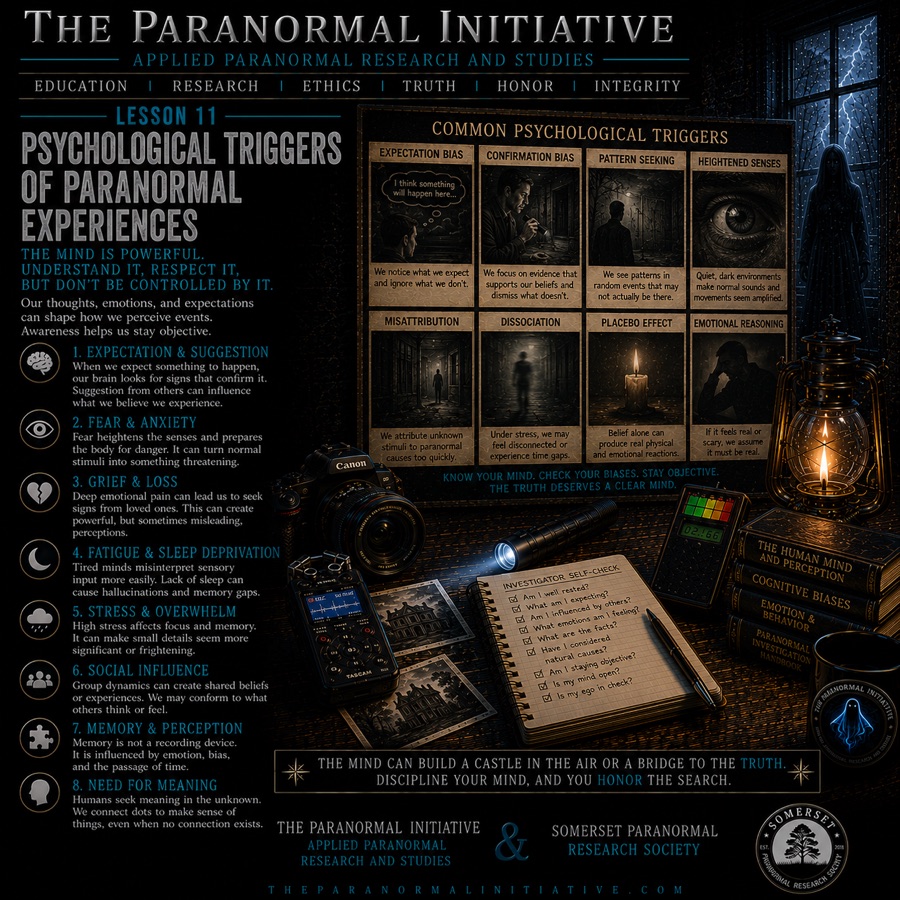
One of the most serious responsibilities in paranormal investigation is how an investigator speaks to a client. A beginner may think that saying "this place is haunted" is simply part of the field. It is not. When an investigator tells a homeowner, tenant, parent, child, employee, manager, or business owner that a location is haunted, demonically affected, cursed, oppressed, or occupied by an entity, that statement can alter the way people live and make decisions. It can make ordinary sounds feel threatening. It can make children afraid to sleep in their rooms. It can cause adults to watch every shadow, smell, light flicker, draft, or creak as if it is a message or attack. It can create a feedback loop in which fear increases attention, attention increases perceived activity, and perceived activity increases fear.
This does not mean investigators should dismiss clients or refuse to discuss paranormal claims. It means they must understand the weight of their words. A professional investigator documents what is reported, documents what is observed, evaluates possible explanations, and communicates uncertainty honestly. A professional investigator does not use the client as an audience for dramatic conclusions. The client is not there to be shocked. The client is there to be heard, helped, and treated with care.
Residential consequences. In a home, a paranormal label can affect the emotional safety of the entire household. A parent who is told that the house has a demon may become more anxious around their children. A child who hears adults discussing a haunting may begin interpreting normal nighttime sounds as threatening. A person who is grieving may become more dependent on the idea that every small event is communication from the deceased. A person already under stress may sleep less, avoid certain rooms, check cameras compulsively, or become afraid to be alone. Even when the investigator leaves, the statement remains in the home. The client has to live with it.
Business consequences. In a workplace, careless claims can affect more than personal fear. A business owner may worry about reputation, customers, staff retention, liability, insurance questions, or public ridicule. Employees may become anxious on certain shifts or refuse to enter certain areas. A restaurant, hotel, shop, theater, museum, or historic site may enjoy folklore as part of public interest, but that is different from an investigator declaring a present threat. A business client may need practical help separating legend, marketing, employee experience, building conditions, and operational safety. The investigator should not create a problem the business did not ask for and cannot easily undo.
Family and relationship consequences. A paranormal interpretation can change how family members treat one another. If one person believes the activity follows them, other people may begin watching that person differently. If a child is believed to attract activity, the child may feel blamed or special in a frightening way. If a spouse is skeptical, the household may become divided between believers and doubters. If a grieving person believes a loved one is present, another family member may feel pressure to agree. The investigator should not add labels that intensify conflict inside the family system. The safest approach is to document experiences without assigning identity or motive to them.
Religious and demonic-claim consequences. Demonic language carries a special psychological charge. The word "demon" can produce fear, shame, moral panic, spiritual dread, and a sense of personal danger. For some clients it may connect to sincerely held religious beliefs. For others it may connect to trauma, childhood fear, media influence, or anxiety. An investigator should never tell a client that they have a demon, that they are oppressed, that an entity is attached to them, or that their home is spiritually dangerous unless they are operating within a qualified religious or pastoral role and following that tradition's proper safeguards. Even then, the paranormal investigator's role is limited. In a secular investigation, demonic language should be treated as client language to document, not as an investigator conclusion to announce.
Suggestion and escalation. Once an investigator introduces a frightening label, the client may begin organizing later experiences around that label. If the investigator says, "this sounds demonic," the client may begin interpreting nightmares, headaches, family arguments, pet behavior, electrical problems, and normal house noises as part of the same demonic pattern. This is suggestion. It can happen even when the investigator did not intend harm. The more authority the investigator appears to have, the stronger the suggestion can become. Cameras, equipment, team shirts, websites, titles, and confident speech all create perceived authority. Students must understand that authority magnifies responsibility.
Financial consequences. A careless claim can push people toward unnecessary spending. A frightened client may buy cameras, sensors, cleansing products, security systems, consultations, or repeat investigations they do not need. They may avoid repairs because they believe the issue is spiritual rather than structural. They may consider moving, closing a business, or changing normal routines. Investigators must not profit from escalating fear. If the investigation identifies a likely building issue, safety issue, pest issue, electrical issue, HVAC issue, plumbing issue, sleep issue, or stress issue, the responsible recommendation is to address that issue before expanding the paranormal explanation.
Public and online consequences. Posting or discussing a client's case online can intensify harm. A residential client may be embarrassed, recognized, mocked, contacted by strangers, or pressured by people with strong beliefs. A business may gain unwanted attention or suffer reputation problems. A dramatic title such as "demon house," "evil entity," or "haunted business confirmed" may attract views, but it can damage real people. Students must learn that privacy, consent, and careful wording are not optional. They are part of the evidence standard.
Legal and professional consequences. Investigators are not doctors, therapists, clergy, electricians, structural engineers, pest inspectors, or law enforcement unless they separately hold those roles. A paranormal investigator who makes medical, psychological, legal, religious, or safety claims outside their competence can create risk for the client and for the team. If a client reports self-harm thoughts, threats, abuse, unsafe living conditions, severe distress, persistent hallucination-like experiences, delusion-like beliefs, dangerous behavior, or inability to sleep or function, the investigator should not continue treating the case as a paranormal puzzle. The priority becomes safety, support, and referral to appropriate professionals or emergency help.
Professional wording standard. Use language that preserves both compassion and uncertainty. Say, "The client reports hearing knocking between 2:00 and 3:00 AM," not "something is trying to communicate." Say, "We documented an unexplained audio event that requires further review," not "a spirit answered us." Say, "We do not have enough evidence to identify a source," not "we cannot rule out a demon." Say, "Because this is causing distress, we recommend support from qualified professionals in addition to our environmental review," not "the activity is feeding on fear." Careful wording is not weakness. It is professional discipline.
The investigator's duty. The investigator's duty is to reduce confusion, not increase it. If the client feels more frightened, more certain of danger, more isolated, or more dependent on the team after the conversation, the team should examine its conduct. A good investigation may still leave unanswered questions, but it should not manufacture fear. The highest standard is not to be the most dramatic team in the room. It is to be the team that leaves the client with clearer documentation, safer next steps, and a more grounded understanding of what is known, unknown, and still being evaluated.