Ghostology 101 · Lesson 12

Spiritual, religious, and demonic-claim language

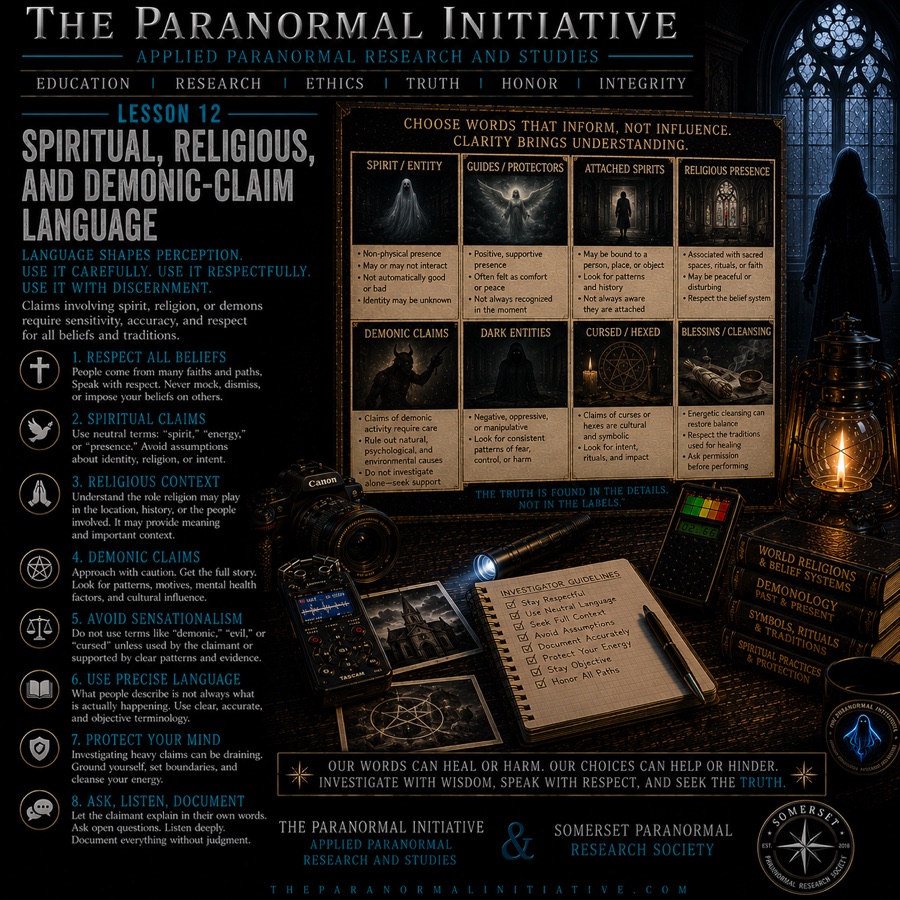
This lesson teaches students how to approach spiritual or demonic language carefully without ridicule, escalation, or unsupported certainty.

All Lessons Lesson 11 Lesson 13
Ghostology 101 lesson 12 visual

Lesson Reading

Lesson Purpose

This lesson teaches students how investigators respectfully navigate reports that involve spiritual, religious, supernatural, or demonic interpretations. The purpose of this lesson is not to teach theology. The purpose is not to determine whether any belief system is correct. The purpose is to teach investigators how to document what witnesses report, respect differing worldviews, recognize when specialized assistance may be appropriate, and remain within the investigator's scope. Students should understand that different cultures, religions, and individuals often use different language to describe similar experiences, and that the investigator's responsibility is to understand the report, not to impose beliefs.

Learning Objectives

By the end of this lesson, students should be able to: explain why paranormal investigators frequently encounter spiritual and religious language during investigations; describe how to document a witness's reported beliefs without endorsing or dismissing them; identify at least three different cultural or religious frameworks that may influence how people interpret paranormal experiences; describe what investigators should NOT do when confronted with spiritual or demonic claims; explain when and how to make a professional referral; and demonstrate respectful communication with witnesses from diverse backgrounds.

Introduction — Different Languages for Similar Experiences

Paranormal investigators meet people from many different backgrounds. A family who believes their home is haunted by a restless spirit may describe the same type of experience that another family describes as a demonic attack. A third family may interpret the same phenomena through the lens of their cultural traditions, using language from their ancestral heritage. A fourth may have no religious framework at all and simply say they are experiencing strange things they cannot explain.

All of these interpretations are valid frameworks for the people experiencing them. The investigator's role is not to decide which framework is correct. The investigator's role is to document what happened, investigate the conditions, and present findings honestly — while treating every person with dignity regardless of their beliefs.

This lesson teaches you how to navigate the complex intersection of belief, culture, and investigation. You will learn how to respond when witnesses use spiritual or religious language, how to avoid escalating frightening claims, how to maintain professional boundaries, and how to make appropriate referrals when a case exceeds your scope. You will also learn that understanding different cultural perspectives makes you a more effective and more compassionate investigator.

Language Shapes Interpretation

The words people use to describe their experiences reveal how they understand those experiences. Language does not just describe reality. It shapes it. When a witness says "a ghost touched me," they are not only reporting a physical sensation. They are interpreting that sensation through a framework that includes the concept of ghosts. A witness from a different background who experiences the same physical sensation might say "a spirit visited me" or "an ancestor made their presence known" or "I felt a draft."

People describe experiences using the vocabulary of their own culture, religion, family traditions, and personal beliefs. A Christian may interpret a disturbing experience as demonic. A Hindu may interpret a similar experience as the work of a restless spirit. A secular person may interpret the same experience as a psychological or environmental phenomenon. None of these interpretations is inherently more valid than the others. They are different frameworks for understanding the same human experience.

The investigator's job is to document the experience in the witness's own words and to investigate the physical, environmental, and psychological conditions that may be influencing it. You do not need to adopt the witness's framework. You do not need to agree with their interpretation. You need to respect their right to interpret their own experience and to document it accurately.

Documenting exact language. When a witness uses spiritual or religious terms, record their exact words. If they say "demonic," write "demonic." If they say "cursed," write "cursed." If they say "my ancestor is trying to tell me something," write that. Do not correct their terminology. Do not translate it into more "objective" language. The words they choose are part of the data. They tell you how the witness understands their experience. Preserve that information.

Avoiding argument. Do not argue with witnesses about their beliefs. If a witness says their home is cursed, do not tell them curses are not real. If a witness says a spirit is attacking them, do not tell them spirits do not exist. Arguing damages trust and closes the door to honest communication. Your role is to investigate the conditions, not to debate theology. You can document a claim without endorsing it, and you can respect a person without agreeing with them.

Spiritual Beliefs Around the World

Paranormal investigators encounter people from every conceivable background. Understanding the basic frameworks of the world's major religious and spiritual traditions helps you communicate respectfully and understand what witnesses are describing. This section provides a high-level introduction. Detailed study of any of these traditions belongs in its own curriculum. The goal here is simply to build awareness and respect.

Christianity. Christianity is the world's largest religion, with over two billion adherents. Christian beliefs about the supernatural vary widely across denominations. Some Christians believe in ghosts or spirits of the dead. Others believe that what appear to be ghosts are actually demons impersonating the dead. Some believe in angelic protection and demonic oppression. Terms like "haunted," "demonic," "angelic," and "blessing" are common in Christian vocabulary. Catholics may request a priest's blessing or an exorcism. Protestants may request prayer or pastoral counseling. Investigators should be aware that Christian witnesses may interpret paranormal experiences through a theological framework that includes concepts of sin, salvation, spiritual warfare, and divine protection.

Judaism. Judaism teaches that the soul survives after death, and Jewish tradition includes accounts of spirits, dybbuks (restless souls), and angels. However, Jewish law generally discourages attempts to contact the dead or engage with spirits. A Jewish witness may describe experiences in terms of spiritual unrest or unfinished business. Terms like "dybbuk" or "golem" may appear in some contexts. Respecting Jewish beliefs means understanding that the framework is different from Christian or secular frameworks and that each Jewish individual may interpret their experiences differently based on their level of observance and tradition.

Islam. Islamic tradition includes belief in jinn — spiritual beings created from smokeless fire who can interact with humans. Some Muslims may interpret paranormal experiences as interactions with jinn rather than ghosts of the dead. Islamic tradition also includes belief in angels, Satan (Shaytan), and the evil eye. A Muslim witness may describe experiences in terms of jinn activity or spiritual attack. Prayers from the Quran are commonly used for protection. Investigators should be aware that Islamic interpretations of paranormal phenomena are distinct from Christian or Western ghost traditions and should be treated with respect.

Hinduism. Hinduism encompasses a vast range of beliefs and practices. The concept of reincarnation — the soul being reborn in a new body after death — is central to many Hindu traditions. Ghosts (bhoota) are often believed to be souls of people who died unnaturally or whose funeral rites were not properly performed. Hindu traditions include rituals for helping restless souls move on. A Hindu witness may describe experiences in terms of unfinished karma, improper death, or ancestral spirits. Understanding these concepts helps investigators respect the witness's framework.

Buddhism. Buddhist traditions vary widely across cultures, but many include beliefs about rebirth, karma, and restless spirits. In some Buddhist traditions, ghosts (preta) are beings who are trapped in a state of constant craving due to attachments in their previous life. Buddhist practices may include merit-making ceremonies to help spirits move on. A Buddhist witness may interpret paranormal experiences through the lens of karma and rebirth. Investigators should respect these interpretations without endorsing or dismissing them.

Indigenous traditions. Indigenous cultures around the world have their own rich traditions of spirit beliefs, ancestor veneration, and relationships with the natural world. These traditions are diverse and specific to each culture. In many Indigenous traditions, ancestors remain involved in the lives of their descendants. Land itself may be considered sacred or inhabited by spirits. Ceremonies for maintaining balance and harmony are common. Investigators working with Indigenous clients or on Indigenous land should educate themselves about the specific traditions of that community and approach the work with humility and respect.

Spiritualism. Spiritualism is a religious movement based on the belief that the dead can communicate with the living through mediums. Spiritualists may interpret paranormal experiences as communication from deceased loved ones or spirit guides. Seances, mediumship, and spirit communication are central practices. Some investigators come from a Spiritualist background, and some clients may identify as Spiritualists. Spiritualist interpretations deserve the same respect as any other framework.

Non-religious perspectives. Many people do not identify with any religious tradition. They may describe their experiences in secular terms: "strange," "unexplained," "weird," "frightening." They may be open to paranormal explanations, skeptical, or uncertain. They may be curious about what science can explain. Non-religious witnesses deserve the same respect as religious ones. Their framework is not inherently more objective or more valid. It is simply different.

This introduction is intentionally broad. The goal is not to make you an expert in comparative religion. The goal is to help you recognize that there are many valid ways to interpret unusual experiences, and that your role is to document and investigate, not to judge or correct.

Religious Terminology

Certain terms appear frequently in paranormal investigation. Understanding what these terms mean in different contexts helps you communicate effectively and avoid misunderstanding.

Spirit. A non-physical being. In many traditions, spirits include souls of the dead, nature spirits, and other entities. The term is broad and can mean different things to different people. Document how the witness uses the term.

Ghost. Generally understood as the spirit of a deceased person that appears to the living. In some traditions, ghosts are restless souls trapped between worlds. In others, they are spirits who have not yet moved on. The term is widely used but carries different connotations in different contexts.

Angel. A spiritual being believed to serve as a messenger or protector of humans. Angels appear in Christian, Jewish, Islamic, and other traditions. Witnesses who report angelic encounters may be describing meaningful experiences that deserve respect.

Demon. A malevolent spiritual being. In many traditions, demons are fallen angels or evil spirits that can harm humans. The term carries heavy emotional and cultural weight. When a witness uses the word "demon," take it seriously — they are likely frightened — but do not assume the label is accurate. Document the term and investigate the conditions.

Blessing. A religious ritual that invokes divine favor or protection. Some witnesses may request a blessing for their home. If you are not qualified to perform a blessing, do not attempt one. Refer the witness to a clergy member of their tradition.

Haunting. A term used broadly to describe recurring reports of unexplained phenomena associated with a specific location. Some religious traditions interpret hauntings as the work of restless spirits. Others interpret them as demonic activity. Others see them as purely natural phenomena. The term itself is neutral, but the interpretation varies.

Possession. The belief that a person's body or mind can be controlled by a spirit or demon. Possession is a religious and psychological concept, not an investigative finding. If a witness believes they or someone in their home is possessed, refer them to appropriate religious or mental health professionals. Do not attempt to diagnose or treat possession yourself.

Curse. A ritual invocation intended to bring harm to someone. Some witnesses may believe their home or family is cursed. Document this belief. Investigate environmental and psychological factors. If the witness wants the curse removed, refer them to a religious professional of their tradition.

These terms often have different meanings in different traditions. A "spirit" in one tradition may be understood very differently in another. When a witness uses any of these terms, ask clarifying questions: "What does that word mean to you?" or "Can you tell me more about what you mean when you say that?" This helps you understand the witness's framework without imposing your own.

Demonic Claims

Demonic claims are among the most challenging reports an investigator can encounter. They require particularly careful handling because the stakes are high. Witnesses who believe they are dealing with demonic activity are often frightened, sleep-deprived, and desperate for help. The wrong response can escalate fear, cause harm, and damage the credibility of the investigation.

Document exactly what is reported. When a witness uses demonic language, document their exact words. Do not correct them. Do not suggest alternative explanations during the interview. Simply record what they say. "I feel like something evil is in my bedroom" should be recorded exactly as stated. The witness's language is data.

Avoid diagnosing situations. Do not tell a witness that their home is demonic. Do not tell them it is not. You are not qualified to make that determination, and doing so can cause serious harm. Telling someone their home is demonic can increase fear, create family conflict, and lead to costly and unnecessary interventions. Telling someone their experience is not demonic may dismiss their genuine fear and damage trust. The appropriate response is to document the claims and investigate the conditions.

Avoid making declarations. Never declare that a location is "clean," "blessed," "safe," or "free of negative energy" unless you have the qualifications and authority to make such declarations. An investigator's role is to document and analyze, not to provide spiritual assurances. If a witness asks whether their home is safe, you can say: "We have documented the environmental conditions and identified several natural explanations for the phenomena you reported. We have not found any evidence of paranormal activity, but we cannot make claims about spiritual matters. We recommend consulting with a religious professional if you have ongoing concerns."

Avoid sensational language. When writing reports about cases involving demonic language, use measured, professional terminology. Do not use dramatic or fear-inducing language. "The witness reported feeling an evil presence" is professional. "The location is infested with demonic entities" is sensational and irresponsible. Your report should document what was reported, not what you imagine to be true.

Why extraordinary claims require extraordinary care. Demonic claims are extraordinary. They involve beliefs about malevolent spiritual forces that can cause real psychological and emotional harm. The investigator's response must be proportionate to the potential harm. This means extra care in documentation, extra caution in language, and extra attention to the witness's wellbeing. When in doubt, err on the side of compassion and caution.

Why the Demonic Label Spreads So Easily

The word "demonic" spreads quickly because it is powerful, frightening, familiar, and dramatic. Many people have heard the word in church, in movies, in podcasts, on paranormal television, and in social media clips. The word already carries a story with it. Once it enters a case, people may begin interpreting ordinary events through that story. A knock becomes a warning. A scratch becomes an attack. A shadow becomes a figure. A nightmare becomes oppression. A strange growl in the wall becomes a voice. The investigator must understand this pattern because the label can begin shaping the case before any evidence has been reviewed.

Paranormal entertainment has helped make demonic language common in public conversation. Dramatic television depends on tension. A quiet explanation about plumbing, air pressure, wildlife, dust, grief, or sleep disruption does not always make exciting television. A claim of evil, oppression, possession, attachment, or demonic influence can make an episode feel urgent. Over time, viewers may absorb the idea that frightening equals demonic, aggressive equals demonic, dark equals demonic, or unexplained equals demonic. That is not investigation. That is media framing. Para TV has made this worse in some corners of the field because the word "demonic" is often treated like a ratings hook. It gives a case instant danger, instant conflict, and instant emotional pressure. Students must understand that what works as entertainment can be harmful in a client's home.

In a real case, the investigator has to slow that process down. The goal is not to embarrass the client for using the word. The goal is to prevent the word from becoming the conclusion before the case has begun. If a client says, "I think it is demonic," a professional investigator might respond, "I understand why that word feels important to you. We will document exactly what has happened and look carefully at ordinary causes before we make any interpretation." This response respects the client without adopting the label.

The class should be very clear on this point: popular interest in evil or demonic cases does not make those cases common, and it does not make the label safe. Many people are drawn to dramatic claims because they feel intense and meaningful. Some people want the most frightening explanation because it gives shape to their fear. Others may repeat the word because they have heard investigators on television use it. A responsible student must learn to separate public fascination from field practice. The question is not, "What would make this case sound dramatic?" The question is, "What has actually been observed, what has been documented, what has been tested, and what remains unknown?"

Once demonic language is attached to a home or business, it can change the way everyone behaves. Family members may become afraid to sleep. Children may be questioned in leading ways. Employees may begin sharing rumors. A business owner may fear reputational damage. A client may pay for spiritual services they do not need. A witness may stop considering medical, environmental, or psychological explanations. This is why the investigator must treat the label as high-risk language. It belongs in the record only as a reported belief or interpretation, not as the investigator's finding.

Before Demonic: Check Ordinary Causes First

Before any investigator considers demonic language, the ordinary world has to be investigated carefully. A scratch on a wall does not mean demonic activity. A scrape inside a wall does not mean a spirit is clawing at the house. A shadow in a hallway does not mean an entity is present. A bump, thump, growl, hiss, knock, whisper, or movement in a room can come from many ordinary sources. Some of those sources are simple. Some are hidden. Some are startling enough that a frightened person may honestly interpret them as threatening.

Scratches and scraping sounds. Scratching inside walls, ceilings, attics, crawlspaces, and basements often has ordinary causes. Mice, squirrels, bats, birds, insects, and other animals can enter small gaps in older structures. They may move through wall cavities, chew, scrape, nest, or attempt to get out. The sound can travel through studs, joists, pipes, ductwork, and plaster in ways that make the source difficult to locate. A client may hear the sound near the headboard and believe it is in the bedroom wall, while the actual source may be in an attic corner, under siding, or near a vent opening.

Growls, hisses, and disturbing noises. Wildlife can produce sounds that are deeply unsettling when heard at night through walls or vents. Some animals can growl, chatter, hiss, screech, or fight with each other in ways that sound larger or stranger than expected. Raccoons, for example, can make a harsh growling sound that may seem shocking if it is muffled through a wall, attic, chimney, crawlspace, or vent. A person lying awake in fear may hear that sound and interpret it as a voice, a growl, or a hostile presence. The investigator should not mock that reaction. A strange sound in a dark house can be genuinely frightening. But fear does not identify the source. The correct next step is to inspect access points, look for droppings or nesting material, check attic and crawlspace conditions, review exterior gaps, and recommend pest or wildlife professionals when needed.

Wall marks, door marks, and surface damage. Scratches on walls, doors, baseboards, furniture, and trim can come from pets, furniture movement, settling, loose hardware, children, tools, belts, keys, nails, insects, moisture damage, or past occupants. A mark discovered after a frightening night may feel connected to the experience, but timing has to be established. Was the mark photographed before? Was the area recently cleaned, moved, painted, or rearranged? Are there matching marks elsewhere in the house? Is the mark at the height of a pet, door swing, chair back, picture frame, or vacuum cleaner? A professional investigator treats the mark as physical evidence, not as a spiritual message.

Bumps, knocks, and footsteps. Houses make noise. Plumbing can knock. Ductwork can flex. Refrigerators cycle. Water heaters expand. Floorboards respond to temperature and humidity. Roof materials shift. Wind can move vents, shutters, loose siding, branches, screens, and doors. A person may hear a pattern and interpret it as footsteps. Sometimes the rhythm is caused by machinery, thermal expansion, water pressure, or a loose object moving in repeated cycles. The investigator's job is to test the environment at the time the sound usually occurs, not to record the sound once and assign it a dramatic cause.

Shadows and movement. Perceived shadows can be created by headlights, passing vehicles, outdoor motion lights, reflections, television screens, phone screens, ceiling fans, tree branches, curtains, insects near cameras, floaters in the eye, fatigue, and low-light vision. Humans are excellent pattern makers. In dim light, the brain fills gaps quickly. If a person is already afraid, the brain may interpret a vague shape as a figure. This does not mean the witness is lying. It means human perception is active, protective, and influenced by context.

Odors and sensations. Smells described as sulfur, decay, perfume, smoke, or rot should be handled carefully. Odors can come from sewer gas, drains, mold, dead animals in walls, electrical overheating, HVAC systems, cleaning products, old wood, damp materials, nearby industry, fireplaces, gas leaks, or personal memory associations. Sensations of being touched can come from drafts, fabric movement, insects, static, muscle twitches, anxiety responses, skin irritation, or sleep-state phenomena. None of these possibilities should be used to belittle the witness. They are simply part of the checklist that must be worked through before any extraordinary claim is considered.

The beginner's rule is simple: the more frightening the claim, the more ordinary causes must be checked first. Fear is not evidence of demons. Intensity is not evidence of evil. A case can feel severe and still be environmental, structural, medical, psychological, or social. The investigator's professionalism is measured by the discipline to keep checking even when the story is dramatic.
Client Harm from Careless Demonic Language

Careless demonic language can harm clients long after the investigation team leaves. If an investigator tells a family that their home is demonic, the family may begin living inside that conclusion. They may sleep less, watch each other more closely, interpret every noise as a threat, and become afraid of rooms they previously used normally. Children may become frightened because adults in the home are frightened. A spouse who was skeptical may become angry. A client who was already anxious may become more anxious. The investigator may have intended to help, but the label can create a psychological burden the client has to carry.

In a business case, the consequences can be different but still serious. A claim of demonic activity can damage a business reputation, frighten employees, affect customers, create gossip, and complicate insurance, property, or workplace concerns. A restaurant, hotel, theater, office, or historic site may be comfortable with a ghost story as local folklore but not with a public claim of evil or demonic infestation. Investigators must never use dramatic spiritual labels for attention, marketing, or social media engagement. A client is not content. A client's fear is not a promotional tool.

There can also be spiritual harm. If a client has a religious background, telling them their home is demonic may trigger deep fear, guilt, shame, or spiritual crisis. They may wonder whether they caused it, whether their family is being punished, whether a child is in danger, or whether their faith has failed them. Those questions belong with qualified spiritual care providers, not paranormal hobbyists. The investigator should make respectful referrals when requested, but should not step into the role of clergy, therapist, doctor, or spiritual authority.

Careless language can also distort the evidence. Once a case is called demonic, team members may unconsciously search for confirmation. They may pay more attention to aggressive-sounding audio, dark photographs, cold spots, scratches, or frightening dreams. They may ignore boring explanations because the dramatic story has taken over. This is confirmation bias in action. The stronger the label, the harder the investigator must work to keep the record clean.

The safer standard is to report the client's language as the client's language. Instead of writing, "The house is demonic," write, "The client describes the activity as demonic and reports fear related to that interpretation. The investigation has not established a cause." Instead of saying, "A demon scratched the wall," write, "The client reports new scratch marks on the east bedroom wall. The marks were photographed, measured, and compared with possible contact points. Wildlife, pet, furniture, moisture, and prior damage explanations remain under review." This keeps the case honest. It protects the client. It protects the investigator. Most importantly, it protects the truth.

Cultural Differences

Different cultures explain unusual experiences in different ways. Understanding these differences helps investigators communicate respectfully and avoid imposing their own cultural assumptions.

Western ghost traditions. In many Western cultures, ghosts are understood as the spirits of deceased people who have not moved on. This framework is familiar from television, movies, and literature. Many Western witnesses interpret their experiences through this lens, using terms like "spirit," "ghost," "apparition," and "haunting."

Ancestor traditions. In many cultures around the world, ancestors are believed to remain involved in the lives of their descendants. Experiences that a Westerner might interpret as a "haunting" might be interpreted in an ancestor tradition as a visit from a family member who has something to communicate. These experiences are often not frightening but are seen as meaningful communications from the ancestral world.

Spirit possession traditions. Some cultures have traditions of spirit possession in which a spirit temporarily takes control of a person's body. These traditions often have established protocols for identifying and addressing possession, including rituals performed by trained practitioners. What might look like mental illness to an outside observer might be understood as spirit possession within the cultural framework. Investigators should be aware of these traditions and should never assume that a behavior they do not understand is necessarily pathological or paranormal.

Land and place traditions. Some cultures believe that certain places — mountains, rivers, forests, crossroads — are inhabited by spirits or have spiritual significance. Disturbing these places can cause spiritual unrest. A witness from such a culture may interpret strange experiences as resulting from disrespect to the land. Understanding this framework helps investigators respond appropriately.

Religious diversity within cultures. Even within a single culture, individuals may have very different beliefs. A person raised in a strongly religious family may interpret experiences differently than someone from the same culture who was raised secularly. Generational differences, education, personal experiences, and exposure to other cultures all shape individual beliefs. Never assume that someone from a particular background holds specific beliefs. Ask them about their own understanding.

Professional Boundaries

One of the most important skills a paranormal investigator can develop is knowing what NOT to do. The investigator's role has clear boundaries. Crossing those boundaries can cause harm to witnesses and damage the credibility of the investigation.

Do not perform exorcisms. Exorcism is a religious ritual that requires specific training and authorization within a religious tradition. If an investigator performs an exorcism without proper qualification, they are practicing outside their scope, potentially causing harm, and exposing themselves to legal liability. If a witness requests an exorcism, refer them to a clergy member of their tradition.

Do not promise spiritual protection. Do not tell witnesses that you can protect them from spiritual harm. Do not sell or recommend spiritual protection products. Do not perform blessings, cleansings, or smudgings unless you are qualified to do so within a recognized tradition and the witness has requested it. Your role is to investigate, not to provide spiritual services.

Do not give medical advice. If a witness reports physical symptoms — headaches, fatigue, nausea, unexplained marks — do not diagnose the cause. Suggest they consult a medical professional. Some symptoms that people attribute to paranormal causes have medical explanations, including carbon monoxide poisoning, mold exposure, sleep disorders, and other conditions. Recommend medical evaluation when appropriate.

Do not give mental health advice. If a witness appears to be experiencing mental health symptoms — hallucinations, paranoia, severe anxiety, delusions — do not attempt to diagnose or treat them. Suggest they consult a mental health professional. Be compassionate and non-judgmental. You can say: "What you are experiencing sounds very distressing. We will document everything and investigate the conditions, but we also recommend speaking with a professional who can help you with how you are feeling."

When to make a referral. Referrals are appropriate when: the witness requests spiritual support and you are not qualified to provide it; the witness shows signs of mental health distress; the witness has medical concerns that could be related to their experiences; the case involves claims that are clearly outside the scope of paranormal investigation. When making a referral, provide the witness with contact information for appropriate professionals and follow up to ensure they received help.

Respecting Witnesses

At the heart of every investigation is a person who has had an experience they do not understand. How you treat that person matters more than any evidence you might collect. Respectful treatment is not just ethical. It is practical. A witness who feels respected is more likely to provide accurate information and to cooperate with the investigation.

Compassionate communication. When a witness is frightened, your first response should be compassion. "I can hear how upsetting this has been for you" acknowledges their feelings without validating or dismissing their interpretation. "We are here to help you understand what is happening" sets a collaborative tone. Avoid language that minimizes their experience: "It's probably nothing" or "You're just tired" are dismissive and damaging.

Document the witness's words. Use their exact language in your notes. If they say "demonic," write "demonic." If they say "evil presence," write "evil presence." If they say "my grandmother is trying to reach me," write that. Your documentation should preserve their interpretation, not replace it with your own.

Avoid correcting beliefs. Even if a witness's interpretation seems unlikely to you, do not correct them. Your role is to document and investigate, not to educate or convert. If a witness believes their home is cursed, document that belief. Investigate the environmental and psychological conditions. Present your findings honestly. The witness may reconsider their interpretation in light of the evidence, or they may not. Either outcome is acceptable.

Avoid arguing. Arguments about theology or the nature of reality have no place in a paranormal investigation. They damage trust, waste time, and produce no useful information. If a witness tries to engage you in theological debate, politely redirect: "That is an interesting question, but our focus right now is on documenting what you have experienced and understanding the conditions. We can explore broader questions later if you wish."

Know when to step back. Some cases may be beyond the scope of paranormal investigation. If a witness is in crisis, if they are experiencing severe mental health symptoms, if they are fixated on a religious interpretation that you cannot address, or if the situation is escalating in ways that feel unsafe, it is appropriate to step back and recommend professional help. Knowing your limits is a sign of professionalism, not failure.

Practical Investigation Examples

The following scenarios illustrate how investigators can respectfully handle cases involving spiritual, religious, or demonic language. Each scenario presents a different challenge and demonstrates professional response.

Example 1: The Christian Family. A Christian family reports that objects in their home move on their own, that they hear knocking sounds, and that their youngest child has been waking up frightened. They believe their home is infested with a demonic entity and request an exorcism. The investigator listens carefully, documents the claims in the family's own words, and explains that while they cannot perform an exorcism, they will thoroughly investigate the home. The investigator checks the environmental conditions: HVAC, plumbing, wiring, and carbon monoxide levels. They find that the home has elevated carbon monoxide levels from a faulty furnace, which can cause hallucinations, confusion, and physical symptoms. They also find that the knocking sounds are caused by loose pipes. The investigator explains these findings to the family, recommends furnace repair, and offers to refer them to a clergy member if they still have spiritual concerns. The family is relieved to have a medical explanation and grateful for the investigator's respectful approach.

Example 2: The Hindu Witness. A woman of Hindu background reports that she feels a presence in her home and has heard footsteps at night. She believes the spirit of a deceased relative is trying to communicate with her because proper funeral rites were not performed. She is not frightened but wants to understand what is happening. The investigator documents her account in her own words, including her interpretation. The investigator checks environmental conditions and finds that the footsteps are caused by the house settling and the HVAC system cycling. The investigator shares these findings with the woman, explaining the natural causes. The woman accepts the explanation but also decides to consult with a Hindu priest about performing the proper rites for her relative. The investigator supports this decision and provides a written report documenting both the environmental findings and the woman's original interpretation.

Example 3: The Muslim Family. A Muslim family reports strange sounds, the feeling of being watched, and a general sense of unease in their home. They wonder if jinn might be involved. The investigator respects their framework, documents their account, and conducts a thorough environmental assessment. The investigation reveals that the sounds are caused by a faulty ventilation system and that the unease may be related to high humidity and poor air quality. The investigator presents these findings clearly and respectfully, noting that environmental factors may explain the reported experiences. The family is relieved and decides to address the ventilation and air quality issues. The investigator provides a written report and offers to follow up.

Example 4: The Spiritualist. A witness who identifies as a Spiritualist reports that she has been receiving messages from a deceased loved one through EVP recordings. She is not frightened and is eager to share her evidence. The investigator listens respectfully, reviews the recordings, and notes that the sounds could have natural explanations including radio interference and auditory pareidolia. The investigator explains these possibilities without dismissing the witness's interpretation. The witness is grateful for the thorough review and appreciates that her beliefs were respected. She decides to continue her own investigation with a better understanding of potential natural explanations.

Example 5: The Indigenous Client. An Indigenous family reports unusual activity on their property: sounds, lights, and the feeling of being watched. They believe the activity may be connected to ancestral spirits who are disturbed by recent construction on the land. The investigator researches the history of the land and finds that it was traditionally used by the family's ancestors. The investigator documents the family's interpretation and conducts an environmental survey. The sounds are traced to construction equipment at a nearby site. The lights are explained by headlights from a road that was recently built. The investigator shares these findings while acknowledging the family's cultural interpretation. The family decides to consult with an elder about appropriate ceremonies. The investigator supports this decision and provides a written report.

Example 6: The Demonic Claim (Carbon Monoxide). A family reports that objects in their home move on their own, that they hear whispers, and that one family member has scratches on their skin. They believe the home is infested with a demonic entity. The investigator listens carefully, documents the claims, and does not argue with the family's interpretation. During the environmental assessment, the investigator discovers that the home has high levels of carbon monoxide, which can cause hallucinations, confusion, and physical symptoms. The investigator also finds that the "scratches" are caused by a reaction to mold in the bathroom. The family is referred to medical professionals and a mold remediation service. They are relieved to have natural explanations. The investigator documents everything and provides a thorough report. The case illustrates why thorough environmental investigation is essential, even — and especially — when claims involve dramatic spiritual language.

Common Beginner Mistakes

Handling spiritual and religious language requires practice and self-awareness. The following mistakes are common among beginners. Recognizing them will help you avoid them.

Arguing theology. Beginners sometimes try to correct a witness's beliefs or argue about the nature of reality. This is never appropriate. Arguments damage trust and produce no useful information. Your role is to document and investigate, not to debate.

Dismissing beliefs. Some beginners dismiss religious or spiritual interpretations as superstition or ignorance. This is disrespectful and counterproductive. A witness whose beliefs are dismissed will not trust you and may not provide accurate information. Even if you do not share a witness's beliefs, you must respect their right to hold them.

Validating everything. The opposite mistake is validating every claim without investigation. Telling a witness "Yes, your home is demonic" is irresponsible and can cause harm. Validate the person's experience without validating their conclusion. "I can see this has been very upsetting for you" validates the emotion without endorsing the interpretation.

Diagnosing demons. Some beginners, influenced by paranormal media, are quick to declare a location "demonic" or "haunted." This is unprofessional and potentially harmful. The investigator's role is to document and analyze, not to diagnose supernatural causes. Leave spiritual diagnoses to qualified religious professionals.

Making promises. Beginners sometimes promise to "fix" a problem that may be beyond their scope. "We will get rid of the spirit for you" is a promise you may not be able to keep. Be honest about what you can and cannot do. "We will investigate the conditions and share our findings with you" is an honest and professional commitment.

Performing rituals. Some beginners attempt to perform blessings, cleansings, or other spiritual rituals without proper training or authorization. This is outside the investigator's scope and can cause harm. If a witness requests a spiritual intervention, refer them to a qualified professional.

Common Misconceptions

The following misconceptions are particularly common when it comes to spiritual and religious language in paranormal investigation. Understanding them will help you avoid the most frequent pitfalls.

"Spiritual language means the witness is irrational." Using spiritual or religious language does not make a witness irrational. It means they are interpreting their experience through the framework that makes sense to them. Many intelligent, educated, and reasonable people hold spiritual beliefs. Dismissing someone because of their beliefs is prejudice, not professionalism.

"Demonic claims should always be taken literally." Demonic claims should be taken seriously, but not necessarily literally. The language may reflect the witness's cultural or religious background rather than an accurate description of events. Document the claim. Investigate the conditions. Do not assume that the witness's interpretation is factual.

"Investigators should never mention spiritual possibilities." If the evidence genuinely supports a spiritual interpretation, it is honest to say so. But that conclusion should come after thorough investigation, not before. An investigator can acknowledge that a case remains unexplained without declaring a spiritual cause. "We were unable to identify a natural explanation for this phenomenon" is a professional conclusion that leaves room for multiple interpretations.

"All religious traditions interpret paranormal experiences the same way." Different religions, and different individuals within each religion, interpret paranormal experiences very differently. Never assume that you know what a witness believes based on their cultural or religious background. Ask them about their own understanding.

"If a witness uses religious language, they do not want a scientific investigation." Many witnesses who use religious or spiritual language are still interested in understanding the physical and environmental conditions. They may want both a scientific investigation and spiritual support. Offering both — within your scope — is appropriate and respectful.

"An investigator should never refer a witness to a religious professional." Referring a witness to a qualified clergy member is appropriate when the witness requests spiritual support. It is not a failure of the investigation. It is recognition that some needs are beyond the investigator's scope. Making an appropriate referral is a sign of professionalism.

Student Activity — Rewriting Statements

For this activity, you will practice rewriting emotionally charged witness statements into objective field documentation while preserving the witness's original wording.

Below are six statements from witnesses. For each statement, write two versions: (1) a direct quote preserving the witness's exact words, and (2) an objective field note that documents the context and conditions without endorsing or dismissing the witness's interpretation.

Statement 1: "This house is evil. I feel a dark presence in my bedroom every night. Something is trying to hurt me."

Statement 2: "My grandmother's spirit visited me last night. I smelled her perfume and felt her hand on my shoulder. I know she is trying to tell me something."

Statement 3: "We need you to get rid of the demon in our basement. It has been making noises and moving things around. Our priest said we should call you."

Statement 4: "I think my house is cursed. Bad things keep happening since we moved in. My husband lost his job, my daughter is sick, and I hear scratching in the walls."

Statement 5: "The spirits of my ancestors are angry because we built the addition without asking their permission. We need to make things right with them."

Statement 6: "I don't believe in ghosts or anything like that, but something is happening in my apartment and I can't explain it. Things move around when I'm not looking."

After completing the exercise, write a short reflection on how the practice of preserving the witness's exact words while also documenting objective conditions helps you maintain respect for the witness while still conducting a thorough investigation.

Reflection Questions

The following questions are designed to help you think more deeply about the concepts in this lesson. Use these as optional reflection or discussion prompts.

1. Why is it important to document a witness's exact words, even when they use spiritual or religious language that you do not personally share? What would be lost if you translated their words into more "objective" language?

2. Imagine you are investigating a case for a family who believes their home is infested with demons. During your investigation, you find clear environmental causes for all of the reported phenomena. How do you present your findings to the family? What do you say to ensure they feel heard and respected?

3. A witness asks you to bless their home. You are not a clergy member and do not have training in any religious tradition. How do you respond? What alternatives can you offer?

4. How does understanding different cultural frameworks for paranormal experiences make you a better investigator? Can you think of a situation where cultural awareness might change how you interpret a witness's report?

5. What is the difference between respecting a witness's beliefs and validating their conclusions? How do you maintain that distinction in practice?

6. A witness reports symptoms that could have either a paranormal or a medical explanation. How do you balance your investigation with the need to recommend medical evaluation? What do you say to the witness?

7. Why is it inappropriate for an investigator to declare a location "clean" or "safe" from spiritual activity? What are the risks of making such declarations?

8. How would you respond if a colleague told you they had performed a spiritual cleansing on a client's home? What would you say to them about professional boundaries?

Key Takeaways

This lesson has covered the essential principles of handling spiritual, religious, and demonic-claim language in paranormal investigation. The key takeaways are:

Respect people. Every witness deserves to be treated with dignity, regardless of their beliefs. Your role is to document and investigate, not to judge, correct, or convert.

Document carefully. Use the witness's exact words. Preserve their interpretation. Do not translate their language into something more "objective." Their words are data.

Stay within your role. Do not perform exorcisms, blessings, cleansings, or other spiritual interventions unless you are qualified. Do not diagnose medical or mental health conditions. Do not make promises you cannot keep.

Know when to refer. If a witness needs spiritual support, refer them to a qualified clergy member. If they need medical or mental health support, refer them to appropriate professionals. Making a referral is not failure. It is professionalism.

Different cultures interpret experiences differently. Learn about the traditions of the communities you serve. Never assume that your framework is universal.

Extraordinary claims require extraordinary care. Demonic and other dramatic claims should be documented thoroughly and investigated carefully. Avoid sensational language in your reports. Let the evidence speak for itself.

Avoid arguments. Debating theology or the nature of reality has no place in investigation. Redirect the conversation to documentation and investigation.

Validate the person, not the interpretation. You can acknowledge someone's fear, grief, or confusion without endorsing their conclusion about the cause.

The investigator's code applies to everyone: respect all, assume nothing, document everything. This is especially important when dealing with spiritual and religious beliefs.

Repository Connections

The concepts in this lesson connect to several resources within The Paranormal Initiative - Applied Paranormal Research and Studies. Use these links to deepen your understanding of how to handle spiritual, religious, and cultural factors in paranormal investigation.

Investigation Compendium: For comprehensive standards on witness interviewing, documentation, and ethical practice, see the Investigation Compendium.

Terminology Reference: For definitions of spiritual and religious terms commonly encountered in paranormal investigation, see the Terminology Reference.

Evidence Compendium: For guidance on evaluating witness testimony and understanding how cultural and religious frameworks affect evidence quality, see the Evidence Compendium.

Legal Forms: For templates of consent forms, release forms, and client agreements that protect both the investigator and the client, see the Legal and Client Forms.

Where You Will Learn More

This section continues the recurring feature in Ghostology 101 that connects each lesson to the broader curriculum. The skills introduced here will be developed further in several advanced tracks.

Applied Paranormal Research and Studies. The professional curriculum includes advanced lessons on spiritual crisis, demonic claims, referral judgment, and client safety. These courses build on the foundations established in this lesson and extend them into professional practice. You will learn how to handle cases involving vulnerable clients, how to recognize when a situation exceeds your scope, and how to make appropriate referrals.

Parapsychology. The Parapsychology track explores the scientific study of paranormal claims, including research on survival after death, mediumship, and apparition experiences. This track provides a deeper understanding of how different cultures and traditions have approached the question of what happens after death.

Field Operations. The Field Operations track covers practical skills for conducting investigations, including client intake, initial interviews, and case management. These skills are essential for handling cases involving spiritual and religious language professionally.

Deeper discussion of religious history, cultural traditions, survival research, and extraordinary claims belongs in these later courses. The foundation you are building now will support everything you learn in the future.

Next Lesson Connection

You have now learned how to handle spiritual, religious, and demonic-claim language with respect, professionalism, and clear boundaries. These skills are essential for every investigation. The next lesson, Lesson 13, will introduce you to investigative equipment. You will learn what each tool actually measures, what its limitations are, and how to use equipment responsibly as part of an investigation.

After studying people, history, the environment, psychology, and belief systems, you are now ready to begin learning about the tools that investigators use to document and measure physical conditions. Lesson 13 marks the transition from understanding the context of investigation to learning the practical skills of field work.

Field Application

In the field, spiritual, religious, and demonic-claim language becomes visible through small decisions. The investigator decides what questions to ask, what details to write down, what assumptions to avoid, and what language to use when speaking with others. A student who understands this lesson should be able to enter a location and behave differently because of it. The learning should change conduct, not simply add information. A client says, 'I think something demonic is in my house.' The investigator should not agree, laugh, argue, or escalate. A professional response might be: 'I understand that this feels frightening. I want to document exactly what has happened, look carefully at the environment, and make sure we handle this respectfully. If you want spiritual support, we can also encourage you to contact a qualified clergy member from your tradition.' The point of the example is not to give the student a script to memorize. It is to show how the concept works under real pressure. Fieldwork is rarely neat. People interrupt each other. Equipment fails. Weather changes. A witness remembers something after the interview is over. A teammate gets excited. A client asks for certainty. A responsible investigator uses the foundation from this lesson to stay oriented when the situation becomes messy. When teaching this section live, ask students to describe what they would do first, second, and third. If they jump straight to a paranormal explanation, bring them back to the process. What exactly was reported? Who reported it? When did it happen? What changed in the environment? What was documented? What can be checked? That sequence is the difference between curiosity and investigation.

Documentation Standard

Documentation is the way this lesson becomes reviewable. The student should not merely say that they understand the concept. They should be able to record it in a case file. Notes should include the claim, the setting, the people present, the relevant environmental conditions, the questions asked, the actions taken, and the limits of what was learned. If a later reviewer cannot reconstruct the reasoning, the documentation is incomplete. Rewrite five escalating statements into careful professional language. For example, rewrite 'This is definitely demonic' as 'The client uses demonic language to describe the experience; the investigation has not established a cause.' This optional practice can be discussed, demonstrated, or written privately. The student should focus on clear separation between observation and interpretation. The goal is to build the habit of writing like an investigator rather than narrating like a storyteller. A good entry should allow someone who was not present to understand what happened and how the student thought through it. The documentation should also include what was not known. Beginners often omit uncertainty because they think it makes them look unprepared. In reality, uncertainty is one of the most professional things an investigator can preserve. Write down what remains unknown, what still needs to be checked, and what would be required before a stronger conclusion could be reached.

Common Failure Points

The common failure is confusing respect with agreement. Respect means the witness is treated with dignity. It does not mean the investigator confirms a spiritual conclusion. Another failure is confusing boundaries with coldness. Referring someone to clergy or mental health support when appropriate is not abandonment; it is professional responsibility. This mistake is common because the paranormal field rewards certainty, confidence, and dramatic language. Social media rewards the strongest claim, not the most careful one. A classroom, however, must reward process. The student should learn to recognize when excitement is pushing them ahead of the evidence. Another common failure is treating the lesson as theory only. A student may agree with the principle in class but abandon it during a case because the situation feels unusual. The entire purpose of Ghostology 101 is to make the principle strong enough to survive the field. The lesson should therefore include examples, examples and optional practice prompts that invite the student to apply the idea rather than simply admire it. The instructor should also watch for language that hides assumptions. Words such as "definitely," "obviously," "evil," "spirit," "energy," "proof," and "debunked" can all be useful in some contexts, but they can also smuggle conclusions into the record. Students should be trained to replace conclusion-heavy language with descriptive language whenever the evidence is still being evaluated.

Production Standard Completion Note

This lesson should be treated as part of the full Ghostology 101 textbook standard. The topic is already developed, but students benefit from one final layer of application: they should be able to explain how spiritual, religious, and demonic-claim language affects investigation planning, field conduct, evidence review, and final reporting. For completion practice, have students write one paragraph answering three questions. What is the central idea of this lesson? What mistake would a beginner commonly make here? What would a responsible investigator write in a case file to show that they applied the lesson correctly? This final exercise turns the lesson from reading material into working method.

Final Application Check

To complete this chapter under the Ghostology 101 production standard, students should perform one final application check. Explain how spiritual, religious, and demonic-claim language would change the way an investigator writes notes, interviews a witness, chooses equipment, reviews evidence, and communicates a finding. The answer should show process, not belief. If the student can connect the topic to those five areas, the lesson has moved from information into method. This check also gives instructors a quick way to see whether the student is ready to continue. A weak answer will usually be vague or conclusion-heavy. A strong answer will name specific documentation habits, specific false positives, specific ethical concerns, and specific limits on what can responsibly be claimed.

Lesson 11 Back to Ghostology 101 Lesson 13