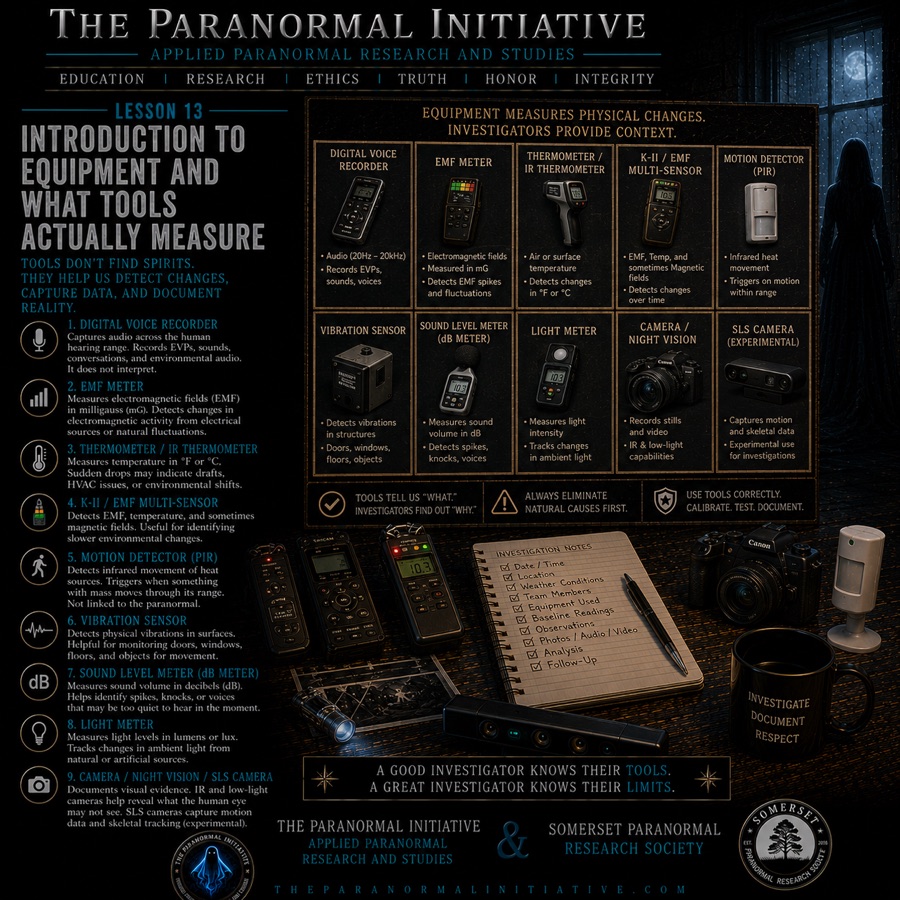
Paranormal investigators use a wide range of tools. This section introduces the most common categories at a high level. Detailed instruction on each type of equipment — including specifications, calibration, advanced use, and false positive identification — belongs in the Equipment Studies track. For now, the goal is to understand what is available and what each category measures.
Audio recorders. Digital audio recorders capture sound for later review. They are used to document environmental sounds, witness interviews, and potential EVP (Electronic Voice Phenomena). A recorder captures whatever sound is present in the environment. It does not distinguish between a spirit voice and a passing car, a radio signal, or a team member whispering in another room. That distinction is made during review by the investigator.
Cameras. Still and video cameras capture light. They are used to document locations, conditions, and potential visual anomalies. A camera can record dust, insects, lens flare, reflections, shadows, and compression artifacts — all of which can look like paranormal phenomena. A camera does not identify spirits. It records light. The investigator must evaluate what the camera captured.
Video recorders. Video cameras capture sequences of images over time. They are useful for documenting movement, changes in lighting, and environmental conditions over the course of an investigation. Video evidence must be reviewed carefully, as compression, frame rate, and lighting changes can create artifacts that look paranormal.
EMF meters. EMF (Electromagnetic Field) meters measure electromagnetic fields. Common sources of EMF include electrical wiring, appliances, power lines, and electronic devices. An EMF meter can help you identify wiring issues, electrical fields, and environmental factors that might be causing reported sensations. A spike on an EMF meter means there is an electromagnetic field present. Whether that reading has paranormal significance depends on controls, distance, source checks, patterns, timing, and corroborating evidence.
RF detectors. RF (Radio Frequency) detectors measure radio frequency energy. Sources include radio and television broadcasts, Wi-Fi signals, cell phones, and other wireless devices. RF detectors are sometimes used to detect communication signals that might be interpreted as paranormal. Like all equipment, they measure physical energy, not spirits.
Thermometers. Thermometers measure temperature. They are used to document environmental conditions and to investigate reports of cold spots. Temperature readings must be interpreted in context: drafts, insulation gaps, HVAC cycling, and natural thermal variation can all create temperature differences that feel significant but are entirely normal.
Hygrometers. Hygrometers measure humidity — the amount of moisture in the air. Humidity readings provide context for other environmental data. High humidity can affect both people and equipment. Low humidity can create static electricity. Humidity readings alone do not indicate paranormal activity.
Barometers. Barometers measure atmospheric pressure. Pressure changes can affect people's mood and perception. They can also cause doors to stick or move, windows to rattle, and structural materials to creak. Barometric readings help investigators understand environmental conditions that might be influencing reported experiences.
Motion sensors. Motion sensors detect movement in an area. They are used to document whether anything moves during an investigation. Motion sensors do not distinguish between a person, an animal, a falling object, or a paranormal entity. They simply detect movement. Any movement must be investigated further.
Vibration sensors. Vibration sensors detect physical vibrations in floors, walls, or objects. They can help identify footsteps, structural settling, traffic vibrations, or other sources of movement. Like motion sensors, they detect vibrations but do not identify their cause.
Pressure sensors. Pressure sensors detect changes in weight or pressure on a surface. They are sometimes used with trigger objects to detect whether something has been moved or touched. Pressure sensors do not distinguish between a person, an animal, or a paranormal cause. They simply detect that pressure was applied.
Light meters. Light meters measure the intensity of light in an area. They can help document lighting conditions and identify changes that might affect visual observations. Light readings are contextual data, not evidence of paranormal activity.
Air quality monitors. Air quality monitors measure various factors including particulate matter, volatile organic compounds, and carbon dioxide levels. Poor air quality can cause health symptoms that people might interpret as paranormal — headaches, fatigue, dizziness, confusion. Air quality monitoring is an important part of environmental assessment.
CO detectors. Carbon monoxide detectors are among the most important safety devices in paranormal investigation. Carbon monoxide is an odorless, colorless gas that can cause hallucinations, confusion, and physical symptoms. High CO levels have been responsible for many reports that people interpreted as paranormal. Every investigator should have a CO detector and should check CO levels early in every investigation.
Environmental logging devices. These devices record multiple environmental factors — temperature, humidity, pressure, light, sound — over time. They provide continuous monitoring that can reveal patterns and changes that might not be noticeable during a single observation. Environmental loggers are valuable tools for establishing baselines and identifying environmental causes.
Specialty interaction tools. Modern paranormal teams often use tools designed to invite or display possible interaction: REM-pod style antenna devices, motion-trigger light balls, proximity light bars, touch sensors, music boxes with motion sensors, trigger object sensors, and vibration or footstep trackers. These tools can be useful for documenting that a sensor changed state, but the sensor response itself does not identify what caused it. A light turning on means a circuit, sensor, field, movement, or vibration threshold was triggered. It does not automatically mean communication.
Radio sweep and spirit box devices. Devices such as SB7-style and SB11-style spirit boxes rapidly scan radio frequencies and produce fragments of broadcast audio, static, and interference. Some investigators use them during controlled question sessions. In Ghostology 101, students should understand the basic limitation immediately: a radio sweep device produces audio fragments from physical radio-frequency sources. Meaningful-sounding words may be coincidence, broadcast bleed, expectation, or auditory pareidolia. A spirit box session requires strict controls, clear logging, and careful review before anything is treated as potentially meaningful.
Portal-style ghost boxes. Portal devices are usually modified or assembled audio chains that route spirit-box or radio-sweep audio through amplification, reverb, noise reduction, guitar pedals, speakers, or custom housings. They can sound impressive, but the more processing added to a signal, the more difficult it becomes to evaluate where a sound originated. A portal can be used as an experiment, but students must document the complete signal chain, settings, volume, radio source, sweep rate, room acoustics, and any post-processing. A dramatic voice through a portal is not automatically stronger evidence than a raw recording. In many cases, it is harder to analyze.
Word-bank and phonetic devices. Devices and apps similar to older Obulus-style tools may produce words from internal databases, phoneme libraries, environmental inputs, or algorithmic selection. Students should never treat a displayed word as proof of communication simply because the word feels relevant. The first question is: how does the device generate output? The second is: what sensors or inputs influence that output? The third is: how often does the device produce vague or emotionally suggestive words under ordinary conditions? Without that knowledge, the output is entertainment or exploratory prompt material, not evidence.
SLS and structured-light cameras. SLS-style systems use depth sensing and body-tracking algorithms to map shapes into stick-figure forms. They do not see spirits. They attempt to identify body-like geometry. Furniture, door frames, corners, hanging objects, railings, mirrors, and odd depth surfaces can create false skeletal mappings. A stick figure is only worth serious review when the environment is clear, the mapping persists in a way that can be analyzed, the camera position is documented, and other simultaneous evidence supports the event.
Multi-sensor research devices. EDI-style research devices and similar multi-sensor platforms can log several conditions at once, such as EMF, temperature, humidity, pressure, light, vibration, and motion. These tools are valuable because they create a timeline of environmental change. Their strength is not that they prove ghosts. Their strength is that they can show whether multiple physical variables changed together, whether a claim occurred during an environmental shift, or whether a reported event matched a vibration, pressure, or EMF change.
Notebooks and pens. The most important tools in any investigation are a notebook and a pen. Equipment can fail. Batteries die. Memory cards fill up. But a notebook and pen always work. They are the tools you use to document everything: observations, measurements, conditions, witness statements, and your own impressions. No piece of electronic equipment is more valuable than a well-kept notebook.
Maps and floor plans. Maps and floor plans help you document the layout of a location, mark areas of interest, and track where observations were made. They are essential for correlating data from different team members and different sessions.
Timing devices. Synchronized clocks and timers allow team members to coordinate their observations and correlate data from different sources. Timestamps are essential for comparing audio, video, and environmental readings. Without synchronized time, evidence correlation is difficult or impossible.