Ghostology 101 · Lesson 18

Investigation Ethics and Professional Conduct

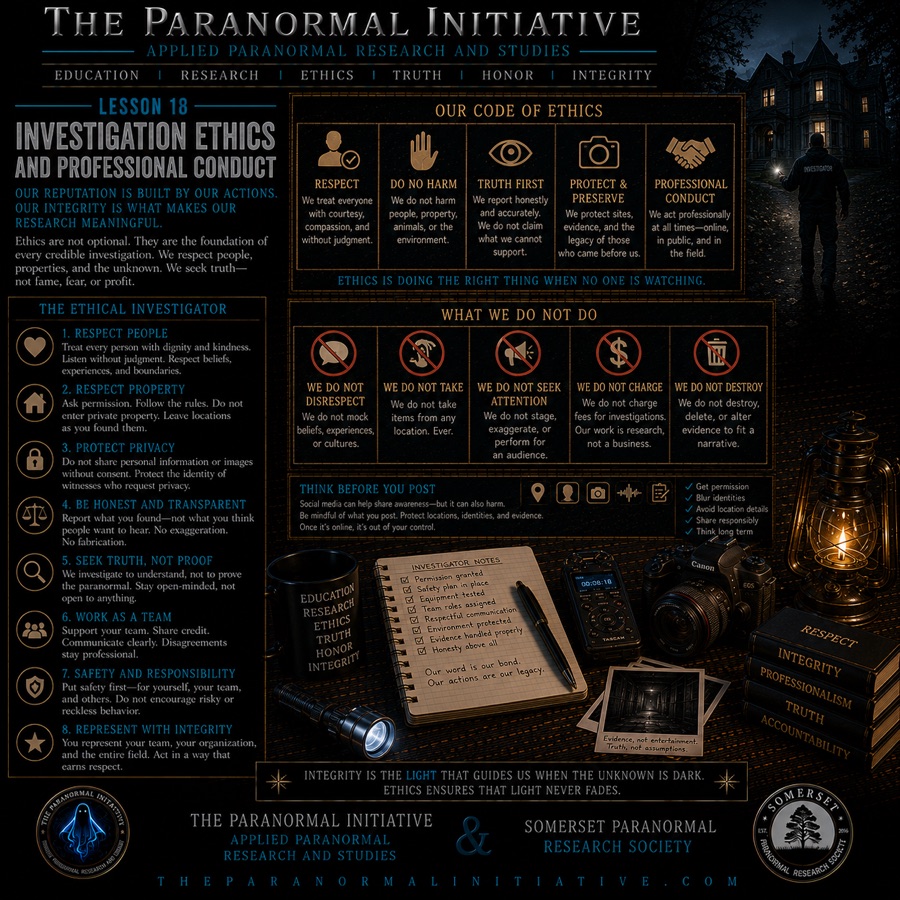
This lesson teaches students that ethics are one of the most important parts of paranormal investigations. It covers respect for clients, property, history, evidence, teammates, and the public, as well as privacy, confidentiality, honesty, and professional conduct before, during, and after investigations.

All Lessons Lesson 17 Lesson 19
Ghostology 101 lesson 18 visual

Lesson Reading

Lesson Purpose

This lesson teaches students that ethics are one of the most important parts of paranormal investigations. The credibility of an investigator is not determined by what they claim to have experienced. It is determined by how they behave — how they treat clients, how they respect locations, how they handle evidence, how they communicate with the public, and how they conduct themselves before, during, and after every investigation. Ethics determine whether an investigator is trusted. Ethics determine whether the field of paranormal investigation is taken seriously. This lesson is not about proving ghosts. It is about respecting people, respecting locations, respecting evidence, and representing the field responsibly. By the end of this lesson, students should understand that integrity is more valuable than exciting evidence.

Learning Objectives

By the end of this lesson, students should be able to: explain why ethics determine the credibility of an investigator; describe what it means to respect clients, property, history, evidence, teammates, and the public; identify the core principles of honesty, integrity, transparency, accountability, and responsibility in investigation; explain why privacy and confidentiality are essential in client work; describe professional conduct expectations before, during, and after investigations; recognize common ethical dilemmas and respond appropriately; and identify common beginner mistakes that compromise ethical standards.

Introduction

Paranormal investigation exists at the intersection of curiosity, compassion, science, history, and human experience. People invite investigators into their homes, share their most personal experiences, and trust that those investigators will treat them with respect. Property owners allow access to historic and fragile locations. Witnesses reveal experiences that they may have never shared with anyone else. The public forms opinions about the entire field based on how investigators conduct themselves.

Professionalism separates researchers from entertainers. An entertainer prioritizes drama, excitement, and audience engagement. A researcher prioritizes honesty, documentation, and ethical conduct. Both may investigate the same location, but they operate under fundamentally different principles. The public often cannot tell the difference between them, which is why ethical conduct is not just a personal virtue. It is a responsibility that every investigator bears on behalf of the entire field.

This lesson teaches you what it means to be an ethical investigator. It covers respect for everyone involved in an investigation, the responsible handling of evidence, professional conduct in all phases of investigation, and the ethical dilemmas that investigators commonly face. By the end of this lesson, you will understand that the most important thing you bring to an investigation is not your equipment, your knowledge, or your experience. It is your integrity.

What Investigation Ethics Really Mean

Ethics in paranormal investigation are not a set of abstract principles. They are practical guidelines for how to treat people, handle evidence, and represent the field. Ethics determine whether an investigation is trustworthy. They determine whether a client feels helped or exploited. They determine whether evidence is presented honestly or exaggerated for attention. Ethics are not separate from investigation. They are what make investigation worthwhile.

Honesty is the foundation of ethical investigation. An honest investigator documents what they actually observed, not what they hoped to observe. They present findings accurately, whether those findings support a paranormal explanation or a natural one. They do not exaggerate, fabricate, or misrepresent evidence. Honesty means being truthful with clients about what you found and what you did not find. It means being truthful with the public about the limitations of your methods and the uncertainty of your conclusions. Honesty is not always comfortable, but it is always necessary.

Integrity means doing the right thing even when no one is watching. It means following proper procedures even when cutting corners would produce more dramatic results. It means treating every case with the same professional standards, regardless of whether the case is famous or obscure. Integrity means being the same investigator in private that you claim to be in public. It means your actions match your words.

Transparency means being open about your methods, your findings, and your limitations. An ethical investigator does not hide how they conducted an investigation or what they found. They share their methods so others can evaluate their work. They acknowledge when they are uncertain. They do not present speculation as fact. Transparency builds trust. When an investigator is transparent, clients and colleagues can see exactly what was done and why.

Accountability means taking responsibility for your actions and your findings. If you make a mistake, you acknowledge it. If you misidentified a natural cause as paranormal, you correct the record. If a client is harmed by your actions, you take responsibility and make it right. Accountability means that your reputation is built on your willingness to be answerable for your work, not on your ability to avoid criticism.

Responsibility means recognizing that your actions have consequences. The words you speak, the findings you publish, and the way you treat people all affect the reputation of paranormal investigation as a field. Every investigation is an opportunity to build trust or to damage it. Responsible investigators recognize that they are representing not just themselves but everyone who investigates paranormal claims.

Ethics continue after an investigation ends. Ethical behavior does not stop when you pack up your equipment and leave the location. It continues when you review evidence, write reports, share findings with clients, and present your work to the public. It continues when you discuss cases with colleagues, post on social media, or give interviews. An ethical investigator maintains the same standards of honesty, integrity, transparency, accountability, and responsibility in every phase of their work, from the first contact with a client to the final publication of findings.

Respecting Clients

Clients are the reason most investigations exist. A client has experienced something they do not understand, and they have reached out to an investigator for help. That act of reaching out requires courage. The client may be frightened, embarrassed, grieving, or skeptical of their own experience. The investigator's first responsibility is to treat that client with respect.

Private homes. When you investigate a private residence, you are a guest in someone's home. Treat the home with the same respect you would expect from a guest in your own home. Knock before entering rooms. Do not touch personal belongings. Do not move furniture without permission. Respect the family's routines and schedules. Remember that this is not just a location for you — it is where the client lives their life.

Businesses. Business investigations require additional considerations. The client may be concerned about employee morale, customer perception, or the financial impact of paranormal claims. Be discreet. Do not discuss the case with customers or employees who are not directly involved. Respect business hours and operational needs. Understand that the client may have competing priorities that affect the investigation.

Families. Paranormal experiences affect entire families. Different family members may have different beliefs, different levels of fear, and different willingness to participate. Some may be eager for answers. Others may be skeptical or reluctant. An ethical investigator respects all family members' perspectives and does not take sides. The goal is to help the family understand what is happening, not to validate one member's interpretation over another's.

Witnesses. Witnesses are people who have had experiences they may not fully understand. They may be uncertain about what they saw, heard, or felt. They may worry about being judged or disbelieved. An ethical investigator listens without judgment, documents the witness's account in their own words, and does not pressure the witness to adopt a particular interpretation. The goal is to understand what the witness experienced, not to convince them that it was or was not paranormal.

Sensitive situations. Some investigations involve sensitive circumstances: recent deaths, family conflicts, mental health concerns, or religious crises. These situations require extra care. The investigator must recognize when a situation exceeds their expertise and refer the client to appropriate professionals. An ethical investigator does not attempt to be a therapist, a clergy member, or a crisis counselor. They investigate the claims and support the client in finding appropriate help for needs beyond their scope.

Children. When children are involved in an investigation, special care is required. Children may be frightened by experiences that adults can more easily contextualize. They may also be highly suggestible, incorporating ideas from adults into their own accounts. Interview children only in the presence of a parent or guardian. Use age-appropriate language. Do not suggest explanations. Prioritize the child's emotional wellbeing over any investigative goal.

Religious beliefs. Clients come from every religious and spiritual background. Their beliefs shape how they interpret their experiences. An ethical investigator respects those beliefs without necessarily validating them. Document the client's interpretation in their own words. Do not argue with their religious framework. If the client's beliefs require spiritual support that you cannot provide, refer them to a qualified professional from their own tradition.

Never mocking experiences. A client's experience is real to them, regardless of its cause. Mocking, dismissing, or belittling a client's experience is not only unethical — it is counterproductive. A client who feels mocked will not trust you, will not share important information, and may be more frightened than before you arrived. Treat every experience with respect, even if you suspect a natural explanation. You can investigate the cause without dismissing the experience.

Listening respectfully. One of the most important skills an investigator can develop is the ability to listen. Before you ask questions, before you set up equipment, before you form hypotheses, listen to what the client has to say. Let them tell their story in their own words. Do not interrupt. Do not correct. Do not suggest. Just listen. The information you gain from respectful listening will guide every other aspect of your investigation.

Maintaining neutrality. An ethical investigator maintains neutrality about the cause of reported phenomena until the evidence supports a conclusion. This does not mean you cannot have hypotheses. It means you do not commit to a conclusion before the investigation is complete. Maintaining neutrality protects the client from premature judgments and protects the investigation from confirmation bias. If a client asks whether you believe their home is haunted, the honest answer is: "We will investigate the conditions thoroughly and share our findings with you. We do not reach conclusions before we have all the information."
Respecting Property

Property is not just a location for investigation. It is someone's home, business, or heritage. How you treat property reflects directly on your professionalism and on the entire field of paranormal investigation.

Permission. Never investigate a location without written permission from the property owner or authorized representative. Permission is not just a legal requirement. It is a mark of respect for the person who owns or manages the property. Written permission protects everyone involved and ensures clear expectations. For templates, see the Legal and Client Forms.

Trespassing. Trespassing is illegal, unethical, and dangerous. It damages your reputation, the reputation of the field, and the trust that property owners place in legitimate investigators. Never enter a property without permission, regardless of how abandoned or accessible it appears. "Abandoned" is a legal status determined by courts, not by the condition of a building. If you cannot obtain permission, choose a different location.

Locked areas. If an area is locked, it is off-limits unless you have explicit permission to access it. Locked areas may contain hazards, private belongings, or sensitive materials. Do not pick locks, force doors, or enter restricted areas. Respect the boundaries that the property owner has established. If you need access to a locked area, request permission and explain why the access is needed.

Historical preservation. Many haunted locations are historic sites with fragile materials and significant cultural value. Treat these locations with the care they deserve. Do not touch artifacts, documents, furnishings, or structural elements unless you have explicit permission. Use flashlights carefully to avoid damaging light-sensitive materials. Do not lean on walls, sit on antique furniture, or handle delicate objects. Follow all rules provided by property managers or historical society staff.

Leaving locations unchanged. The only evidence you should take from a location is the data you collected. Leave the location exactly as you found it. Return furniture to its original position. Do not leave trash, equipment, or personal items. Do not take souvenirs or keepsakes. The location should show no sign that you were there, except for your gratitude and professionalism.

Cleaning up. If you create any mess during an investigation — from equipment setup, spilled water, or other incidental causes — clean it up before you leave. Leave the location in the same or better condition than you found it. This basic courtesy is a sign of respect and professionalism.

Never damaging property. Do not cause any damage during an investigation. Do not drive nails or screws into walls. Do not move heavy furniture without permission and assistance. Do not use equipment that could damage floors, walls, or furnishings. If accidental damage occurs, report it immediately to the property owner and take responsibility for repair or compensation.

Photography restrictions. Some locations have restrictions on photography, particularly historic sites, museums, and private residences. Respect these restrictions. Do not take photographs in areas where photography is prohibited. Do not publish photographs of a client's home without explicit permission. If you are unsure whether photography is allowed, ask before you begin.

Drone permissions. Drones require separate permissions and considerations. Many locations prohibit drone use due to privacy concerns, safety risks, or historical preservation rules. If you plan to use a drone, obtain explicit permission from the property owner and comply with all federal, state, and local regulations. Never fly a drone over private property without permission.

Respecting Historical Locations

Many haunted locations are also historical sites of significant cultural value. These locations are not merely investigation targets. They are irreplaceable records of human history, architecture, and culture. Ethical investigators treat historical locations with the reverence they deserve.

Preserving history. Historical locations are fragile and irreplaceable. A single careless act can damage materials that have survived for centuries. Approach every historical location with the mindset of a preservationist. Your goal is to leave the location in the same condition it was in when you arrived, so that future generations can also learn from and appreciate it.

Understanding context. Historical locations are not just backdrops for paranormal investigation. They are places where real people lived, worked, loved, suffered, and died. Understanding the historical context of a location helps you appreciate its significance and treat it with appropriate respect. Research the history of every location you investigate, not just the ghost stories associated with it.

Working with caretakers. Many historical locations have caretakers, curators, or property managers who are responsible for their preservation. These individuals are not just gatekeepers to be negotiated with. They are partners in the stewardship of the location. Build respectful relationships with caretakers. Follow their rules. Ask for their guidance. Recognize that they have a deep understanding of the location that you do not.

Historical societies. Local historical societies are valuable resources for research and context. They can also become partners in responsible investigation. Involving historical societies in your work demonstrates that you take history seriously and are committed to ethical practice. Some historical societies may be willing to collaborate on investigations, providing access and expertise in exchange for documentation and preservation support.

Museums. Museum properties are among the most sensitive investigation locations. They contain artifacts, exhibits, and materials that cannot be replaced. Museum staff have professional standards for preservation and access that must be respected. If you investigate a museum, do so with the understanding that the museum's mission — education and preservation — takes priority over any investigative goal.

Why investigators are guests. In every location you investigate, you are a guest. Whether you are in a private home, a historic building, a business, or a public space, you are there by permission. Your access can be revoked at any time if you behave unprofessionally. Conduct yourself as a guest who is grateful for the opportunity, not as an entitled investigator who has a right to be there. The best investigators are those who are invited back because of their professionalism and respect.

Respecting Team Members

Ethical conduct extends to how you treat your own team members. A team functions effectively only when all members feel respected, safe, and valued.

Professional communication. Communicate with team members clearly and respectfully. Avoid gossip, personal criticism, and inflammatory language. Address disagreements about investigation methods or findings professionally, focusing on the issue rather than the person. Good communication prevents misunderstandings and maintains team cohesion.

Safety. Every team member has a responsibility for the safety of every other team member. Speak up if you see a hazard or unsafe behavior. Do not pressure others to take risks they are uncomfortable with. Respect the physical and emotional limits of your teammates. A team that prioritizes safety protects everyone involved.

Honesty. Be honest with your team about your observations, your doubts, and your mistakes. If you realize you misinterpreted something, say so. If you made an error in documentation, correct it. Honesty within the team builds trust and improves the quality of the investigation. A team that hides mistakes from itself cannot produce credible results.

Disagreements. Disagreements are normal and healthy in investigation. Different team members may interpret the same evidence differently. An ethical team handles disagreements respectfully. Discuss different interpretations openly. Test competing hypotheses. Do not dismiss a team member's perspective because it does not match your own. The best conclusions often emerge from honest disagreement. For guidance on investigation standards that support team collaboration, see the Investigation Compendium.

Leadership. Team leaders have additional ethical responsibilities. A good leader sets the standard for professionalism, safety, and ethical conduct. They ensure that all team members understand their roles and responsibilities. They make decisions that prioritize the team's wellbeing and the integrity of the investigation. They take responsibility for the team's actions and outcomes. Leadership is not about authority. It is about service to the team and the investigation.

Following procedures. Teams function effectively when everyone follows agreed-upon procedures. Documentation formats, communication protocols, safety procedures, and evidence handling standards should be established before the investigation and followed by all team members. Following procedures is not about blind obedience. It is about ensuring that the team's work is consistent, reliable, and credible.

Respecting experience. Experienced investigators have knowledge and skills that beginners have not yet developed. Respect that experience by listening to their guidance and learning from their expertise. At the same time, experienced investigators should respect the fresh perspectives that beginners bring. A healthy team values contributions from members at all experience levels.

Helping beginners. Experienced investigators have an ethical responsibility to help beginners develop their skills. This means providing guidance, answering questions, and offering constructive feedback. It also means giving beginners meaningful opportunities to participate and learn. The future of the field depends on experienced investigators who are willing to mentor the next generation.

Constructive criticism. Criticism should be constructive, specific, and focused on behavior, not the person. "Your notes would be more useful if they included time stamps" is constructive. "Your notes are terrible" is not. Deliver criticism privately when possible. Be open to receiving criticism from others. The goal of criticism is improvement, not humiliation.

Respecting Evidence

Evidence is the foundation of every investigation. How you handle evidence determines whether your findings are credible or worthless. Ethical evidence handling is not optional. It is the core of professional investigation practice.

Never altering evidence. Original evidence files must never be altered. Audio recordings, photographs, video footage, and documents should be preserved in their original form. If you need to enhance, clip, or adjust a file for analysis, work with a copy. The original file is your primary evidence. If it is altered, it is no longer reliable. For comprehensive standards on evidence classification and preservation, see the Evidence Compendium.

Never fabricating evidence. Fabricating evidence is one of the most serious ethical violations an investigator can commit. Creating false audio recordings, staging photographs, or making up witness statements destroys your credibility and damages the entire field. Fabrication is not just unethical. It is fraudulent and may have legal consequences. Never fabricate evidence for any reason, including to produce more dramatic results or to support a preferred conclusion.

Never removing metadata. Digital files contain metadata that records information about the file's creation, including date, time, device, and settings. This metadata can be essential for verifying the authenticity of evidence. Never remove or alter metadata. Preserve original files with their metadata intact. If you need to share a file, provide a copy and note that the original is available for verification.

Never adding sound. Adding sound to an audio recording — whether by over-dubbing, mixing, or digital editing — transforms the recording from evidence into a creation. If you add sound to an audio file, it is no longer a record of what occurred during the investigation. It is a production. Ethical investigators never add sound to evidence recordings.

Never enhancing deceptively. Enhancement is a legitimate analytical tool, but it must be used transparently. Enhancing an audio recording to make a faint sound more audible is acceptable if the enhancement is documented and the original file is preserved. Enhancing a photograph to create details that were not present in the original is deceptive. Always compare enhanced versions to the original. If the enhancement creates something that is not present in the original, it is not revealing evidence. It is creating an artifact.

Proper documentation. Every piece of evidence must be documented with information about when, where, and how it was collected. File naming conventions, logs, and chain-of-custody records are essential. Evidence without documentation is not evidence — it is an unverifiable file. For standards on investigation documentation and chain of custody, see the Investigation Compendium.

Chain of custody. Chain of custody is the documented history of every piece of evidence from collection to presentation. It answers: who collected it, when, where, who has handled it, and whether it has been altered. Maintaining chain of custody is essential if evidence may ever be used in any formal context. Even if you never plan to use evidence in court, chain of custody is a professional standard that protects the integrity of your work.

Transparency. Be transparent about your evidence and your methods. Share your evidence with colleagues for independent review. When presenting findings, describe what you found, how you found it, and what limitations apply to your analysis. Transparency does not mean you must share everything publicly. It means you are willing to have your work examined and evaluated by others. Transparency is the best defense against accusations of bias or fabrication.

Social Media Responsibility

Social media has transformed how investigators share their work and communicate with the public. It also creates significant ethical challenges. What you post on social media reflects on you, your team, and the entire field of paranormal investigation.

Avoid sensationalism. Sensationalism prioritizes excitement over accuracy. It uses dramatic language, exaggerated claims, and emotional appeals to attract attention. Sensationalism damages the credibility of the field by creating the impression that investigators are more interested in entertainment than in truth. Present your findings factually. Let the evidence speak for itself. If your evidence is genuinely interesting, it does not need dramatic presentation.

Avoid clickbait. Clickbait is content designed to attract attention and encourage clicks, often through misleading or exaggerated headlines. "You Won't Believe What We Captured Last Night" is clickbait. "Audio Anomaly Documented in Residential Investigation — Preliminary Analysis" is professional. Clickbait undermines your credibility and treats your audience as consumers rather than as informed readers.

Avoid fake titles. Do not use titles or credentials that you have not earned. Do not call yourself a "paranormal researcher" if you are a hobbyist. Do not claim affiliations you do not have. Exaggerated titles may impress casual readers, but they will be recognized as false by knowledgeable investigators and will damage your reputation.

Avoid misleading thumbnails. If you create video content, do not use thumbnails that misrepresent your evidence. A thumbnail that shows a dramatic image that is not actually in your video is deceptive. Thumbnails should accurately represent the content they accompany.

Do not exaggerate findings. Present your findings accurately. If you captured a sound that might be a voice but could also be radio interference, say that. If you photographed an anomaly that is probably dust but you cannot be certain, say that. Exaggeration may attract short-term attention, but it destroys long-term credibility. For guidance on responsible evidence presentation, see the Evidence Compendium.

Do not claim certainty. Paranormal investigation rarely produces certainty. Most findings are ambiguous, inconclusive, or open to multiple interpretations. Do not claim certainty where none exists. Use measured language: "may indicate," "could be consistent with," "remains unexplained." Certainty should be reserved for findings that have been thoroughly tested and independently verified.

Avoid spreading misinformation. Before sharing someone else's content, verify its accuracy. Do not share unverified claims, rumors, or sensational stories. If you share content that turns out to be false, correct the record publicly. Your credibility depends on your commitment to accuracy, not on how many followers you have.

Represent investigations honestly. When posting about an investigation, describe what you did, what you found, and what limitations apply. Do not present preliminary findings as conclusive. Do not imply that an investigation was more extensive or more conclusive than it actually was. Honest representation builds trust with your audience.

Confidentiality

Confidentiality is one of the most important ethical obligations an investigator has. Clients share personal information with you in confidence. Violating that confidence can cause real harm — to clients, to their families, and to the reputation of the field.

Private residences. The address and details of a private residence investigation should never be shared publicly without the client's explicit written permission. A client's home is their sanctuary. Disclosing its location can lead to unwanted attention from curiosity-seekers, trespassers, or media. Protect the privacy of every residence you investigate.

Client identities. Do not share client names, identifying details, or personal information without explicit permission. If you discuss a case publicly, use pseudonyms and remove identifying details. A client may be comfortable sharing their story with you but not with the public. Respect their boundaries.

Addresses. Never share the address of an investigation location without permission. This applies to both current and past investigations. An address that was public knowledge during an active investigation should still be protected after the investigation concludes. Sharing addresses can lead to trespassing, harassment, and unwanted media attention.

Personal information. Any personal information a client shares with you — family history, medical concerns, employment details, financial circumstances — is confidential. Do not share it without permission. Do not use it in reports without anonymizing it. Do not discuss it with anyone who is not directly involved in the investigation.

Children. Special care is required when children are involved. Never share identifying information about children. Never share photographs of children without parental permission. Prioritize the safety and privacy of minors above all other considerations. If there is any doubt about whether information about a child should be shared, do not share it.

Medical information. Clients may share medical information that is relevant to their experiences. This information is confidential. Do not share it without permission. If medical information is relevant to the investigation, document it in a way that protects the client's privacy. If you are unsure whether to include medical details in a report, err on the side of privacy.

Business investigations. Business investigations involve additional confidentiality considerations. The client may be concerned about employee morale, customer perception, or competitive disadvantage. Do not share information about business investigations without explicit permission. Respect the client's business interests as you would respect their personal privacy.

When anonymity matters. Anonymity matters in many situations. Clients who report paranormal experiences may fear ridicule, professional consequences, or social stigma. Protecting their anonymity is not just a courtesy — it is an ethical obligation. If a client requests anonymity, honor that request absolutely. Do not share details that could identify them, even indirectly.

Obtaining permission before publication. Before publishing any case material — in reports, articles, social media posts, or presentations — obtain explicit written permission from the client. The permission should specify what information will be shared, in what format, and with what audience. If the client withdraws permission at any time, respect their decision, even if it means not publishing findings you consider important. The client's right to privacy takes priority over your interest in sharing your work.

Common Ethical Dilemmas

Ethical dilemmas are situations where different values or obligations conflict. Recognizing ethical dilemmas and knowing how to respond to them is an essential skill for every investigator. The following scenarios represent real ethical challenges that investigators face.

Dilemma 1: Client requests secrecy. A client asks you not to tell their spouse about the investigation. The client believes the spouse would be angry or would not believe them. However, the spouse lives in the home and has a right to know that investigators will be present. Proper response: Explain to the client that you cannot conduct an investigation without informing all household members. Offer to speak with the spouse together with the client. If the client refuses to inform the spouse, decline the investigation. An investigation conducted without the knowledge of all affected parties is unethical and could create legal problems.

Dilemma 2: Team member fabricates evidence. You discover that a team member has fabricated evidence — perhaps they added a sound to an audio recording, staged a photograph, or made up a witness statement. Proper response: Confront the team member privately. Ask for an explanation. If the fabrication is confirmed, remove the team member from the team and from any ongoing investigations. Document what you found and how you responded. If the fabricated evidence has been shared publicly, issue a correction. Fabrication is one of the most serious ethical violations and must be addressed decisively.

Dilemma 3: Property owner changes permissions. A property owner gave you written permission to investigate, but during the investigation, they change their mind and ask you to leave. Proper response: Leave immediately. Do not argue. Do not attempt to negotiate. Thank the owner for their time and pack up your equipment. You may ask if you can follow up later, but respect their decision. A property owner has the right to revoke permission at any time for any reason. Pressuring them to allow you to continue is unethical and could escalate the situation.

Dilemma 4: Media requests interviews. A local news station learns about your investigation and requests an interview. The client has not given permission for media involvement. Proper response: Decline the interview. Explain that client confidentiality prevents you from discussing the case without permission. If the client is interested in media involvement, discuss the implications with them first. Media attention can be beneficial or harmful depending on how it is handled. Never involve media without the client's informed consent.

Dilemma 5: Disagreements about publishing. You and a team member disagree about whether to publish a case. You believe the evidence is strong enough to share. Your team member believes the evidence is too ambiguous and could be misinterpreted. Proper response: When team members disagree about publication, the default should be not to publish until consensus is reached. If consensus cannot be reached, err on the side of caution. Publishing over a team member's objection can damage relationships and the team's credibility. If the evidence is genuinely ambiguous, waiting or choosing not to publish is the more ethical choice.

Dilemma 6: Dangerous locations. A client asks you to investigate a location that is structurally unsafe. The building has visible damage, and entering it would be dangerous. Proper response: Decline the investigation. Explain that your team's safety and your ethical obligations prevent you from entering unsafe structures. Offer to conduct a research-only investigation or to assist the client in finding resources to make the building safe before an investigation. No investigation is worth risking injury or death.

Dilemma 7: Public pressure. A case attracts significant public attention. Social media followers and the public are demanding answers. You do not have enough evidence to draw firm conclusions. Proper response: Resist the pressure to provide premature conclusions. Issue a statement that explains your process, the current status of the investigation, and when you expect to have findings ready. Do not speculate. Do not offer preliminary conclusions that you may have to retract later. Public pressure does not override your ethical obligation to be thorough and honest.

Dilemma 8: Financial conflicts. A client offers to pay you for an investigation. You typically do not charge for investigations, but the client insists on offering compensation. Proper response: Be transparent about your policies. If you do not charge for investigations, explain why and politely decline. If you do accept payment, be clear about the terms and ensure that the payment does not create an expectation of a particular outcome. Accepting payment for investigations creates ethical obligations to be transparent, professional, and honest. Never accept payment in exchange for a predetermined conclusion.

Common Beginner Mistakes

Ethical mistakes are common among new investigators. Recognizing them is the first step to avoiding them.

Posting too quickly. Beginners often post evidence online immediately after an investigation, before they have had time to review it thoroughly or test natural explanations. This can lead to sharing false positives, embarrassing errors, and claims that must later be retracted. Develop the discipline of review before release. Wait at least 24 hours before sharing any findings. Review thoroughly. Test natural explanations. Then share.

Overstating evidence. Beginners sometimes present ambiguous evidence as definitive proof. A faint sound becomes "clear EVP." A blurry photograph becomes "an apparition." A random EMF spike becomes "a communication." Overstating evidence damages credibility and misleads the public. Present evidence accurately and acknowledge uncertainty. Let the evidence speak for itself.

Ignoring permissions. Beginners may overlook the need for written permission, especially when investigating public locations or locations that appear abandoned. They may assume that verbal permission is sufficient or that no permission is needed. Ignoring permissions is illegal and unethical. Always obtain written permission before every investigation.

Trespassing. Closely related to ignoring permissions, trespassing is one of the most serious ethical violations. Beginners may be tempted to investigate abandoned buildings, restricted areas, or locations with compelling ghost stories without permission. Trespassing is illegal, dangerous, and damages the reputation of the field. If you cannot obtain permission, do not investigate.

Breaking equipment rules. Some locations have specific rules about equipment use. Beginners may ignore these rules in their eagerness to investigate, using flash photography where it is prohibited, setting up equipment in restricted areas, or using equipment that could damage sensitive materials. Follow all rules provided by property owners and managers. If you disagree with a rule, discuss it respectfully rather than ignoring it.

Disrespecting locations. Beginners sometimes treat locations as backdrops for their investigation rather than as places with their own significance and history. They may move objects without permission, touch artifacts, leave trash, or behave in ways that show disregard for the location. Treat every location with the same respect you would want shown to your own home.

Being overly dramatic. Beginners influenced by paranormal television may adopt dramatic mannerisms, exaggerated language, and performative reactions. This undermines the seriousness of the investigation and can frighten clients or damage the team's credibility. Investigate with professionalism and restraint. Let the evidence create whatever drama is appropriate.

Ignoring safety. In their enthusiasm, beginners may ignore obvious safety hazards. They may enter unsafe structures, investigate alone, or fail to prepare for emergencies. Safety is an ethical obligation. No evidence is worth an injury. If a location is unsafe, do not investigate it. If conditions become unsafe during an investigation, stop.

Student Activity

Read each of the following six scenarios. For each scenario, answer three questions: What happened? What ethical issues exist? How should the team respond?

Scenario 1: The Unauthorized Publication. After a residential investigation, a team member posts a detailed account of the case on social media, including the family's last name and the address of the home. The investigator who posted it says they were just excited about the evidence and did not think about privacy. The client sees the post and is upset.

Scenario 2: The Edited Recording. During evidence review, an investigator enhances an audio recording to make a faint sound more audible. The enhanced version sounds like a clear voice saying a word. The investigator shares only the enhanced version online, without mentioning that the original was much less clear. Followers are impressed, but other investigators who hear the original are skeptical.

Scenario 3: The Rival Team. Another investigation team asks you to share your client's contact information because they want to do their own investigation at the same location. Your team has already completed your investigation and provided the client with your report. The other team says they can get better evidence.

Scenario 4: The Media Inquiry. A reporter contacts you about a case you investigated three months ago. The case involved a family who reported strange experiences in their home. Your investigation found natural explanations for most of the phenomena. The reporter wants to do a story about the family and asks you to share their contact information. The family has not given permission for media involvement.

Scenario 5: The Financial Offer. A property owner offers you $1,000 to investigate their historic building. They say they are willing to pay because they know the building is haunted and want proof. They expect you to find evidence of paranormal activity. If you do not find anything, they will be disappointed.

Scenario 6: The Unsafe Location. A client asks you to investigate a building that was damaged in a fire six months ago. The building has been boarded up but not repaired. The client believes the fire may have been caused by paranormal activity and wants you to investigate before the building is demolished. The building shows clear signs of structural damage and hazardous materials.

For each scenario, use these as optional reflection or discussion prompts. Discuss your responses with a partner or mentor if possible. The goal is to practice recognizing ethical issues and thinking through appropriate responses.

Reflection Questions

1. Why do ethics matter more than evidence in determining an investigator's credibility? Can you think of a situation where an investigator with compelling evidence would not be trusted because of ethical failures?

2. How would you feel if a client shared details of your investigation with the public without your permission? How does that perspective inform your obligation to protect client confidentiality?

3. A team member wants to post an investigation photograph on social media. The photograph shows a dark shape that could be a shadow figure or could be a camera artifact. The team member wants to present it as evidence of paranormal activity. How do you respond?

4. You are investigating a historic building and accidentally knock over a small decorative object, breaking it. The property owner is not present. What do you do? Why is your response an ethical issue?

5. A client tells you that their experiences are being caused by a demon. You find environmental causes for all the reported phenomena. How do you present your findings to the client? How do you respect their beliefs while being honest about what you found?

6. A fellow investigator posts dramatic claims on social media that you know are exaggerated. The investigator has a large following and is seen as a leader in the field. Do you say something? If so, how do you address the issue respectfully?

7. You are offered a paid investigation at a famous haunted location. The payment is generous, and the location would provide excellent experience for your team. However, the property owner expects you to find evidence of paranormal activity and has hinted that they will promote your team if you produce good results. What do you do?

8. What is the most important ethical principle you will carry into every investigation you conduct? Why does that principle matter to you?

Key Takeaways

This lesson has covered the essential principles of investigation ethics and professional conduct. The key takeaways are:

Ethics determine the credibility of an investigator. An investigator with strong ethics is trusted even when their evidence is ambiguous. An investigator with weak ethics is not trusted, no matter how compelling their evidence appears.

Respect clients by listening without judgment, protecting their privacy, maintaining neutrality, and never mocking their experiences. Clients are the reason investigations exist, and they deserve the highest standard of care.

Respect property by obtaining written permission, never trespassing, leaving locations unchanged, and protecting historic sites. How you treat property reflects on you and on the entire field.

Respect historical locations by understanding their context, working with caretakers, and recognizing that you are a guest. Historical sites are irreplaceable and deserve preservation.

Respect team members through professional communication, safety, honesty, constructive criticism, and mentoring. A team that respects each other produces better work.

Respect evidence by never altering, fabricating, or deceptively enhancing it. Maintain proper documentation and chain of custody. Be transparent about your methods and findings.

Be responsible on social media by avoiding sensationalism, clickbait, misleading thumbnails, exaggeration, and false certainty. Represent investigations honestly and correct misinformation.

Protect confidentiality by never sharing client information without permission. Protect addresses, identities, personal information, children's details, and medical information. Obtain permission before publication.

Recognize ethical dilemmas and respond appropriately. Common dilemmas include client requests for secrecy, team member fabrication, changed permissions, media inquiries, publication disagreements, dangerous locations, public pressure, and financial conflicts.

Avoid common beginner mistakes including posting too quickly, overstating evidence, ignoring permissions, trespassing, breaking equipment rules, disrespecting locations, being overly dramatic, and ignoring safety.

The most valuable thing you bring to an investigation is not your equipment. It is your integrity. Integrity is more valuable than exciting evidence. An ethical investigation may not produce dramatic results, but it will always produce trustworthy ones.

Repository Connections

The concepts in this lesson connect to several resources within The Paranormal Initiative - Applied Paranormal Research and Studies. Use these links to deepen your understanding of investigation ethics and professional conduct.

Investigation Compendium: For comprehensive standards on investigation methodology, documentation procedures, ethical conduct, and professional practice, see the Investigation Compendium.

Evidence Compendium: For standards on evidence classification, chain of custody, documentation, and transparent presentation, see the Evidence Compendium.

Forensic Analysis Compendium: For guidance on distinguishing genuine anomalies from artifacts, contamination, and false positives, and for standards on ethical enhancement and analysis, see the Forensic Analysis Compendium.

Investigation Standards: For the foundational standards that guide ethical investigation practice, see the Investigation Compendium.

Investigation Ethics Manual: For a comprehensive reference on ethical decision-making in paranormal investigation, including detailed case studies and ethical frameworks, see the Investigation Compendium.

Terminology Reference: For definitions of terms used in this lesson, including ethics, integrity, transparency, accountability, confidentiality, chain of custody, and fabrication, see the Terminology Reference.

Equipment Manual: For guidance on responsible equipment use, documentation of equipment readings, and avoiding false positives, see the Equipment Manual.

Legal and Client Forms: For templates of permission documents, confidentiality agreements, media release forms, and client intake forms, see the Legal and Client Forms.

Where You'll Learn More

This lesson has introduced the foundational principles of investigation ethics and professional conduct. These concepts will be developed further in several advanced tracks.

Applied Paranormal Research and Studies. The professional curriculum includes advanced instruction on client care, ethical decision-making, legal considerations, and professional practice. These courses build directly on the ethical foundations established in this lesson and extend them into professional investigation work.

Field Operations Track. The Field Operations track teaches practical skills for conducting investigations, including client intake, team management, documentation, and post-investigation procedures. These skills are essential for putting ethical principles into practice in the field.

Evidence and Analysis Track. The Evidence and Analysis track teaches how to handle evidence according to professional standards, including chain of custody, documentation, and transparent reporting. These courses reinforce the ethical obligations introduced in this lesson.

Capstone and Professional Application. The capstone track includes lessons on ethics of monetizing paranormal education, building public credibility, and presenting findings professionally. These courses help you apply ethical principles to the business and public-facing aspects of investigation.

Each of these tracks will deepen your understanding of what it means to conduct yourself ethically as an investigator. The foundation you are building now will support everything you learn in the future.

Next Lesson Connection

Now that you understand the ethical responsibilities that define a professional investigator, you are ready to learn how to create professional documentation and reports. Lesson 19: Professional Investigation Documentation and Reporting will teach you that an investigation is only as valuable as its documentation. You will learn how to structure reports, write objective observations, separate facts from interpretations, use photographs and audio logs properly, and organize evidence so that others can review your work years later. The ethics you have learned in this lesson will guide the documentation standards you apply in Lesson 19.

Lesson 17 Back to Ghostology 101 Lesson 19